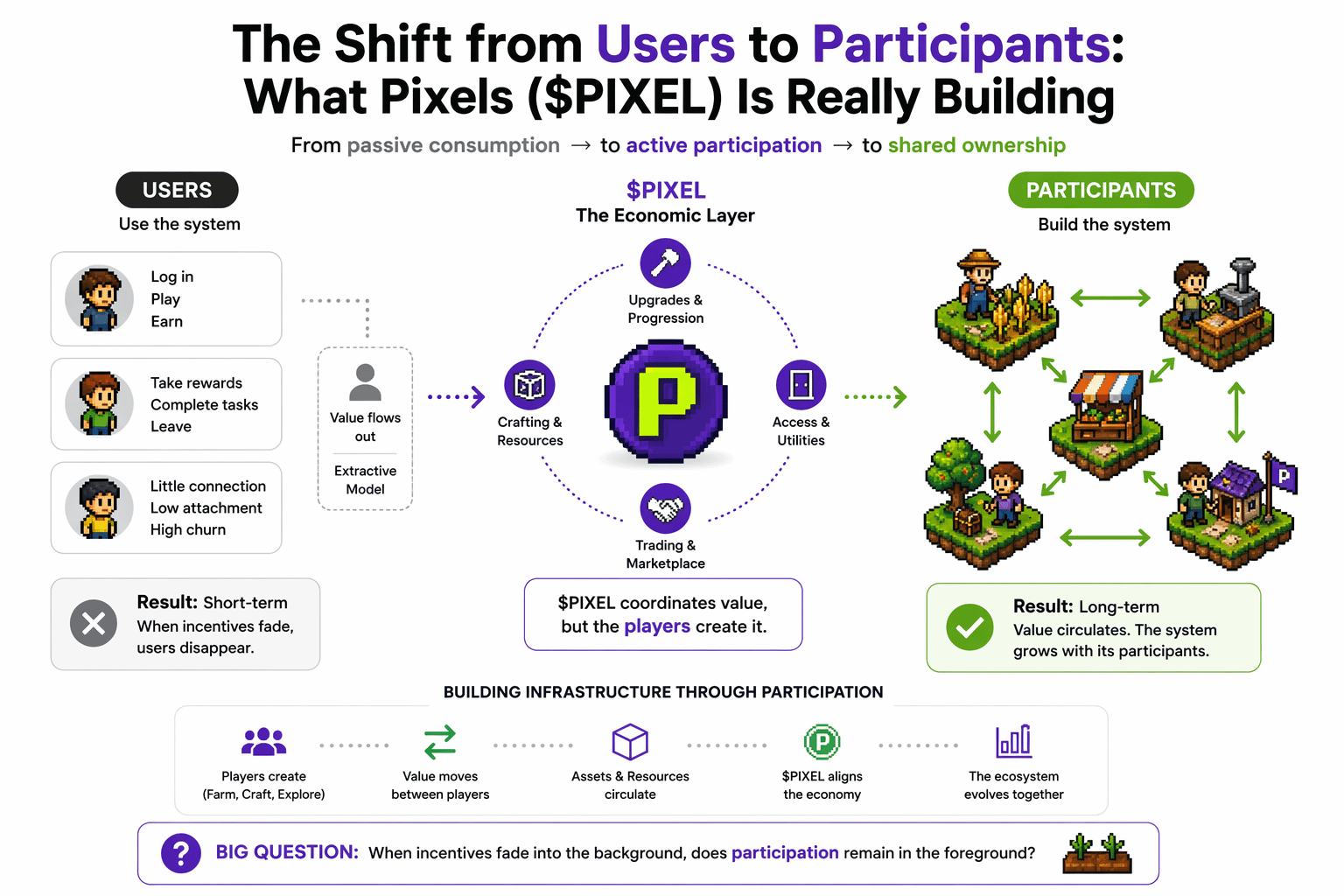

I’ve been noticing a quiet shift happening in how people interact with digital systems. Not just in crypto, but across platforms in general. The difference between something people use and something they actively participate in is becoming more obvious.
Most platforms today are built around users. You log in, consume, maybe interact a little, and leave. The system gives you something, you take it, and that’s the relationship. It’s passive. Replaceable. And honestly, easy to abandon.
But the systems that last tend to look different. People don’t just use them—they contribute to them. They shape outcomes, interact with others, and in some way, become part of the system itself.
That’s where things start to get interesting when you look at Pixels.
So the question becomes: is Pixels just attracting users… or is it slowly turning them into participants?
Because that distinction matters more than it sounds.
Most Web3 games in the last cycle were designed around users. They optimized for onboarding, rewards, and short-term engagement. Log in, complete tasks, earn tokens. The loop was clear and effective—for a while. But it didn’t create attachment. It didn’t create dependency on the system itself.
And without that, behavior doesn’t stick.
Players showed up for incentives, not because they felt connected to what they were doing. The moment those incentives weakened, activity dropped. Not gradually—but sharply. Which tells you something important: the system wasn’t being used, it was being extracted from.
The insight here is simple, but easy to overlook—participation creates durability.
When someone participates in a system, they’re not just taking value, they’re also contributing to its continuity. Their actions affect other participants. Their decisions matter beyond their own outcome. And over time, that builds a kind of soft attachment that incentives alone can’t replicate.
This is where Pixels starts to feel like it’s operating on a slightly different layer.
At a surface level, it’s still a game. You farm, you craft, you explore, you trade. But if you look at how those actions connect, you start to see something else forming. Players aren’t just completing isolated tasks—they’re interacting with a shared environment where their output can affect others.
You grow resources that others might need.
You trade items that someone else depends on.
You develop land that becomes part of a larger ecosystem.
That’s not just usage. That’s participation.
And once that shift begins, the system starts behaving differently.
Instead of players asking, “What can I earn today?” the question slowly becomes, “What can I do here today?” That might sound like a small change, but it’s actually fundamental. One is transactional. The other is relational.
Now connect that to the $PIXEL token.
In many projects, the token sits above everything else. It dictates behavior, drives incentives, and often becomes the main focus. But in Pixels, the token feels more embedded within the environment. It’s used for upgrades, crafting acceleration, progression, and access—but it doesn’t constantly demand attention.
It’s there when you need it, not when you’re forced to think about it.
That positioning matters because it allows the game layer to lead, while the economic layer supports. And when the economy supports behavior instead of dominating it, participation becomes more natural.
From an infrastructure perspective, this is where things start to align.
If you think about Pixels not as a game, but as a system, it begins to resemble a lightweight digital economy. One where:
Participants produce value through gameplay
That value moves between other participants
The token coordinates exchanges without overpowering them
The environment evolves based on collective activity
This is very different from a reward distribution model. In reward-driven systems, value flows from the top down. In participatory systems, value flows horizontally—between users who are no longer just users.
And that horizontal flow is what gives systems resilience.
Because even if external incentives slow down, internal interactions can continue. Players don’t need constant input from the system if they’re already engaging with each other.
But this is also where the challenge lies.
Because participation can’t be forced.
You can design mechanics that encourage it, but you can’t guarantee it. If the experience doesn’t hold attention, if the loops aren’t engaging enough, if players don’t find meaning in what they’re doing—they revert back to user behavior. They log in, extract value, and leave.
Which brings everything back to the real test.
Not metrics. Not charts. Not even short-term growth.
But behavior over time.
Are players forming habits inside the system?
Are they interacting with each other in ways that create ongoing activity?
Is value circulating between participants, or is it mostly flowing outward?
Because that’s the line between something that feels active and something that actually is alive.
Right now, Pixels sits in that transition phase.
It’s not fully there yet—but it’s not operating like most of the previous models either. It has the structure to support participation. It has loops that encourage interaction. It has an economy that’s integrated rather than imposed.
But structure alone isn’t enough.
It needs consistency.
It needs players who return not just for rewards, but because they feel part of something that continues with or without them.
And that leads to the bigger question that sits underneath all of this:
When incentives fade into the background, does participation remain in the foreground?
Because if the answer becomes yes, even at a smaller scale, then Pixels isn’t just building a game—it’s building infrastructure. A system where users evolve into participants, and participation becomes the foundation of value.
If not, then it follows a familiar path—strong start, temporary engagement, and eventual decline.
That’s the difference.
Between something people try…
And something they stay in.
Between a product…
And a system.
Between users…
And participants.