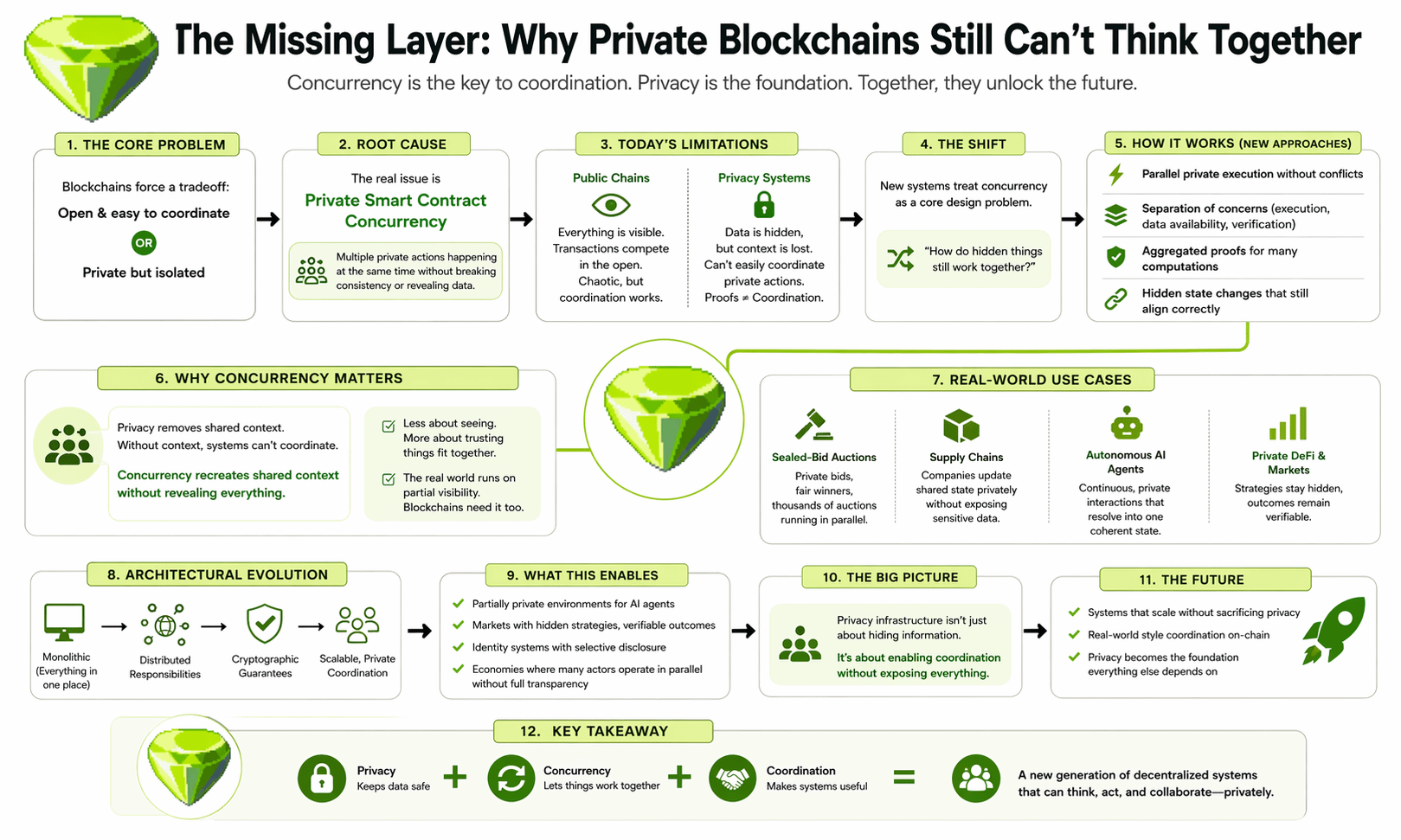
There’s this quiet problem sitting right at the core of blockchain design, and it doesn’t get talked about enough. People usually frame things as “privacy vs transparency,” but that’s only part of the story. The deeper issue is structural. Most blockchains today force a choice: you can have systems that are open and easy to coordinate, or systems that are private but kind of cut off from everything else. Getting both at once is where things start to fall apart.
That tradeoff has shaped a lot of what we see. DeFi works because everything is visible prices, liquidity, positions. Identity systems lean toward privacy, but then they struggle to interact smoothly. And the moment you try to build something that actually feels like real world coordination auctions, negotiations, autonomous agents you hit a wall pretty quickly. That wall is private smart contract concurrency.
At first, “concurrency” sounds like one of those technical terms you can ignore. It just means multiple things happening at the same time. But in blockchains, it’s not a small detail it’s kind of everything.
Public chains deal with concurrency in a blunt but effective way: they make everything visible. Every transaction is out in the open, competing to be included, and consensus figures out the order. It’s chaotic, sometimes inefficient, but it works because everyone can see the same state.
Privacy systems flip that. They hide the data, which is the whole point but in doing so, they also hide the context needed to coordinate. Once state is private, the system can’t easily tell how different actions relate to each other. That’s where things start to break down.
Zero knowledge proofs helped move things forward. They let you prove something is valid without revealing the underlying data, which is powerful. But they don’t really solve coordination. A proof can say, “this is correct,” but it doesn’t help when hundreds or thousands of private computations need to interact at the same time without stepping on each other. That’s why a lot of “private DeFi” ideas look good on paper but struggle in practice they scale the cryptography, not the coordination.
What’s starting to change now is subtle but important. Some newer systems are beginning to treat concurrency as a core design problem, not just a side effect. Instead of asking, “how do we hide data?” they’re asking, “how do we let hidden things still work together?”
That shift shows up in different ways. Some architectures are experimenting with execution models where private state changes can happen in parallel without conflicts. Others are separating pieces of the system like execution, data availability, and verification so they don’t all have to happen in the same place at the same time. There are also ideas around aggregating proofs, where many independent computations can be combined into something that’s still easy to verify. It starts to feel less like isolated transactions and more like a system that can actually keep up with itself.
But there’s a more human layer to this that often gets overlooked. Privacy and usability have always felt like opposites, and it’s not just because of bad design. It’s because privacy removes shared context. When everything is hidden, people and systems lose the signals they rely on to make decisions.
In the real world, we don’t operate with full transparency. We work with partial visibility prices, reputations, hints of intent. That’s enough to coordinate. Blockchains took that and pushed it to the extreme by making everything visible. Now we’re trying to rebuild coordination in a world where visibility is selective again.
That’s why concurrency matters so much. If a system can handle multiple private actions at once and still keep everything consistent, it’s basically recreating shared context in a different form. Not by showing everything, but by ensuring that everything still lines up correctly. It’s less about seeing and more about trusting that things fit together.
Once you start looking at it that way, the use cases open up.
Take a sealed bid auction. Everyone submits bids privately, the system picks a winner, and losing bids stay hidden. That idea has been around forever. But running thousands of those auctions at the same time, all interacting with other contracts, without breaking anything that’s still a hard problem.
Or think about supply chains. Different companies need to coordinate inventory and logistics, but they don’t want to expose sensitive data. If multiple parties are updating shared state at the same time, you need more than encryption. You need a way for those updates to coexist without conflict.
Then there’s AI. Autonomous agents don’t wait their turn they act continuously, reacting, negotiating, making decisions on the fly. If their internal logic or data needs to stay private, the system has to handle a constant stream of concurrent, private interactions that still resolve into a single coherent state. That’s a very different kind of pressure compared to simple transaction processing.
We’re already seeing hints of how systems might adapt. Instead of one big process doing everything, responsibilities are getting split. Some parts handle execution, others generate proofs, others validate or sequence. It starts to look more like real-world distributed systems, just with cryptographic guarantees layered on top.
And slowly, a different idea is taking shape: privacy infrastructure isn’t just about hiding information. It’s about enabling coordination without exposing everything.
Concurrency is the piece that makes that possible.
Without it, private systems stay limited useful in narrow cases, but hard to scale into something broader. With it, they start to feel more like actual economies, where many independent actors can operate at once without needing to reveal everything they’re doing.
Looking ahead, this could change how decentralized AI works. Agents might operate in partially private environments, only revealing what’s necessary. Markets could exist where strategies stay hidden but outcomes are still verifiable. Identity systems could allow selective disclosure without turning into disconnected silos.
And the strange thing is, none of this feels completely new. It actually feels closer to how coordination already works in the real world. People don’t share everything, yet systems still function.
The difference is that now, for the first time, we might be able to build that balance directly into the infrastructure itself.
If that happens, privacy stops being just another feature.
It becomes the thing everything else quietly depends on.