
I didn’t catch it right away.
It just felt like the usual grind - log in, run around, knock out a few tasks, maybe glance at the market, maybe not. Nothing that screamed “this is different.” But after a bunch of sessions, something small started nagging at me. Like the whole thing was quietly steering how I played, without me noticing.
Not in that loud, obvious game-design way. More like an undercurrent.
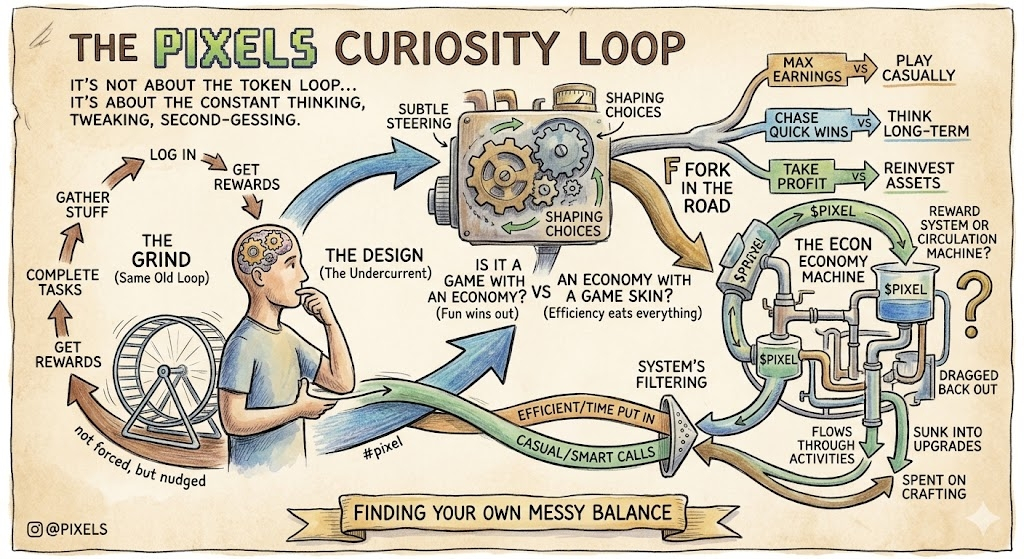
@Pixels isn’t really forcing you to play harder. It’s shaping the choices you make while you’re in there.
On the surface it’s the same old loop: gather stuff, finish tasks, get rewards. But if you actually slow down, you realize nothing happens in a vacuum. Every resource you grab feeds into something else. Every reward has a pull somewhere. Every little decision quietly clashes with ten others.
So it stops being “what am I doing?” and turns into “why am I doing this instead of that?”
That’s when the system starts showing its teeth.
Look at the economy. $PIXEL isn’t just some handout reward — it actually moves. It flows through activities, gets sunk into upgrades, gets spent on crafting, pulled by player decisions. You earn it through effort, but it doesn’t just pile up in your wallet. It gets dragged back out again.
Makes you wonder: is this a reward system… or just a really well-oiled circulation machine?
Because if the tokens are always in motion, real stability doesn’t come from pure scarcity. It comes from players deciding to jump back in instead of cashing out and leaving.
And that slides straight into how it messes with your head.
Every time you log in, you’re at a fork in the road. Do I try to squeeze out max earnings today? Or just chill and play casually? Reinvest everything into assets, or take some profit? Chase quick wins or think long-term?
None of it feels forced. But it’s all gently nudged.
There’s this soft pressure - not in-your-face, but it’s there - pushing you toward playing more efficiently. Once you spot it, you start asking yourself: am I actually enjoying this… or just trying to solve it?
Those two things feel pretty different.
And honestly, maybe that tension is the whole trick. The system doesn’t break when people min-max the hell out of it. It just swallows the optimization and turns it into more activity, more time sunk in, more stuff feeding the loop.
One thing that barely gets mentioned is the filtering. Not everyone moves at the same speed. Not every approach pays off the same. The tasks, the resource caps, the progression walls - they’re not just content. They quietly sort people by how much time they’re willing to put in, how much they know, and how smart their calls are.
It controls the flow more than the players themselves. Who ramps up fast? Who spends heavy? Who dips out early? Who sticks around for the long haul?
The trade-off is sneaky: the more efficient you get, the more it can start feeling like a second job. But if you ignore the optimization completely, you watch everyone else pull ahead.
So where’s the sweet spot supposed to be?
I don’t think there’s one fixed answer. Maybe the whole point is letting each person find their own messy balance between “this is fun” and “this is worth it.”
Zoom out further and it gets even trickier. A system like this needs more than just warm bodies logging in. It needs incentives that actually line up. Reasons to stay instead of just showing up. And a decent dance between new tokens coming in and tokens getting pulled back out.
From what I’ve seen, Pixels seems to be tinkering with that balance rather than hammering it into place. Which is smart… but also kinda risky.
Flexible is good - it can shift with how people actually play instead of snapping when the meta changes. But constant change also means it’s harder to lock in a strategy that feels reliable. Does that keep things exciting? Or does it make people hesitant to commit?
Then there’s the bigger identity question.
Is this a game that happens to have an economy… or an economy wearing a game skin?
Because if it’s the first, fun should win out. If it’s the second, efficiency is eventually gonna eat everything.
Right now it sits right in the middle, and I think that might be on purpose.
Not fully one thing or the other. Just holding that tension.
And weirdly, that tension might be the best part. It keeps you thinking, tweaking, second-guessing your own plays.
Not the token loop.
The curiosity loop.
That one feels way harder to quit.#pixel