
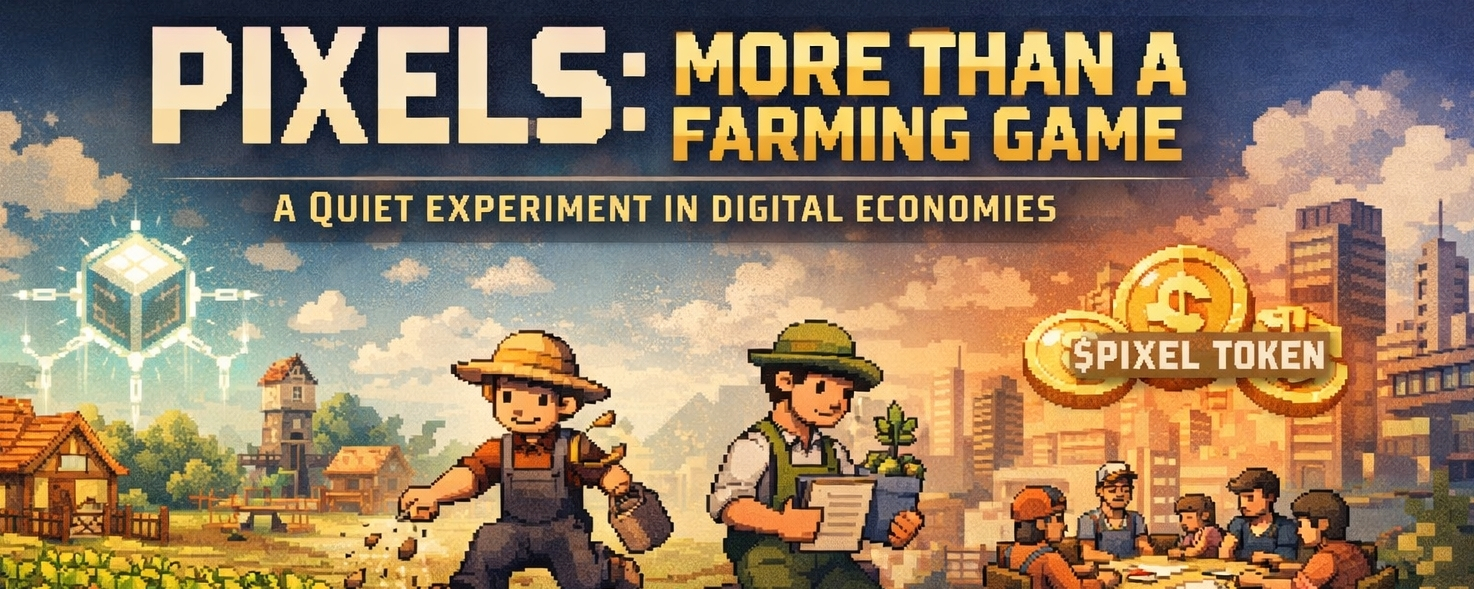
At a glance, Pixels looks almost too simple to take seriously. You plant crops, gather resources, decorate your land a peaceful loop that feels familiar, even predictable. But spend a little more time inside it, and something deeper starts to reveal itself. Beneath that calm surface sits a carefully structured system that isn’t just about playing—it’s about sustaining something over time.
That raises an interesting question: why does a casual farming game even need an economy?
Most games don’t. You log in, grind, earn rewards, spend them, and log out. The cycle resets. Your effort rarely carries meaningful weight beyond that loop. Pixels, however, stretches this loop. It introduces continuity an attempt to make your time and decisions matter beyond a single session.
This is where blockchain-based ownership comes in. It may sound like a buzzword, but from a player’s perspective, it shifts the experience. If you spend a week building your farm, in a traditional game it remains locked within that environment. In Pixels, there’s at least a structural claim that what you build belongs to you.
But ownership alone doesn’t create value. You can own something worthless just as easily as something valuable. So the real question becomes: where does that value actually come from?
Pixels seems to explore this through behavior rather than fixed rewards. There’s no guaranteed outcome handed to every player. Instead, results depend on how you play your efficiency, your planning, your ability to coordinate with others. It starts to resemble a small, functioning economy rather than a static game system.
Imagine two players investing the same amount of time. One rushes through tasks, wastes energy, and ignores optimization. The other carefully plans crop cycles, minimizes waste, and collaborates with a guild. Same tools, same time but very different outcomes. That difference is not random; it’s behavioral. And that’s where Pixels quietly separates itself.
The social layer deepens this further. Guilds here aren’t just casual groups they act more like production units. Players share strategies, coordinate efforts, and sometimes even align outputs. It begins to feel less like multiplayer gaming and more like small-scale digital cooperation almost like micro-economies forming inside the game world.
Then there’s the token layer: $PIXEL. In many Web3 games, tokens feel disconnected players earn rewards, sell them, and move on. The cycle is short-lived. Pixels is trying a different approach by linking rewards to actual in-game contribution. Systems like staking and activity-based distribution aim to reduce the “free reward” problem, though they’re still evolving.
This introduces a subtle but important shift:
From Play-to-Earn → to Play-and-Participate
Instead of simply extracting value, players are encouraged to help create it. Your role isn’t just to benefit from the system but to actively shape it.
Even the frequent updates often every couple of weeks start to look different under this lens. They’re not just about adding new content. They function as economic adjustments: introducing new items, sinks, and mechanics to balance the ecosystem. It’s less about game expansion and more about system tuning.
And that may be the core idea behind Pixels. It doesn’t aim to be the most complex or visually overwhelming game. It keeps things simple on the surface. But underneath, it’s experimenting with something much harder: making time, effort, and coordination economically meaningful without sacrificing the fun.
Is it perfect? Not at all.
Questions remain. What happens if user growth slows down? How sustainable is the reward system? How centralized is the control behind the scenes? And how fair is the overall distribution?
But even with these uncertainties, it’s difficult to ignore what’s happening here. Pixels isn’t just presenting an idea it’s testing a framework in real time.
Can a game function like a lightweight economy?
Can ownership influence behavior, not just perception?
Can coordination outperform individual grinding?
Pixels doesn’t fully answer these questions yet. But it’s asking them and more importantly, building in a way that lets the answers evolve over time.
Maybe that’s where the real significance lies.
Not in “play and earn,”
but in play, contribute, and see if the system recognizes your role. 🚀