
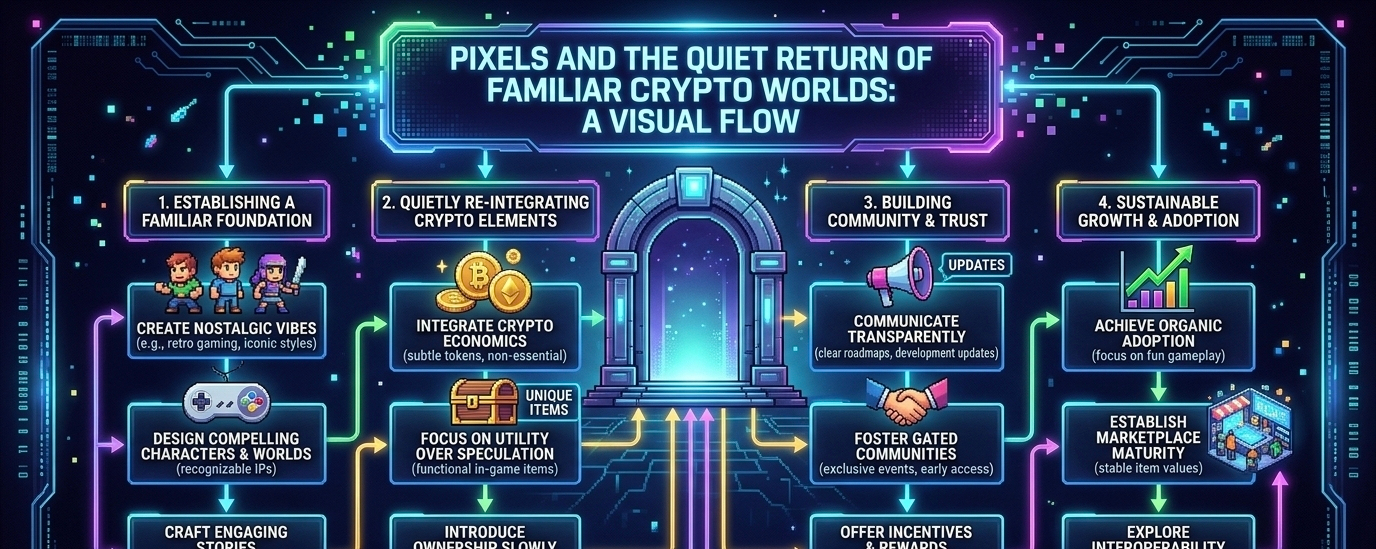

I remember the first time I came across Pixels. It didn’t feel new in the way people usually mean that word in crypto. Nothing really does anymore if you’ve been around long enough. It just felt like another version of something I had already seen, except this time the colors were softer and the pitch was quieter. Farming, exploration, crafting loops. A social layer wrapped around a game that wants to be an economy. It sits on Ronin, which already carries its own history, its own ghosts from the Axie era that once felt like a beginning and later felt more like a lesson people keep relearning in different forms.
There’s a certain familiarity in how Pixels presents itself. Not in a bad way, just in a tired one. The kind of familiarity that comes from watching the same narrative return every cycle with a slightly different coat of paint. This time it’s “cozy,” “open world,” “community-driven.” Before it was “play-to-earn,” and before that it was something else dressed up as inevitability. The words shift but the shape stays the same. Something about ownership, something about digital labor, something about escaping old systems by recreating them in a more colorful room.
I don’t feel excitement looking at it. That part of me got burned out somewhere between cycles, somewhere between hype waves that promised economies and delivered short-lived activity spikes that collapsed into silence once incentives thinned out. What’s left is more observational than emotional. You watch how long things hold attention when rewards are reduced to nothing more than the experience itself. That’s usually where the truth is, or at least a version of it that survives longer than token charts.
Pixels looks thoughtfully designed. That’s the strange part. It doesn’t look like a rush job or an obvious extraction loop. There’s care in the visuals, in the pacing, in the way it tries to make repetition feel like progression. Farming systems, resource loops, social interactions that are slow enough to feel almost deliberate. You can tell someone spent time trying to make it feel like a place rather than a product. But intention doesn’t always survive contact with players, and even less with markets.
Ronin as a base adds another layer of memory. I still think of it as a chain shaped by one dominant experiment that scaled too quickly and then had to rebuild meaning afterward. Everything built there carries a faint echo of that first big promise. It’s not fair to reduce it to that, but narratives stick in crypto longer than technology does. They become the air around projects, whether developers want it or not.
Pixels exists in that air. It is both a game and a continuation of an idea that keeps trying to justify itself. That games can carry economies, that players will stay when speculation fades, that social coordination inside a digital world can become sticky enough to outlast financial incentive. These ideas are not wrong. They just keep failing in the same places, quietly, repeatedly, without dramatic collapse. More like evaporation than explosion.
What stands out to me isn’t the mechanics. It’s the gap between how complete everything looks and how uncertain its foundation feels. You can build a world that feels alive in short sessions, even sustained sessions, but that doesn’t automatically translate into permanence. People can inhabit something without needing it. That distinction matters more than design quality, but it’s harder to measure, so it’s often ignored.
I’ve seen this pattern enough times now that I stop trusting the early signals. On-chain activity, user spikes, trading volume tied to in-game events. All of it moves like weather. Interesting to observe, not reliable as meaning. The real question always comes later, after incentives flatten. Who is still there when there is nothing new being distributed.
Pixels tries to answer that by leaning into social texture. Guild-like behavior, shared spaces, slow accumulation of resources. These are all known strategies now. They work for a while. Sometimes longer than expected. But they don’t always resolve the deeper issue, which is that most people still arrive for the same reason they always have in crypto contexts. They are either early, or they hope they are early, or they are pretending not to care that timing is still the most important variable.
There’s also something slightly melancholic about how polished these ecosystems become. You can see the effort to reduce friction everywhere. Smoother onboarding, clearer progression loops, less confusion, fewer rough edges. But friction is sometimes where persistence lives. When everything becomes too smooth, it becomes easier to leave without noticing you left.
I think about how many projects like this I’ve watched evolve over the years. Some had worse design and better outcomes. Some had better design and disappeared quietly. It’s never fully correlated. That’s one of the more uncomfortable truths in this space. Good execution is not a guarantee of relevance. And relevance, once lost, rarely returns through quality alone.
Pixels sits in that uncertain middle space. It is not obviously failing. It is not obviously succeeding in a durable sense either. It is simply existing, iterating, adjusting to attention cycles it did not create but must survive inside of. That alone takes more work than it looks like from the outside.
Sometimes I wonder if these worlds are being built for people, or for the idea of people. For metrics that represent presence rather than presence itself. It’s hard to tell the difference when everything is mediated through wallets and activity graphs. The human layer becomes statistical very quickly.
Still, there are moments where it almost feels real. A small interaction, a player-driven economy behaving in a way that wasn’t explicitly scripted, a sense that maybe something organic is forming underneath the systems. But I’ve learned not to trust those moments too quickly. They can be the beginning of something, or just the illusion of one.
So I watch it the same way I watch most of these projects now. Not with expectation, not with dismissal either. More like passing familiarity with something that might become important later, or might not be remembered at all. Both outcomes feel equally plausible at this distance.
It keeps building, and the market keeps moving around it, and users come and go in patterns that feel familiar enough to predict but never precise enough to rely on. And somewhere in that movement, the real answer probably forms, slowly, without announcement.
Or maybe it doesn’t form at all.
