
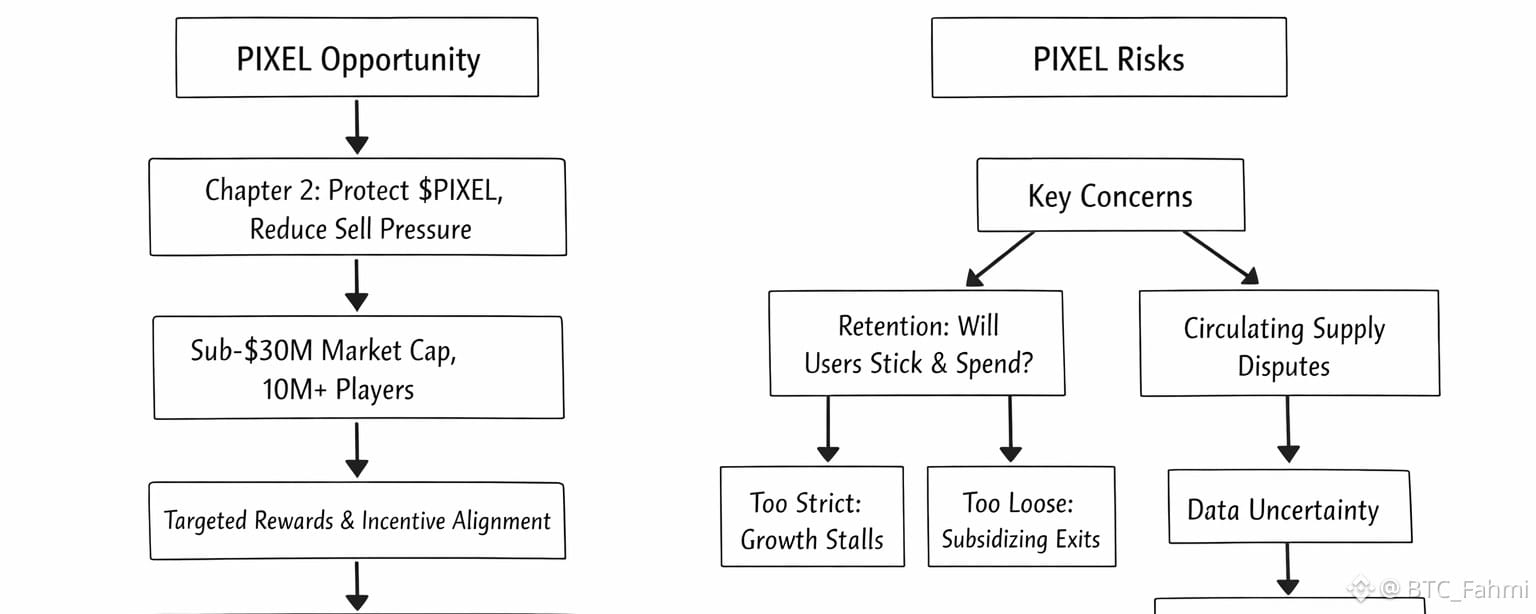
I remember the exact moment I stopped looking at Pixels like just another game token. It was after watching too many reward systems in this sector do the same stupid thing. They paid people fast, let everyone dump, called it growth, then spent the next few months pretending the leak in the bucket was just “market conditions.” Pixels felt different when I saw the team openly say Chapter 2 was meant to protect $PIXEL by making players strategize and work together for token rewards, while moving the inflation-heavy soft currency layer off-chain to reduce sell pressure and keep the economy playable. That’s not flashy. It’s just what a team does when it knows rewards can kill the product if they arrive too easily. 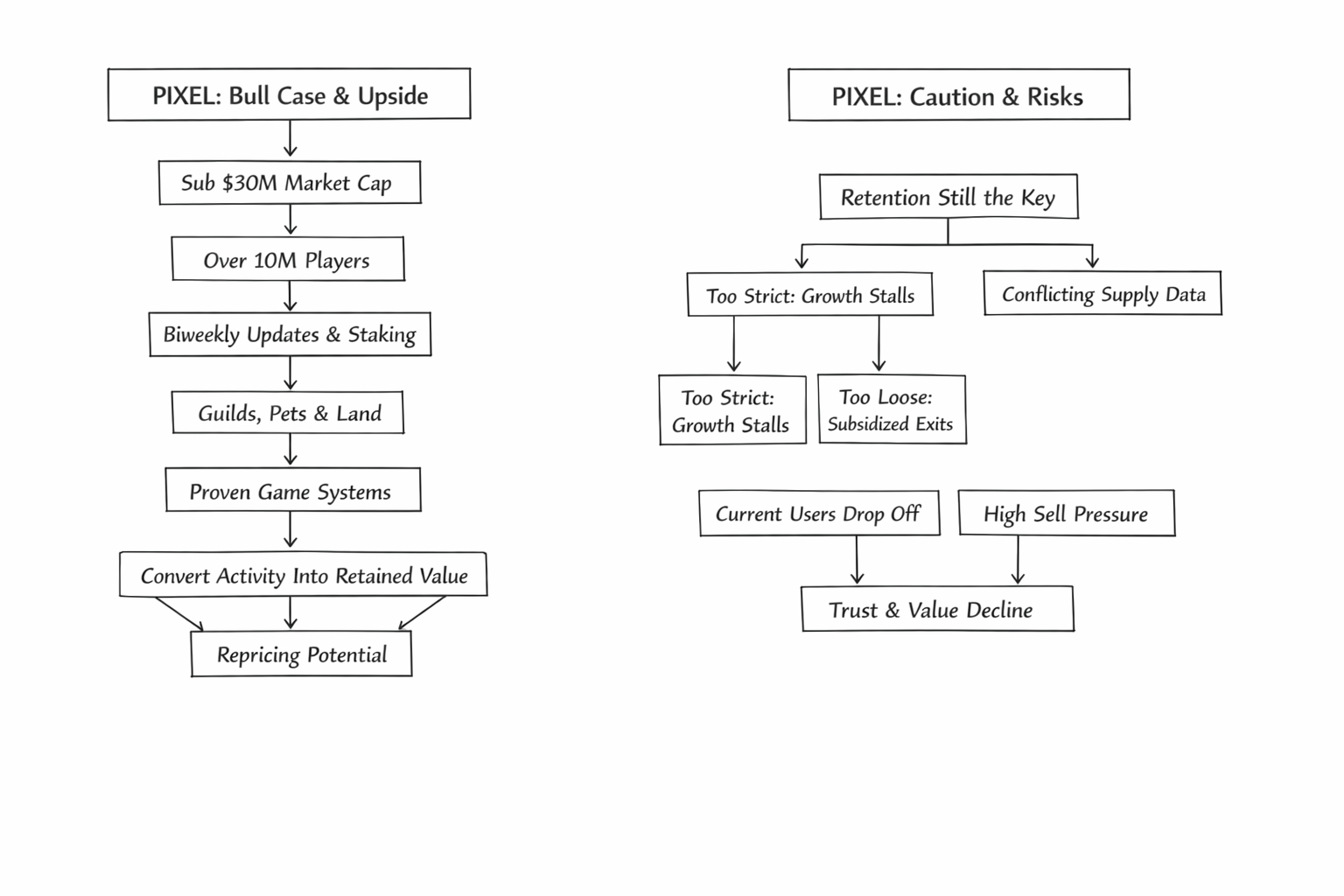 Today that caution is showing up in the market in a weird way. PIXEL is trading around $0.00825, with roughly $18.7 million in 24 hour volume and a market cap near $27.9 million on CoinMarketCap, against a 5 billion max supply and about 3.38 billion circulating. Binance shows a similar price and also places circulation a little above 3.1 billion. That matters because this is no longer a token where you can hide behind the “small float” story. A lot of supply is already out. So when you look at PIXEL now, you’re not really betting on scarcity theater. You’re betting on whether this game can keep people inside the loop long enough for spending, staking, guild play, and progression to matter more than farming and exiting. And honestly, that’s the part I respect. The 2025 whitepaper doesn’t lean on empty “earn more” language. It talks about targeted rewards, better incentive alignment, and using data to reward actions that create long term value. Even the older docs made a point that the premium token should not exist mainly to increase future earnings. In plain English, the system is trying to reward contribution without turning every player into a mercenary accountant. That’s a much harder balance than people think. It’s like running a cafe where you want regulars, not just people who show up because you handed out coupons at the door. The realistic bull case starts there. If PIXEL is sitting around a sub $30 million market cap while the official site still advertises over 10 million players, regular biweekly updates, staking, guild mechanics, pets, land, and a broader publishing direction, then the upside argument is pretty simple. The market has already crushed expectations so hard that Pixels does not need perfection to get repriced. It just needs proof that the premium layer can convert activity into retained value. If a game with this kind of installed audience figures out how to make rewards feel earned, limited, and worth recycling back into the ecosystem, traders will notice fast. At this valuation, you do not need heroic assumptions for that to matter. But here’s what keeps me cautious. Retention is still the whole trade. Not downloads. Not social buzz. Not one good month of volume. The official site saying over 10 million players sounds good, but traders don’t get paid on cumulative signups. They get paid when current users stick, spend, and stop treating the token like a temporary paycheck. If the reward filters are too strict, growth can stall. If they’re too loose, you’re back to subsidizing exits. That tradeoff is real. I also don’t love that major data sites still show conflicting circulating supply figures. When trackers disagree that much, it creates friction for valuation work and makes it harder for the market to trust the number it’s pricing. So that’s where I land. Pixels is interesting to me precisely because it seems unwilling to hand out rewards until the system can carry them. That’s the adult decision. It also means the token probably won’t look exciting to people who only understand growth when it’s noisy. Fine. Let them chase louder charts. I’d watch PIXEL right here, but I’d watch it like a trader, not a fan. Watch whether volume stays real. Watch whether the game keeps giving people reasons to come back besides extraction. Watch whether the economy keeps tightening instead of panicking. Because if Pixels solves retention, this valuation starts to look lazy. If it doesn’t, cheap can always get cheaper.

مقالة
Pixels Doesn’t Hand Out Rewards Until the System Can Sustain Them
إخلاء المسؤولية: تتضمن آراء أطراف خارجية. ليست نصيحةً مالية. يُمكن أن تحتوي على مُحتوى مُمول. اطلع على الشروط والأحكام.