
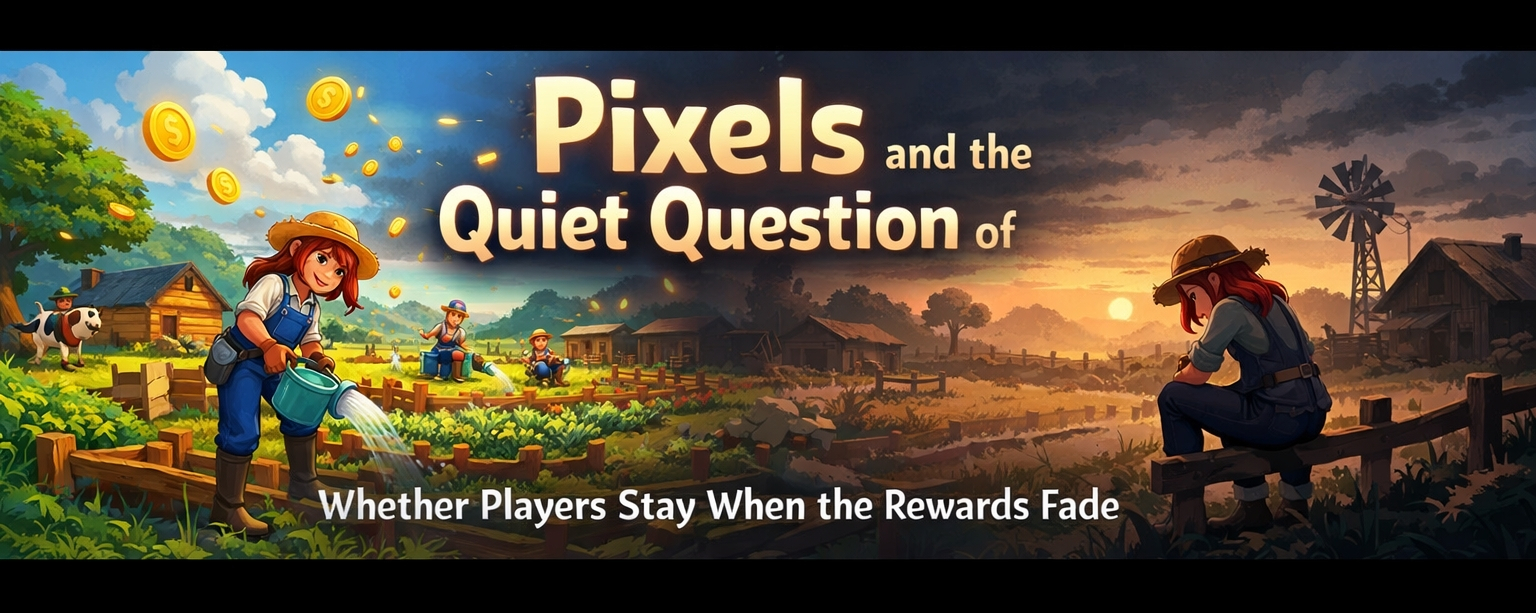
I’m watching Pixels more closely these days, trying to understand what’s actually happening beneath the surface instead of just following the excitement around it. I’m waiting to see how real the activity is, not just how it looks on dashboards or social media. I’ve noticed that a lot of people are drawn in quickly, which makes sense because Pixels is simple, accessible, and easy to start. But I focus less on how fast people enter and more on why they stay. I stopped looking at narratives because they always sound convincing in the moment, and I started paying attention to real usage. I remember when I thought differently, when I believed that if a game looked active, it must be healthy, but now I question that assumption every time.
When I look at Pixels, I see a system that mixes gameplay with economics in a very direct way. Farming, crafting, trading, owning land, all of it creates movement, but I keep asking myself if this movement is natural or if it’s driven by rewards. Are players farming because they enjoy the loop, or because it pays? That question stays in my mind because it defines everything else. If most activity depends on incentives, then the system becomes fragile the moment those incentives weaken.
I try to understand where the value is coming from inside Pixels. Is it being created through player interaction, or is it mostly being distributed through rewards and then circulated? Because if it’s mostly rewards, then new capital needs to keep entering to support the system. And if that slows down, the pressure starts to show. I’ve seen this pattern before, where activity looks strong until rewards drop, and then everything suddenly feels quieter.
At the same time, I can’t ignore that Pixels has lowered the barrier for people to participate. It’s easier to get into compared to older Web3 games, and that matters, especially in regions where people are open to earning through digital platforms. I think about players in developing markets, where even small earnings can be meaningful. That creates real adoption, but it also creates a different kind of user behavior. People become more focused on extracting value quickly rather than building something long-term inside the game.
Trust is something I keep coming back to. Not just trust in the project itself, but trust in its future. Players might trust that Pixels works today, but do they trust it enough to invest their time over months or years? If they don’t, they will act carefully. They will take what they can and move on. That kind of behavior is understandable, but it makes it harder for the system to grow into something stable.
I also watch how the token is used inside Pixels. Is it something players genuinely need, or is it mainly something they earn and sell? Because if most users are sellers, then there needs to be strong reasons for others to buy and use it. Without that balance, the economy starts to lean in one direction, and that usually doesn’t last long. A healthy system needs real demand, not just constant distribution.
The development side looks active, and I respect that. The team is clearly trying to improve the experience, add features, and keep things moving. But I ask myself whether these updates are changing how people behave or just keeping attention alive for a bit longer. Real strength usually comes when players start creating value for each other, not just interacting with the system to earn.
Identity inside Pixels still feels early to me. Players have land and progress, but I wonder how deep that connection really goes. If rewards were reduced, would people still log in just to play, build, and interact? Or would most of them slowly disappear? That’s an uncomfortable question, but it’s an honest one.
I don’t get too impressed by user numbers anymore. I care more about what happens after the initial wave. Do people stay? Do they come back without being pushed? That’s where the real signal is. Because growth is easy when incentives are strong, but retention is what shows whether something has real value.
There’s also the bigger environment to think about. Money flow in the broader market affects everything. When liquidity is high, projects like Pixels can grow faster. When things slow down, only the ones with real usage tend to hold up. Regulations could also become a factor, especially if earning through games becomes more common in different countries.
In the end, I keep things simple in my head. Pixels is interesting, it’s active, and it’s clearly doing something right in terms of attracting users. But I’m not rushing to conclusions. I’m watching how people behave when things become normal, when rewards are no longer the main attraction. Because the real question for me is always the same: if the incentives fade, does the system still make sense for the people inside it?