
None of it exists, of course. It’s light arranged in a grid, refreshed dozens of times per second. And yet the feeling it producesa quiet, almost private aweis real.
That gap between material simplicity and emotional weight is where the power of pixels lives.
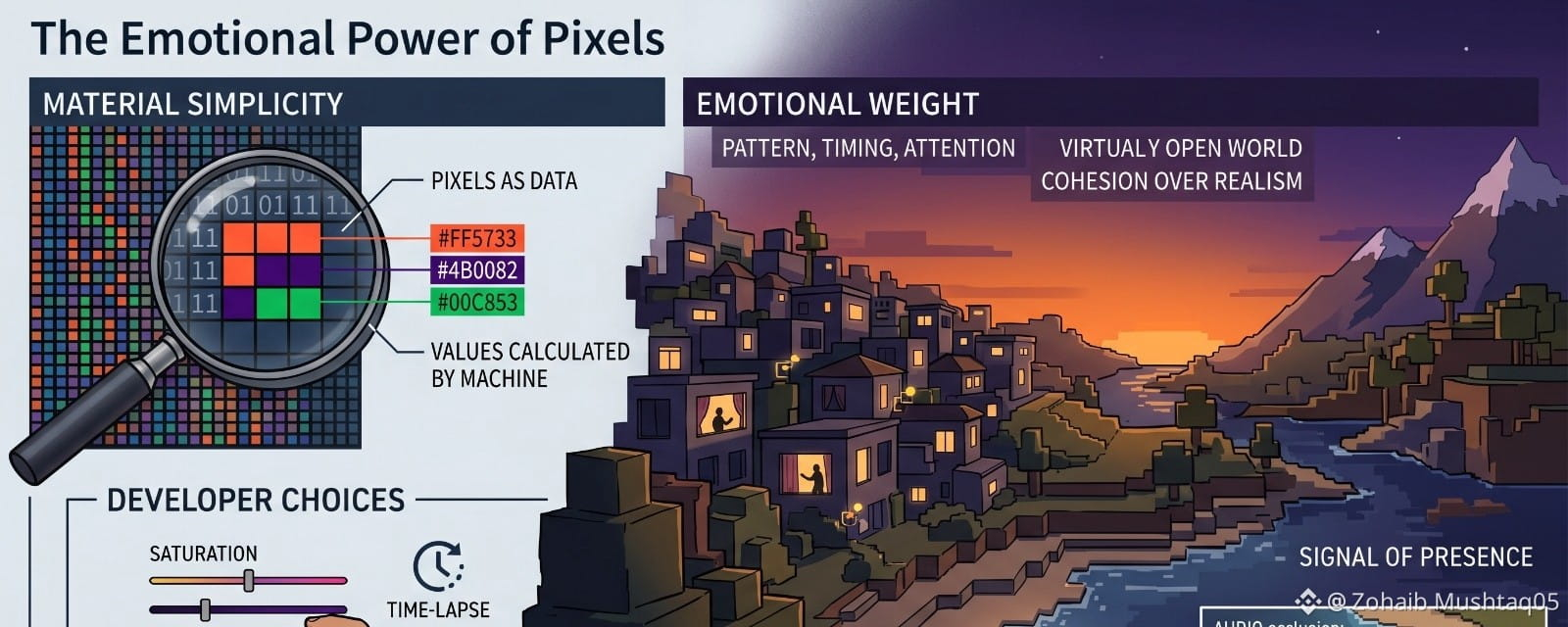
Open-world games are built from units so small they disappear at normal viewing distance. A 4K screen holds more than eight million pixels. Each one shifts color based on instructions calculated by a machine under your television or desk. The hardware doesn’t know what a sunset is. It processes values. But developers make choices about those values: how saturated the orange should be, how quickly the purple deepens, how long the light lingers before night takes over. Those choices accumulate. They form mood.
Scale used to dominate conversations about expansive game worlds. How far you could travel. How many districts a city contained. Now the discussion has turned, quietly, toward texture. Not just how big a place is, but how it feels to inhabit minute by minute.
Walk through a dense virtual neighborhood and pay attention to the windows. Some are lit. Some are dark. In a few, silhouettes move behind curtains. These are small animations, often looped. They cost memory and processing power. An artist had to decide how long the shadow pauses before shifting, how opaque the curtain should be, whether the interior light flickers slightly to mimic an aging bulb. Most players will never isolate these details. But they register them subconsciously. The street feels occupied.
That sense of occupation matters. Humans are finely tuned to signs of other lives. We look for movement at the edges of our vision. We listen for changes in tone. When a game world mirrors those cues—even in simplified form—it taps into instincts honed long before screens existed.
The emotional charge of pixels doesn’t depend on realism alone. In fact, some of the most affecting worlds lean into stylization. Consider a landscape built from visible squares, trees composed of chunky blocks, faces suggested by a handful of lines. The abstraction leaves room. Memory collaborates with design.
Instead, they focus on cohesion. A restricted color palette. Consistent geometry. Carefully timed animations. Constraints shape style, and style shapes emotion.
Sound works alongside the image, often doing more than players realize. A pixelated shoreline becomes convincing when waves arrive with slight variation, when gulls call from different directions depending on camera angle. Audio engines now simulate occlusion, so a wall dampens sound rather than merely lowering its volume. These are technical solutions to perceptual problems. They allow a sparse arrangement of pixels to suggest depth beyond the screen.
Emotion also emerges from interaction. In an expansive world, the ability to alter small things carries weight. They say: you were here, and the world noticed.
Developers talk about persistence as a design goal. It’s harder than it sounds. Every persistent object consumes memory. Every tracked change adds complexity. Teams have to decide what the world remembers and what it forgets. Total persistence is impossible; hardware has limits. So they choose carefully.
There’s an emotional logic to them. We tend to remember meaningful disruptions and discard minor accidents. A storm that uproots a tree feels permanent. A glass tipped off a counter does not. When game worlds mirror that hierarchy, they feel aligned with lived experience.
The labor behind these choices is easy to overlook. Artists spend days adjusting how light scatters across wet pavement. Programmers optimize shaders so consoles don’t overheat rendering reflections. Writers trim dialogue so a passing comment sounds natural rather than staged. Much of this work is invisible when it succeeds. You don’t congratulate a game for having believable shadows. You simply accept them and move on.
Yet when something is offa stiff animation, a face that doesn’t quite emotethe spell weakens. We are sensitive to tiny discrepancies. A fraction of a second’s delay in a character’s response can flatten a scene. Emotional power, in digital spaces, is cumulative and fragile.
These are pixels doing quiet narrative work.
Expansive game worlds will likely continue to grow. Hardware will improve. Resolution will climb. But resolution alone does not guarantee resonance. The emotional power of pixels lies less in their quantity than in their arrangementin the discipline to place them with intention, to let small details carry meaning.
At their best, these worlds remind us that emotion doesn’t require physical substance. It requires pattern, timing, and attention. A screen lights up. Colors shift. A character pauses before speaking. And somewhere in that dance of illuminated squares, a player feels something steady and unforced.
It’s easy to dismiss pixels as trivial, as mere components in a technical system. But arranged with care, they become signals we recognize instinctively: signs of weather, of presence, of passing time. In vast digital landscapes, it’s those signalsthe subtle onesthat turn scale into experience and space into memory.