

have tried enough Web3 games to know how most of them usually go.
At first, everything feels exciting. The community is loud, the token is moving, people start posting screenshots, and suddenly the game is everywhere. For a few days or a few weeks, it feels like the next big thing. Then slowly the excitement fades. The gameplay starts to feel repetitive, the rewards stop feeling worth the effort, and what looked like a game begins to feel more like a chore with extra steps.
That is exactly why Pixels stood out to me.
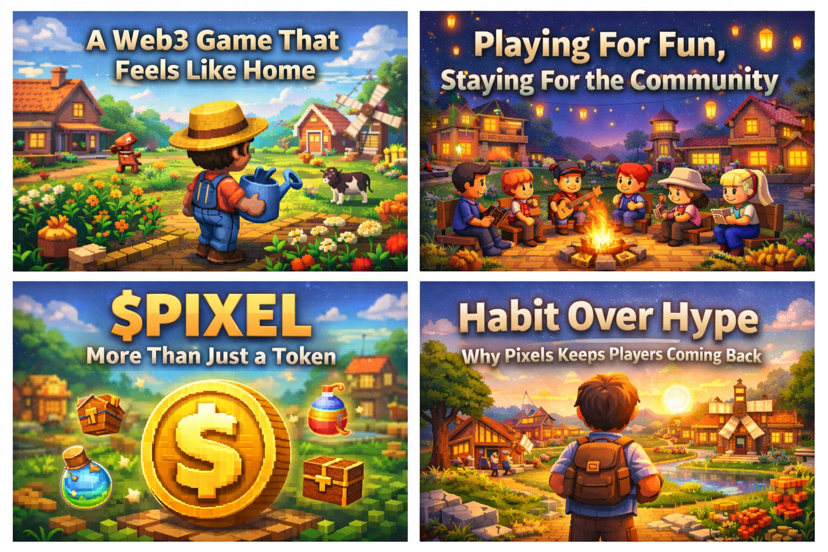
Pixels did not feel special because it promised huge rewards. It felt different because it was easy to enjoy. The moment I spent time in it, I understood why people kept coming back. The farming is simple, the world feels light, and the social side of the game gives it a warmth that most blockchain games never manage to create. It does not throw complexity at you just to sound advanced. It keeps things comfortable, and that works in its favor.
That matters more than people think.
In crypto gaming, many projects focus too much on extraction. They build around rewards first and hope the gameplay will be enough to keep people interested. But players always notice when the economy matters more than the experience. Once the incentives slow down, the cracks start to show. Pixels feels like one of the few projects that understood early that people stay longer when a game is genuinely pleasant to play.
It is built on Ronin, which already gives it an advantage. The experience feels smooth, transactions are easier than what many players expect from blockchain games, and the overall barrier to entry does not feel heavy. That alone helps. A game cannot grow if the first hour is frustrating. Pixels avoids that problem by making the onboarding feel lighter and more natural.
The game itself is not trying too hard to impress you with noise. That is part of its charm. You can farm, explore, gather resources, interact with other players, build your own routine, and slowly become attached to your little corner of the world. It has that rare quality where players do not always log in because they are chasing something. Sometimes they log in because they simply want to be there. That is a much stronger sign of long term value than most people realize.

And that brings us to $PIXEL.
A lot of gaming tokens struggle because they exist without meaningful connection to player behavior. They are added as financial layers, but they do not always feel necessary to the actual experience. works better when it feels connected to progression, access, customization, and deeper participation inside the ecosystem. That is where its value becomes more interesting. It is not just about price charts or short term volatility. It is about whether the token has a role inside a world that players care about.
That is the more important question.
When a game has a real player base, a living economy, and consistent engagement, the token starts to feel less like decoration and more like infrastructure. In Pixels, that connection gives a stronger identity than many GameFi tokens ever achieve. It becomes part of a broader system built around activity, ownership, and retention instead of existing only for speculation.
Of course, that does not mean there are no risks. Crypto gaming is still unpredictable. Market conditions change fast. Sentiment changes even faster. No token is immune to that. But Pixels feels more grounded than most because it is not relying only on hype to stay relevant. It has something quieter and more durable behind it: habit.
That is what makes this project interesting to watch.
Habit is powerful. When people return to a game again and again, even in quieter market conditions, it says something. It means the product is doing more than attracting attention. It is building a routine. And in gaming, routine is everything. You can manufacture excitement for a launch, but you cannot fake retention forever. Players either care enough to come back, or they do not.
Pixels seems to understand that better than a lot of projects in this space.
It is not trying to become successful by shouting louder than everyone else. It is growing through familiarity, comfort, and consistency. Those may sound like small things, but they are often what separate a temporary trend from a sustainable ecosystem. The project feels more focused on keeping players engaged than simply keeping speculators interested, and that makes a real difference.
What I like most is that Pixels does not feel trapped in the old “play to earn” mindset. It feels closer to something healthier. A game first. An economy second. Ownership as an added layer, not the entire reason to exist. That balance is hard to get right, especially in Web3, and Pixels deserves credit for getting closer than most.
So no, I am not saying this is some guaranteed moonshot or pretending every part of crypto gaming has already been solved.
I am saying something much simpler.
Pixels feels real.

It feels like a game people can actually enjoy without forcing themselves to care. It feels like a world that players can return to because they want to, not because they feel pressured to grind. And in a sector full of projects that confuse activity with loyalty, that difference matters a lot.
That is why Pixels still deserves attention.
Not because it is the loudest project in Web3 gaming.