
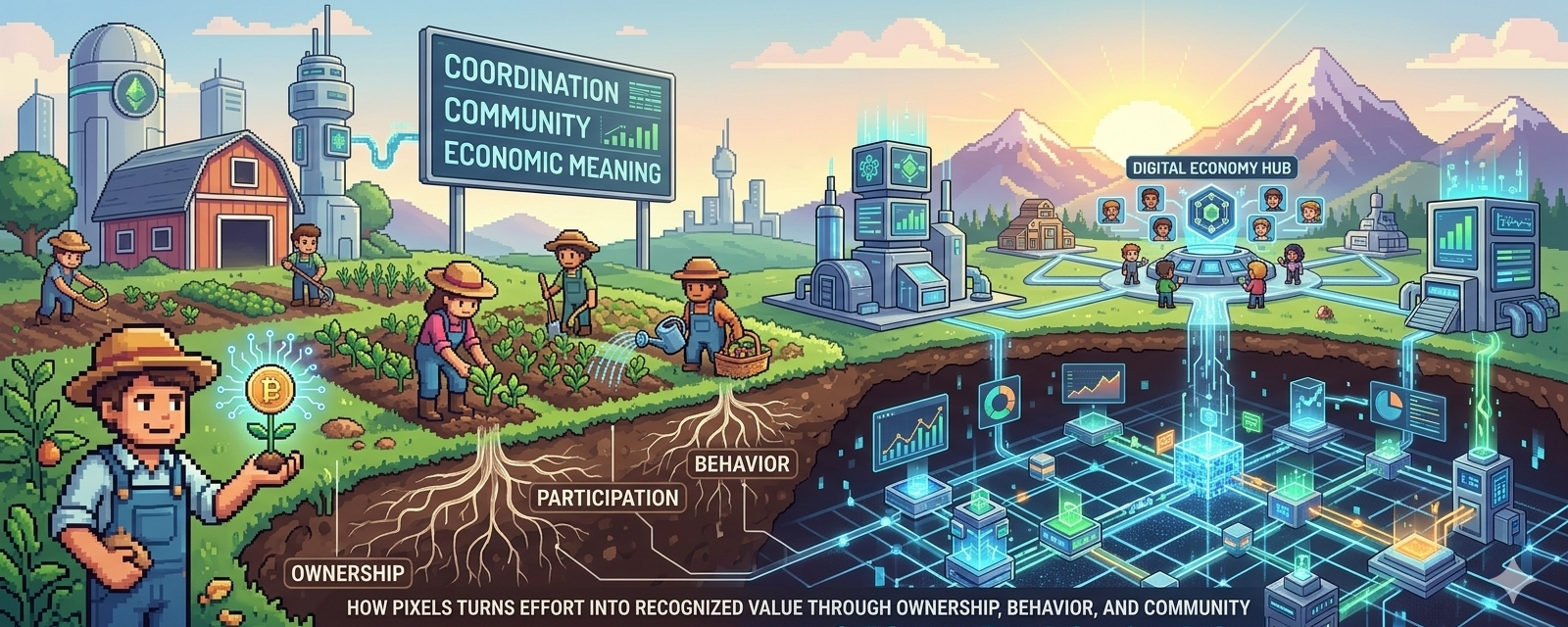
@Pixels At first, Pixels looks like a soft, simple farming game. You water crops, collect resources, decorate your land a little, and move at your own pace. Nothing about it feels loud or complicated. But the more time you spend inside it, the more you start noticing that there is something else happening under the surface. It is not only built to be played for a few minutes and forgotten. It feels like it is trying to create continuity, a sense that what you do today can still matter tomorrow. That is what makes it interesting. The game is simple on the outside, but inside it is trying to hold together a much bigger idea.
What really changes the experience is ownership. In most games, your effort disappears the moment you log out. You can build something, grow something, improve something, but it stays trapped inside a closed world that only exists while the game is open. Pixels brings in blockchain ownership, and that small shift changes the feeling of playing in a big way. Suddenly, your farm is not just a temporary progress bar. It feels like something you have actually built and accumulated over time. That does not automatically create value by itself, because ownership alone is never enough. You can own something and still have no reason for it to matter. So the real question becomes: where does the value come from?
Pixels seems to answer that through behavior. It does not hand out value in a fixed, automatic way. The outcome depends on how you play, how carefully you plan, how efficiently you use your time, and how well you coordinate with others. Two players can spend the same number of hours in the game and still end up with very different results. One may rush, waste energy, and play without thinking ahead. Another may move more slowly, plan crop cycles, coordinate with guildmates, and reduce unnecessary loss. Same game, same tools, but different thinking creates different outcomes. That is what gives the system a more realistic feeling. It starts to resemble a small digital economy where decisions matter more than simple repetition.
The social side makes that even more visible. Guilds do not feel like random groups of players hanging out together. They begin to work more like small production units. People share effort, coordinate strategy, and sometimes depend on each other to get better results. That changes the whole feeling of the game. It stops being only multiplayer and starts looking like a coordination system. In a way, it creates a kind of digital cooperation that feels closer to real-world teamwork than to normal gaming.
The token layer adds another level to that idea. In many games, rewards are often detached from real contribution. Players farm, collect, sell, and move on. Pixels seems to be trying to reduce that kind of empty reward cycle by connecting token distribution more closely to actual participation and activity. It is not perfect, and it does not solve everything, but the direction matters. The shift is subtle but important: from play-to-earn to play-and-participate. That changes the psychology of the whole system. You are not only taking value out of the game. You are also helping create the conditions that give the system meaning in the first place.
Even the regular updates start to feel like more than just fresh content. New items, new industries, new sinks, and new mechanics do not just keep the game alive visually. They also help tune the economy. They work like balancing tools, shaping how resources move and how the system behaves over time. That makes Pixels feel less like a simple farming game and more like an ongoing experiment in game design, economic design, and player behavior all mixed together. It is trying to stay approachable while quietly testing something difficult: can time, effort, and coordination be made economically meaningful without making the game feel heavy or forced?
That question is probably the most interesting part of all. Pixels is not trying to be the most complex game ever made. It seems more interested in staying simple enough for people to enjoy, while still experimenting with a deeper structure underneath. It asks whether a game can behave like a small economy, whether ownership can actually influence behavior, and whether cooperation can become more valuable than solo grinding. It does not answer those questions perfectly, and maybe it does not need to yet. What matters is that it is asking them in a way that feels real.
That is why Pixels stands out. It does not just tell players to play and earn. It creates a system where playing, contributing, and coordinating begin to mean something. And that is what makes it feel different. Not because it is flashy, but because it is quietly trying to turn effort into something the system can recognize.
