

There’s something you notice early on when you watch people play Pixels: two players start at the same time, follow nearly identical steps plant crops, harvest, repeat and somehow, one of them pulls ahead. They gather resources faster, unlock upgrades sooner, just move through the game at a different pace. The other player trails behind, even though it looks like they’re putting in the same effort.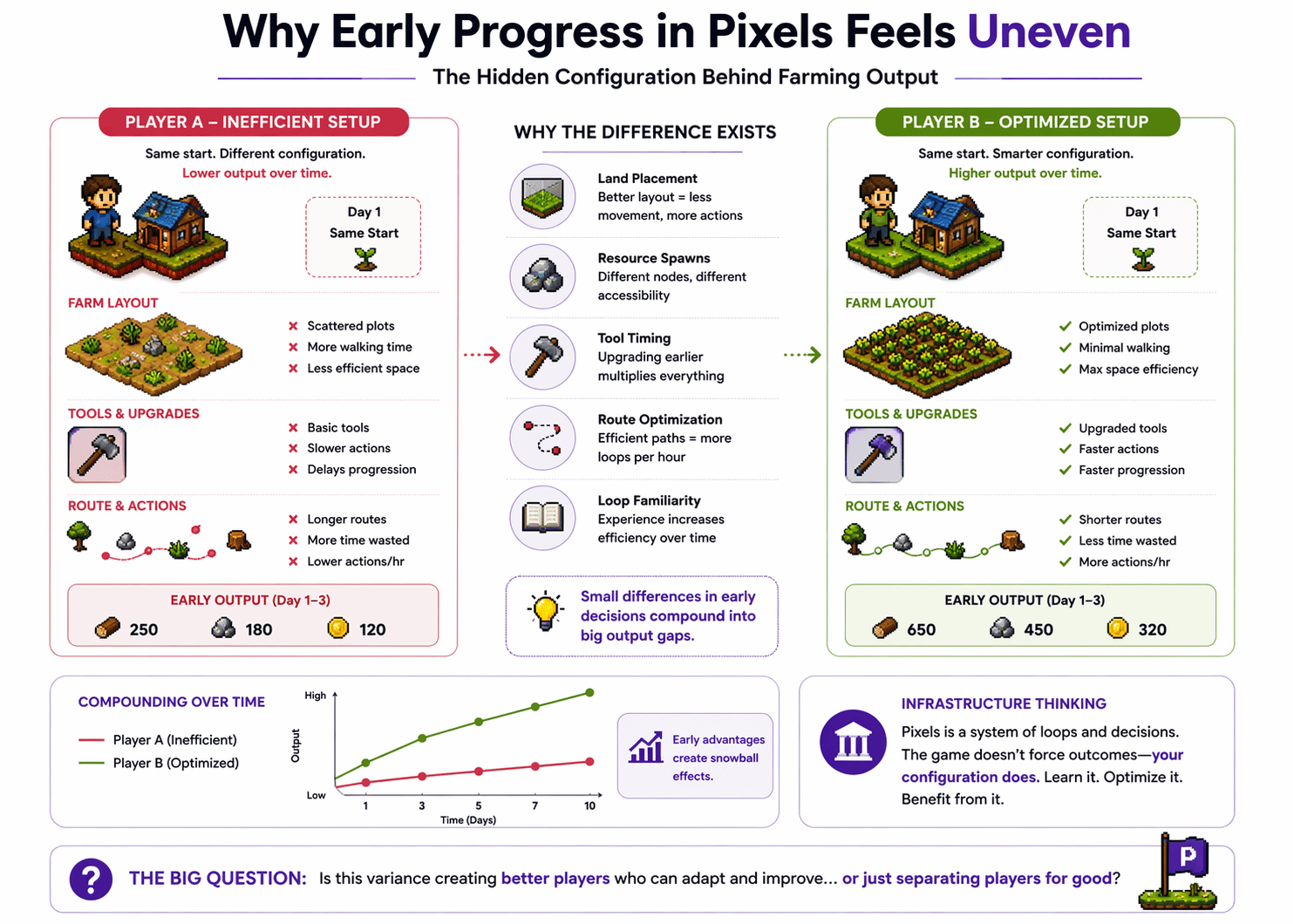
At first, it feels like luck, right? Or maybe it’s just one of them putting in a little more time. But honestly, when you look closer, that explanation doesn’t really hold up. The gap isn’t just chance it comes from a bunch of tiny factors you barely notice until they start to pile up.
You get things like:
How their land is laid out some setups just flow better.
When and where resources happen to spawn.
The split-second timing on when someone upgrades a tool.
The path they run while handling their crops.
Just being a bit faster or more familiar with the loop.
Each one on its own feels like nothing. Put them together, though, and you end up with a real difference. One player accidentally stacks a bunch of “little wins,” and suddenly there’s a gap that just keeps opening up.
The big thing here: a system does not need to be rigged to feel unfair. It just has to be sensitive.
When a game lets small choices create big outcomes, you get natural variance. In something like Pixels, where the actions repeat and build on each other, those minor differences don’t go away. They snowball.
It all comes back to how the game is built.
Pixels is not some flat, one-size-fits-all grind where everyone moves forward at exactly the same rate. Sure, sometimes you plant, you harvest, you get what you put in. But a lot depends on timing, the way your land sits, the order you do things, how you decide when to upgrade. All these little decisions make up what you could call a “soft configuration.” Not hardcoded “winners” just small, sneaky conditions that shape your results.
Like:
How well you chain actions together
The moment you decide to invest in an upgrade
Which early resources you pump into what
Which loops you double down on or skip
Over time, these tiny advantages act like hidden multipliers. One player just breezes a little faster, and it shows.
From a system design point of view, this is where things get interesting.
A game with no variance gets stale really fast. But crank up the randomness too much, and it feels unfair. The trick is to strike a middle ground, where smart choices matter but outcomes don’t feel completely arbitrary.
Right now, Pixels finds itself pretty close to that sweet spot.
It lets results diverge and that makes it interesting. But for a new player, the early experience can feel inconsistent. When you do not understand the mechanics yet, it’s easy to think the game is just being random or unfair.
That’s when perception kicks in.
If it feels random, people get frustrated and check out. But if they sense that effort and optimization actually move the needle, it gets exciting they start experimenting, learning, trying to get better.
That’s the difference between people walking away and people getting hooked.
So take a step back and think about what Pixels is really doing. It’s not just looping a farming mechanic. It’s setting up a system where what you do actually shapes your results. And honestly, in any real system just think about businesses or economies there are always differences. Some people find a way to do things more efficiently. Others figure out smarter ways to allocate their resources. Some folks adapt quicker.
That gap isn’t necessarily a flaw. It’s what gives the system energy and movement.
If you made the game perfectly equal for everyone, you’d kill any motivation to get better. But if you let differences compound too quickly, you leave new players in the dust before they even know what hit them.
So the whole challenge is this tightrope:
Enough variance to reward smart play.
Enough stability to keep it from feeling random.
Enough transparency so players can actually see what’s going on.
Pixels hits in the middle right now not totally clear, so early progress sometimes feels like a mystery, but not random. There’s space to figure things out if you pay attention.
Which raises a bigger question.
This is not just about growing crops faster it’s about how a system manages differences in how people play. Is Pixels building a game that turns variance into skill and mastery? Or does it risk turning early mistakes or unlucky moments into roadblocks you never get past?
That’s really what defines if a system invites competition or just shuts people out.
If you can learn, adapt, and close the gap with better decisions, then that early sense of unevenness becomes a challenge worth taking on. But if your starting setup or those early moves lock you into a losing lane, it’s a different story now you just feel stuck.
In a system that wants to act like a real economy, this stuff matters.
Real economies aren’t totally equal, but they have got to let people move up if they figure out how.
So the big question for Pixels is not whether gaps exist it’s whether players can do something about them.
Can you spot where you went wrong?
Can you adjust and improve?
Is the system rigged, or can you actually catch up?
If the answer’s yes, then those uneven starts are just the first step into a game with real depth.
If not? It turns into frustration.
Which brings us back to this: Is the variance in Pixels making people sharper players or just pushing them apart?
Because that’s where a system either becomes something rich and worth coming back to or it just divides people and fizzles out.
