
Gays stop scrolling .... Look 👀
There’s a pattern that shows up again and again in Web3 games, and once you’ve experienced it a few times, it becomes hard to ignore. The structure is usually built around incentives first and gameplay second. You’re pulled in by the promise of earning, guided into repetitive loops, and then gradually lose interest once the rewards stop feeling worth the effort. Against that backdrop, comes across as an attempt to shift that balance, even if it doesn’t completely escape the gravitational pull of the space it exists in.
What feels different at the start is the absence of urgency around earning. The game doesn’t immediately push you into optimizing or extracting value. Instead, it lets you settle into its world at a slower pace. You walk around, you farm, you explore, and you gradually figure out how things connect. It’s not groundbreaking in terms of mechanics, but the framing matters. When you’re not constantly reminded that there’s money to be made, you start engaging with it more like a game and less like a system to exploit.
That difference in tone has a subtle but important effect on how players behave. In many Web3 environments, people arrive with a transactional mindset. They’re thinking about efficiency from the first minute. Here, that instinct is still present, but it takes longer to surface. For a while, curiosity replaces calculation. That window—however temporary—is valuable because it gives the game a chance to establish itself on its own terms.
A big part of why that works is the way the game handles social presence. Most Web3 games technically include other players, but they often feel like isolated experiences running in parallel. You see avatars moving around, but there’s no real sense of shared space. In Pixels, that feeling is slightly different. There’s a constant awareness that other people are doing similar things at the same time, occupying the same world rather than separate instances of it.
That might sound like a small detail, but it changes the emotional texture of the experience. When you’re farming or exploring and you see others nearby, it creates a quiet sense of participation. You’re not just progressing through a system—you’re existing within a space that feels active. That kind of low-level social design tends to be more effective than forced interaction systems. It doesn’t rely on structured cooperation or competition. It just makes the world feel inhabited.
Retention in games has always been tied to that feeling more than most designers admit. People come back because the world feels alive, because there’s continuity, because their presence seems to matter in some small way. Tokens can bring players in, but they rarely keep them around. Pixels seems to understand that, at least to some degree, and builds around it rather than trying to compensate for its absence with higher rewards.
The economic layer is where things get more complicated, as it always does in Web3. The presence of a token inevitably introduces speculation, and speculation has a way of reshaping player behavior over time. The question is not whether that happens, but how much the game can absorb before it starts to distort the experience.
What stands out here is that the economy doesn’t feel entirely built around emission. In many similar projects, the primary loop is simple: perform actions, receive tokens, sell tokens. That structure creates constant pressure on the system, because value is always flowing outward. Unless there are strong reasons to keep or spend those tokens within the game, the cycle becomes unsustainable.
Pixels appears to be aiming for something closer to a circular economy, where value moves between players rather than just being distributed from the top. Resources, land, and production systems all play a role in that. The token still exists as an important layer, but it’s not the only source of value. That distinction is important because it shifts the focus from extraction to participation.
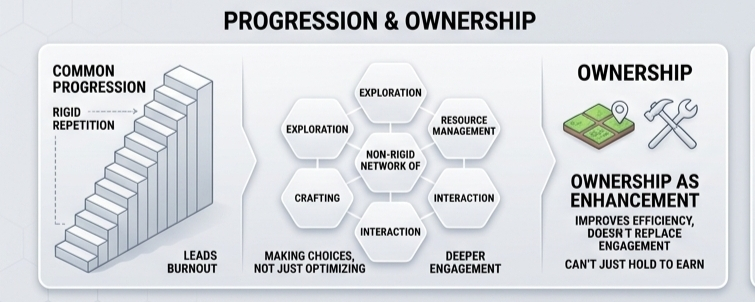
Ownership in this context feels less like a shortcut and more like an enhancement. Having assets can improve your efficiency or expand your options, but it doesn’t replace the need to actually engage with the game. You can’t simply hold something and expect it to generate value in isolation. That’s a meaningful departure from systems where ownership alone is enough to earn.
At the same time, it would be unrealistic to ignore the risks. Any system that allows assets to be traded will attract players who are primarily interested in financial outcomes. Over time, they tend to push the game toward optimization and away from exploration. The real challenge is whether the underlying design can withstand that pressure without collapsing into the same patterns seen elsewhere.
Progression is another area where the difference becomes noticeable. In many Web3 games, progression is tightly linked to repetition. You perform the same actions over and over, gradually increasing your output. It’s a model that prioritizes efficiency above all else, and it often leads to burnout or automation.
In Pixels, progression feels less rigid. There’s still repetition, especially in farming cycles, but it’s embedded within a broader system. You’re not just doing one thing more efficiently—you’re navigating a network of activities that connect to each other. Exploration, resource management, crafting, and interaction all play a role, and the path forward isn’t always obvious.
That lack of a single optimal loop creates a different kind of engagement. Instead of asking how to maximize returns per minute, you find yourself making choices about where to focus and how to approach the game. It’s a slower, more deliberate form of progression, and while it may not appeal to everyone, it tends to create a deeper sense of involvement.
There’s also something to be said about how the game handles pacing. It doesn’t rush you toward endgame content or overwhelm you with systems from the start. That slower onboarding process makes it easier to build a connection with the world, even if the mechanics themselves are relatively simple. In a space where many projects try to do too much too quickly, that restraint feels intentional.
The broader distinction that emerges from all of this is the difference between designing for players and designing for token holders. In a token-first system, everything revolves around maintaining price and attracting capital. Gameplay becomes a means to an end, rather than the core experience. In a player-first system, the goal is to create something people actually want to spend time in, regardless of financial incentives.
Pixels doesn’t completely escape the influence of its token, but it does push it into the background more than most. The game is allowed to exist as a game, at least initially. That doesn’t guarantee long-term success, but it creates a stronger foundation than starting with incentives alone.
There’s also a broader conversation here about what constitutes a real game economy. A lot of Web3 projects mistake reward distribution for economic design. They hand out tokens and call it an economy, even though there’s little interaction between players beyond selling to each other. A true game economy is more interconnected. Players create value through their actions, and that value circulates within the system.
Pixels shows early signs of moving in that direction. The interplay between resources, land, and player activity suggests a more organic structure. But building a real economy is difficult, especially when external market forces are constantly influencing behavior. The system has to be resilient enough to handle both engagement-driven players and profit-driven ones at the same time.
In the end, the question isn’t whether Pixels is perfect. It clearly isn’t. There are moments where the underlying Web3 dynamics become visible, where optimization starts to creep in, where the balance feels fragile. But compared to many of its peers, it feels more grounded. It doesn’t rely entirely on hype, and it doesn’t collapse into pure extraction from the start.
The more interesting question is whether it can maintain that balance over time. Early design choices can only carry a game so far. Eventually, new content, new players, and new economic pressures will reshape the system. Whether it evolves into something sustainable or drifts toward the familiar patterns of the space will depend on how those changes are handled.
For now, it feels like a step in a different direction. Not a complete departure, but a noticeable shift. And in a space that often repeats the same mistakes, even a partial change in approach stands out more than it probably should.
