
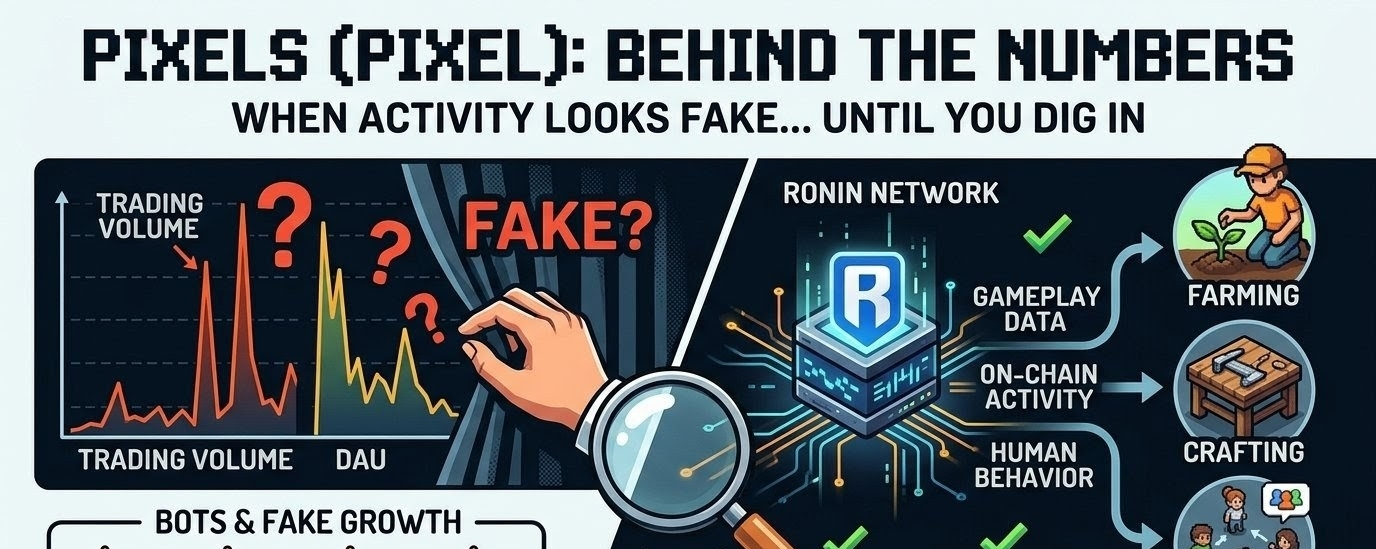
I’ll be honest when I first looked at Pixels, I didn’t buy it.
Not even a little.
A pixel-art farming game… somehow pushing serious trading volume? Yeah, I’ve seen this movie before. It usually ends with fake activity, incentive abuse, and a chart that looks great until it doesn’t.
So the gut reaction was simple: this is inflated.
Because let’s be real most of the time in Web3, if the numbers look weird, they are weird.
But here’s where things started to get interesting.
Instead of staring at exchange data (which, honestly, you should never fully trust anyway), I went to where the actual activity lives: the Ronin Network.
And that changes the lens completely.
Ronin isn’t some random chain full of yield farms and looping trades. It’s built for games. So when transactions happen, they usually tie back to actual gameplay.
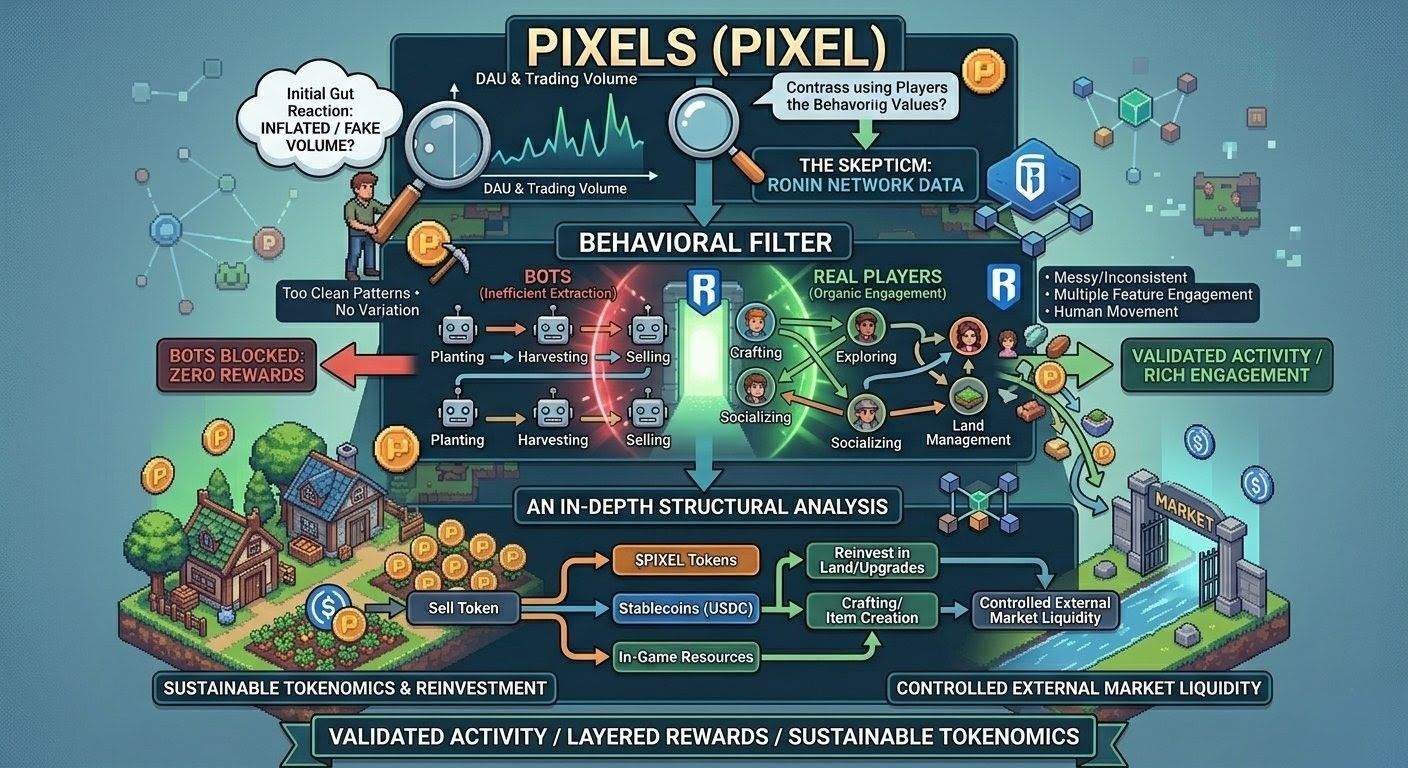
People planting stuff. Harvesting. Crafting. Trading items. Moving around land.
It’s messy. It’s inconsistent. It looks… human.
And that matters more than people think.
Because bots? Bots are clean. Too clean. They repeat the same loop perfectly. No variation. No weird behavior. Just pure optimization.
And yeah Pixels had bots. A lot of them early on. No point pretending otherwise.
But instead of doing the usual “ban wave and hope for the best,” they went a different route.
They changed how rewards work.
That’s the real story here.
There’s this layered system people call it “stacked,” which is a decent way to describe it. It doesn’t just check if you’re active. It watches how you’re active.
Like:
Do you move around naturally, or follow the exact same path every time?
Do you engage with multiple parts of the game, or just grind one loop?
Do your sessions look like a person playing… or a script running?
And here’s the thing bots can fake activity, but they struggle to fake behavior over time.
So instead of instantly banning them, the system just… cuts them off.
No rewards.
That’s it.
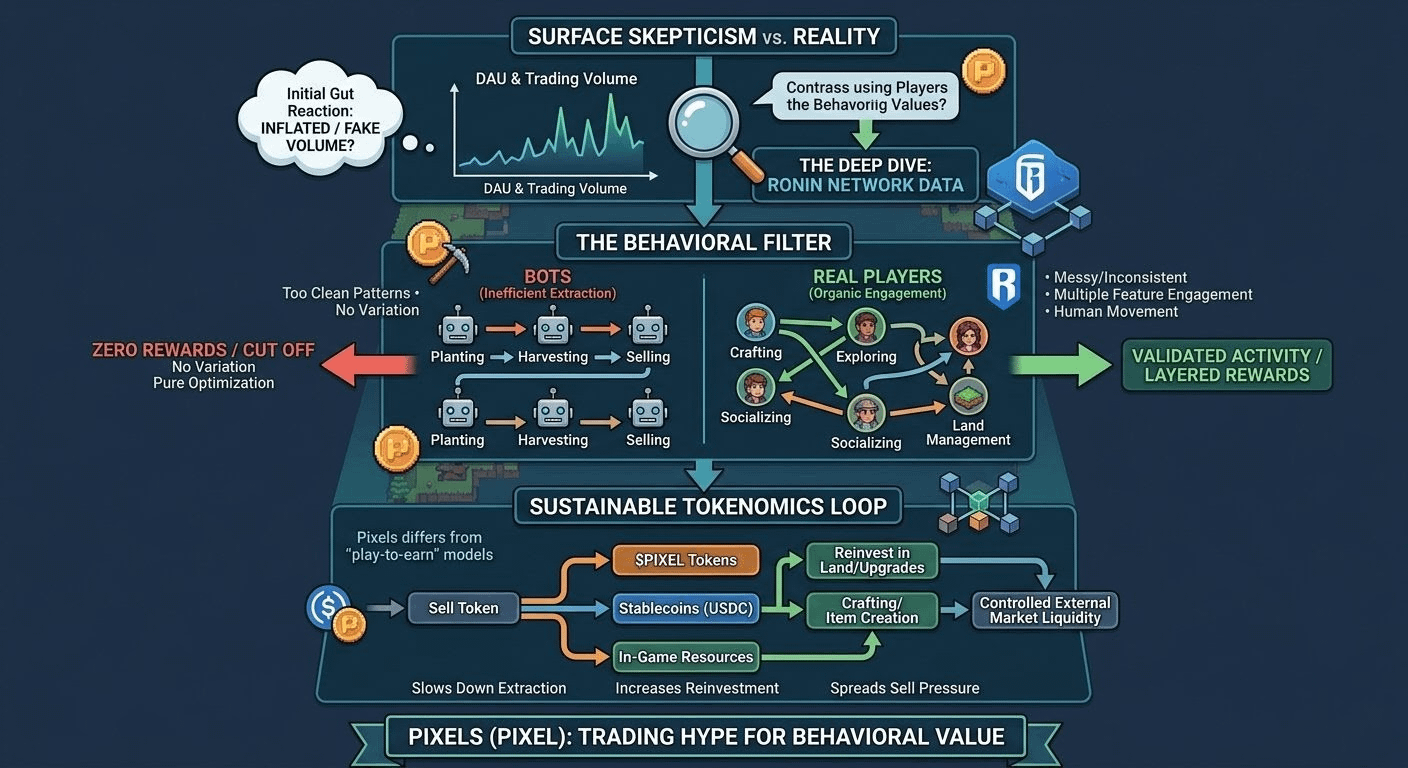
And once the rewards stop, bots don’t stick around. Why would they?
This is where things get a bit counterintuitive.
You start seeing DAU numbers drop.
Normally, that’s bad. Like, really bad.
But here? It’s actually a good sign.
Because what’s really happening is simple: the game is trimming the fat.
Fewer bots. Fewer low-quality users.
What’s left? People who are actually playing.
So yeah, the number goes down. But the quality goes up.
People don’t talk about this enough, but raw DAU in Web3 games is kind of a useless metric if you don’t know who those users are.
Pixels seems to understand that. Most projects don’t.
Now let’s talk about the part where most games completely fall apart the rewards.
You already know the standard loop:
Play → earn token → dump token → repeat
It’s efficient. It’s also a slow-motion collapse.
Because everyone’s extracting. No one’s really participating.
Pixels tries to break that loop. Not perfectly but in a way that actually makes sense.
Instead of just handing out PIXEL tokens like candy, they mix things up:
Some rewards come in stablecoins
Some come as in-game resources
Some are tied to deeper gameplay, not just showing up
At first, that sounds like a small tweak. It’s not.
It changes player behavior.
Because now you can’t just farm and instantly dump everything. You end up reinvesting. Upgrading land. Crafting items. Getting pulled deeper into the system.
It slows things down.
And slowing things down, in this context, is a good thing.
Fast extraction kills games. Every time.
This doesn’t eliminate sell pressure nothing does but it spreads it out. Makes it less brutal.
And honestly, this is where Pixels gets it right in a way most Web3 games don’t.
They’re not trying to win with graphics.
Because… they can’t. And they know it.
Let’s not pretend here this isn’t a AAA experience. It’s simple. Almost basic.
But here’s the thing graphics don’t matter nearly as much in Web3 as people think.
Economics matter.
A lot more.
I’ve seen beautifully designed games collapse because the token model was broken. And I’ve seen simple games stick around because the economy actually worked.
Pixels is clearly betting on the second path.
And so far? It’s holding up.
Not perfectly. Not permanently. But it’s holding.
Now, before this starts sounding like a love letter it’s not.
There’s still real risk here.
High volume cuts both ways.
Yeah, it means there’s liquidity.
But it also means people can exit fast.
Really fast.
If sentiment shifts, if rewards feel weaker, if players get bored or find something better money doesn’t hesitate. It leaves.
And when it leaves, it leaves hard.
That’s the part people like to ignore.
Strong mechanics don’t make something bulletproof. They just give it a better shot at surviving.
Pixels isn’t some final answer to Web3 gaming.
But it is… different.
Instead of inflating user numbers, it filters them.
Instead of dumping tokens into the system, it controls distribution.
Instead of ignoring bots, it makes them irrelevant over time.
That doesn’t guarantee success.
But it does make the current activity harder to dismiss as fake.
And honestly? In this space, that alone is saying something.
So yeah I started out skeptical.
Still am, to a degree.
But after actually digging into how this thing works… I get it now.
Just don’t forget what works today can break tomorrow.
So if you’re watching this, don’t watch the hype.
Watch the behavior.
That’s where the truth shows up.
