
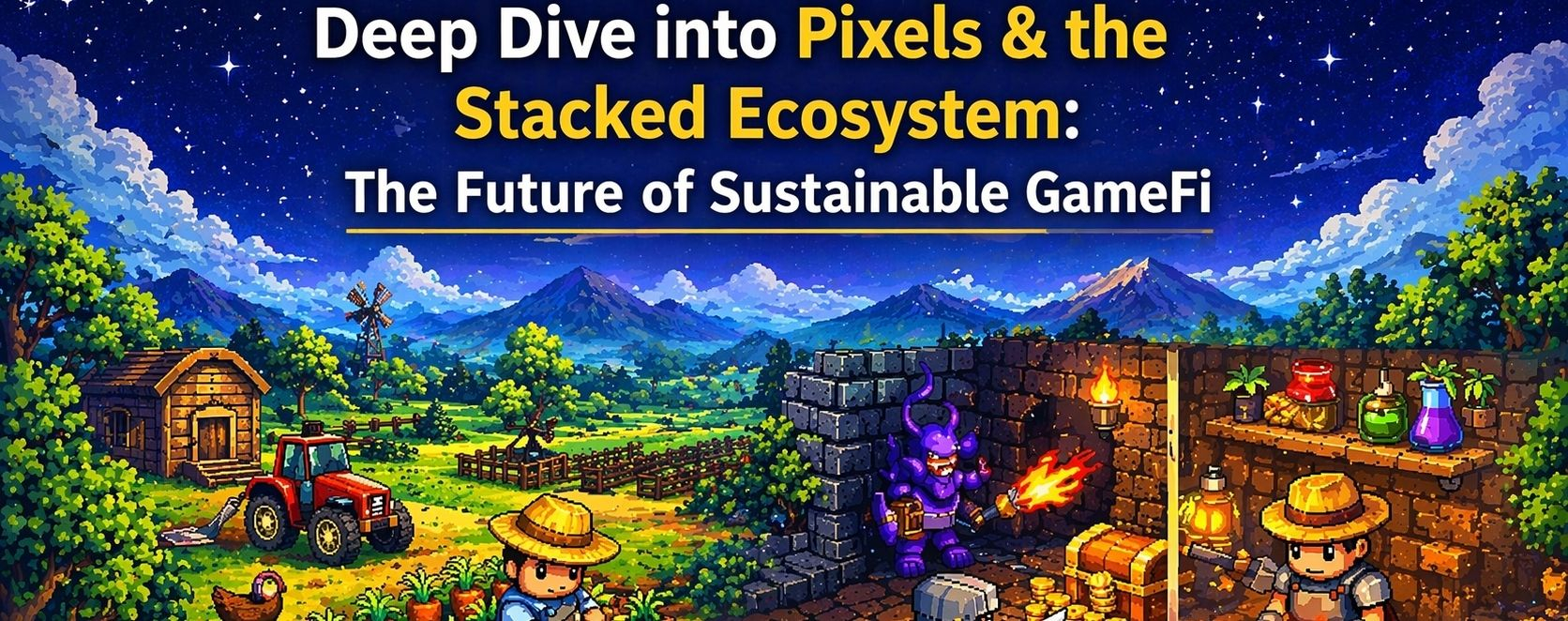
The evolution of Web3 gaming has reached a pivotal stage, and Pixels stands out as one of the most structurally sound and economically sustainable ecosystems in this space. Unlike traditional play to earn models that often collapse due to inflationary tokenomics, Pixels introduces a “Stacked” ecosystem a layered economic design that integrates resource generation, utility sinks, and player-driven market dynamics.
At its core, Pixels is not just a farming game. It is a carefully engineered economic simulation where each player contributes to a decentralized production chain. Farming, crafting, trading, and battling are not isolated activities they are interconnected loops that continuously recycle value within the system. This creates long term engagement rather than short term extraction.
The role of $PIXEL is particularly important. Instead of being just a reward token, it functions as a core utility asset powering upgrades, facilitating trades, and enabling participation in higher level gameplay. This multi layered demand reduces sell pressure and helps stabilize the in game economy over time.
From a systems design perspective, the Stacked model addresses one of the biggest challenges in GameFi: sustainability. By introducing effective resource sinks (such as crafting costs, land upgrades, and progression mechanics), Pixels ensures that value is continuously reinvested rather than extracted from the ecosystem.
Additionally, the integration of social and competitive mechanics particularly through guild coordination and tower battles adds another layer of retention. Players are motivated not only by earning potential but also by progression, competition, and digital asset ownership.
In conclusion, Pixels is not just another GameFi project. It represents an evolving economic ecosystem where PIXEL acts as the backbone of a balanced and scalable system. If this model continues to develop, it could set a new standard for the future of decentralized gaming.