
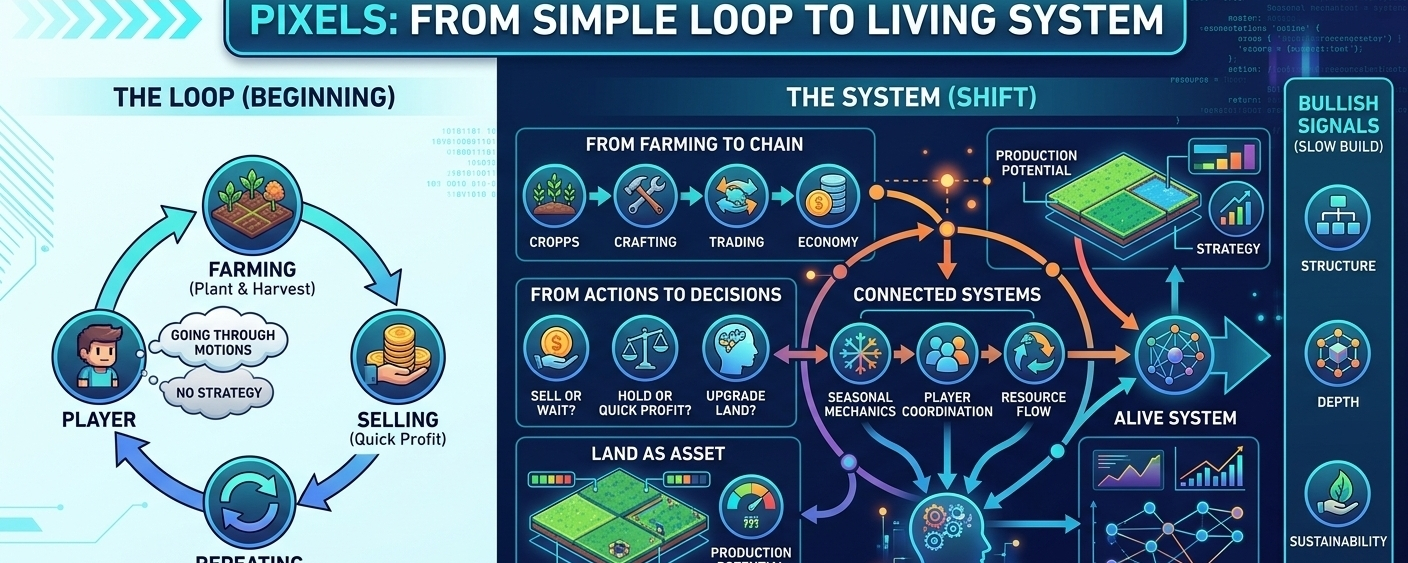
At the beginning, everything feels familiar.
A small piece of land, some seeds, a bit of time… and then the usual cycle: planting, harvesting, selling.
If you’ve played any Web3 game before, Pixels initially looks the same just another loop built on repetition.
But the real story doesn’t start there.
The real story begins when you realize it’s no longer just a loop… it’s slowly becoming a system.
🔄 From Loop to System The Moment Things Change
I didn’t notice it immediately.
I was playing like everyone else. Grow, sell, repeat. No deeper thinking, no real strategy just going through the motions.
Then something subtle shifted.
I stopped selling everything instantly.
Not because I planned it… but because I started noticing patterns. Some items moved faster. Others gained value over time. Holding sometimes made more sense than selling.
That’s when a new layer appeared:
Timing started to matter.
And that’s when it clicked
👉 This isn’t just a reward loop.
👉 This is a live system.
🌾 Farming Is No Longer Just Farming
Once you begin to see the system, everything changes.
Farming used to mean just growing crops.
Now it becomes an input.
Crops feed into crafting
Crafted items move into trading
Trading shapes the economy
You’re no longer just farming… you’re participating in a chain.
And that’s where Pixels stands out.
Nothing feels isolated.
Everything connects.
🧠 From Actions to Decisions Where the Real Game Begins
Most games teach you what to do.
Pixels slowly starts teaching you how to think.
That shift is everything.
Should I sell now or wait?
Is holding more valuable than quick profit?
Do I focus on farming or crafting?
Is upgrading land the smarter long-term move?
These aren’t just actions anymore.
They’re decisions.
And decisions turn a game into a system.
🏡 Land Not Just Space, But Capacity
At first, land feels like just a place to play.
But as you understand the system, it becomes an asset.
It defines:
Your production potential
Your efficiency
Your long-term positioning
That’s another key shift
👉 Space becomes strategy.
🔗 Connected Systems Depth Without Overcomplication
What makes Pixels interesting is that it doesn’t create depth by adding complexity.
It creates depth through connection.
Recent updates make this clearer:
Seasonal mechanics
Player coordination
Resource flow
These don’t feel like separate features.
They flow into each other.
The result?
👉 The game doesn’t feel optimized
👉 It feels alive
⚖️ The Balance Where Most Games Break
This is where things get tricky.
Once a game becomes a system, player behavior changes.
You start:
Thinking more
Planning more
Sometimes over-optimizing
And that’s where most games fail.
The two extremes:
Too much efficiency
👉 Curiosity disappears
👉 The game feels like work
Too much openness
👉 Direction disappears
👉 Engagement fades
Pixels is currently sitting right between these two.
And that’s exactly what makes it interesting.
🔍 Organic Discovery Nothing Feels Forced
Pixels doesn’t force complexity on you.
It lets you discover it.
You naturally start understanding:
Which strategies work
When timing matters
Where patience pays off
This kind of learning feels organic.
And that keeps players engaged longer.
🌐 A Reactive Economy Not Static, But Alive
The economy in Pixels isn’t fixed.
It reacts to:
Player behavior
Supply and demand
Market timing
You’re not just earning.
You’re observing.
And observation itself becomes an advantage.
🚀 Why This Feels Bullish (Without the Hype)
The bullish case for Pixels isn’t based on hype.
There’s no loud narrative pushing it forward.
Instead, something quieter is building:
👉 Structure
👉 Depth
👉 Sustainability
These are the foundations that don’t show immediately…
But tend to matter the most over time.
This is a slow build.
And slow builds often become obvious all at once.
🔮 The Road Ahead If This Direction Continues
If Pixels keeps evolving this way:
The player-driven economy can mature further
Decision-making will become even more meaningful
Social coordination could become a major layer
And most importantly
👉 Players won’t just play for rewards
👉 They’ll play to understand and master the system
💭 Final Thought Where the Real Value Is
The real value in Pixels isn’t in what you do.
It’s in how you think while doing it.
That difference is subtle…
But powerful.
If the game maintains this balance
Not too rigid
Not too loose
It won’t just remain a Web3 game.
It can become a true ecosystem.
📌 Conclusion
Pixels isn’t perfect.
But it’s evolving.
And more importantly
👉 It’s evolving in the right direction.
The transition from loop to system is where most games break.
Pixels is currently standing at that edge.
And that’s exactly what makes it worth watching.