
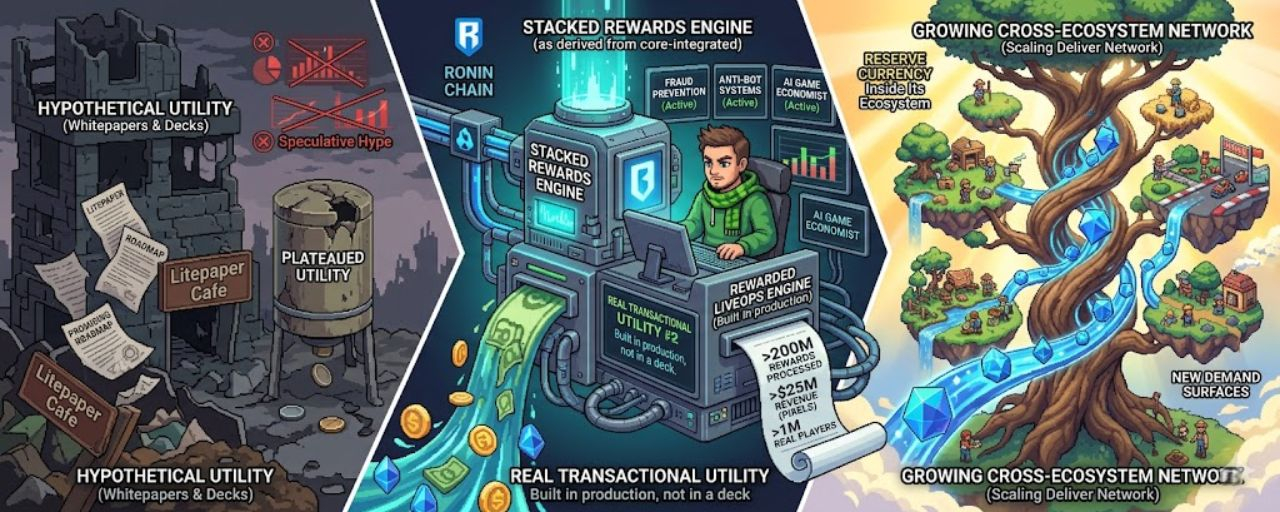
Most theses are built on whitepapers, roadmaps, and promises from teams who have never shipped anything real. I have read hundreds of them. Most age poorly.
But every once in a while, a token comes along where the thesis is not built on what might happen it is built on what already has.
@Pixels Pixel is that token. And I want to walk you through exactly why, from the perspective of someone who studies markets for a living.
Pixel a Cross-Ecosystem Currency
With the launch of Stacked the rewarded LiveOps engine built by the Pixels team pixel repositioned as something far more significant: a cross-game rewards and loyalty currency that powers an entire growing network of titles.
Every game that plugs into Stacked becomes a new demand surface for $PIXEL. Every player earning rewards across those games touches $PIXEL. Every studio running reward campaigns through Stacked infrastructure creates new utility for the token not hypothetical utility written in a litepaper, but real transactional utility happening inside live games with real players.
This is the difference between a token tied to one restaurant and a token that powers an entire food delivery network. The second model scales. The first one plateaus.
From a Forex perspective, I think of it like this: pixel from a single currency pair to becoming a reserve currency inside its own ecosystem. That kind of structural shift in utility is exactly what long term value is built on.
The $25 Million That Proves It Works
Now here is where the thesis stops being a story and starts being evidence.
Stacked powered systems have already contributed to over $25 million in revenue inside the Pixels ecosystem. Two hundred million rewards processed. Millions of real players. Real retention numbers. Real economic activity.
I cannot stress enough how rare this is in crypto.
Most tokens asking you to believe in a cross ecosystem vision have zero proof of concept. They have decks. They have Discord announcements. They have token unlocks scheduled and advisory boards listed.
Pixels has $25 million in actual, measurable revenue generated by the exact infrastructure that pixel inside of.
That is not a promise. That is a receipt.
When I evaluate any asset whether it is a currency pair, a commodity, or a crypto token, I ask one question before anything else: is there real economic activity behind this, or is this purely speculative positioning?
Pixel swer. And the answer is $25 million.
The Infrastructure Moat
What makes this even more compelling is the nature of what Stacked built to get there.
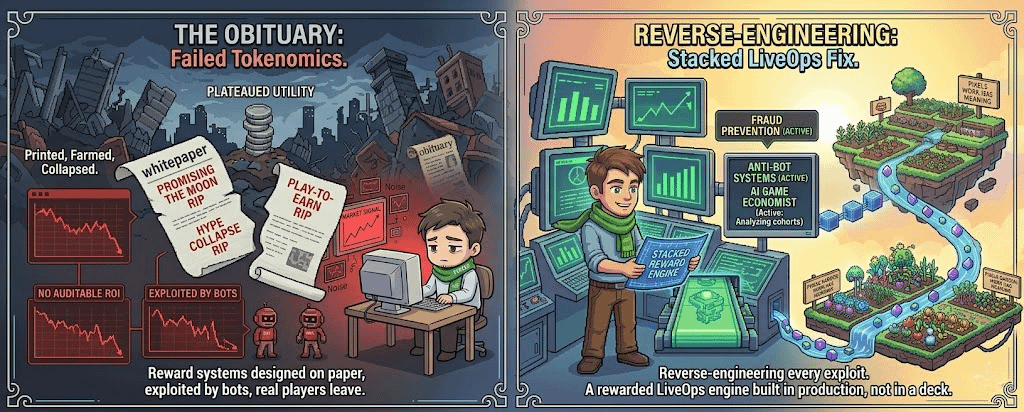
Fraud prevention. Anti bot systems. Behavioral data at scale. An AI game economist that analyzes player cohorts and surfaces reward experiments worth running. These are not features you build in a weekend hackathon. They take years of live adversarial usage to develop.
Most teams can ship a quest board. Very few can build a reward system that survives real exploitation at scale.
Stacked already has. That infrastructure is the moat protecting the pixel being easily replicated by a competitor next quarter.
Why This Matters Right Now
The broader crypto gaming market is waking up again. Studios are looking for infrastructure partners who have proven systems, not just compelling pitches. Stacked is entering that conversation with something nobody else has: a working product, a proven economy, and a token already embedded in a live cross game rewards network.
Every new studio that joins Stacked is a new source of pixel player earning rewards across that network is a new participant in the pixel.
pixel dollar of revenue that runs through Stacked infrastructure is evidence that the thesis holds.
I farm in Pixels every morning before I open a chart. Not because it is a game. Because it is the clearest proof I have found in this market that someone actually built what they said they would build.
The $25 million is not a milestone. It is a foundation.
Real rewards. Real economy. Real receipts.
pixels on Binance Square $PIXEL #pixel
