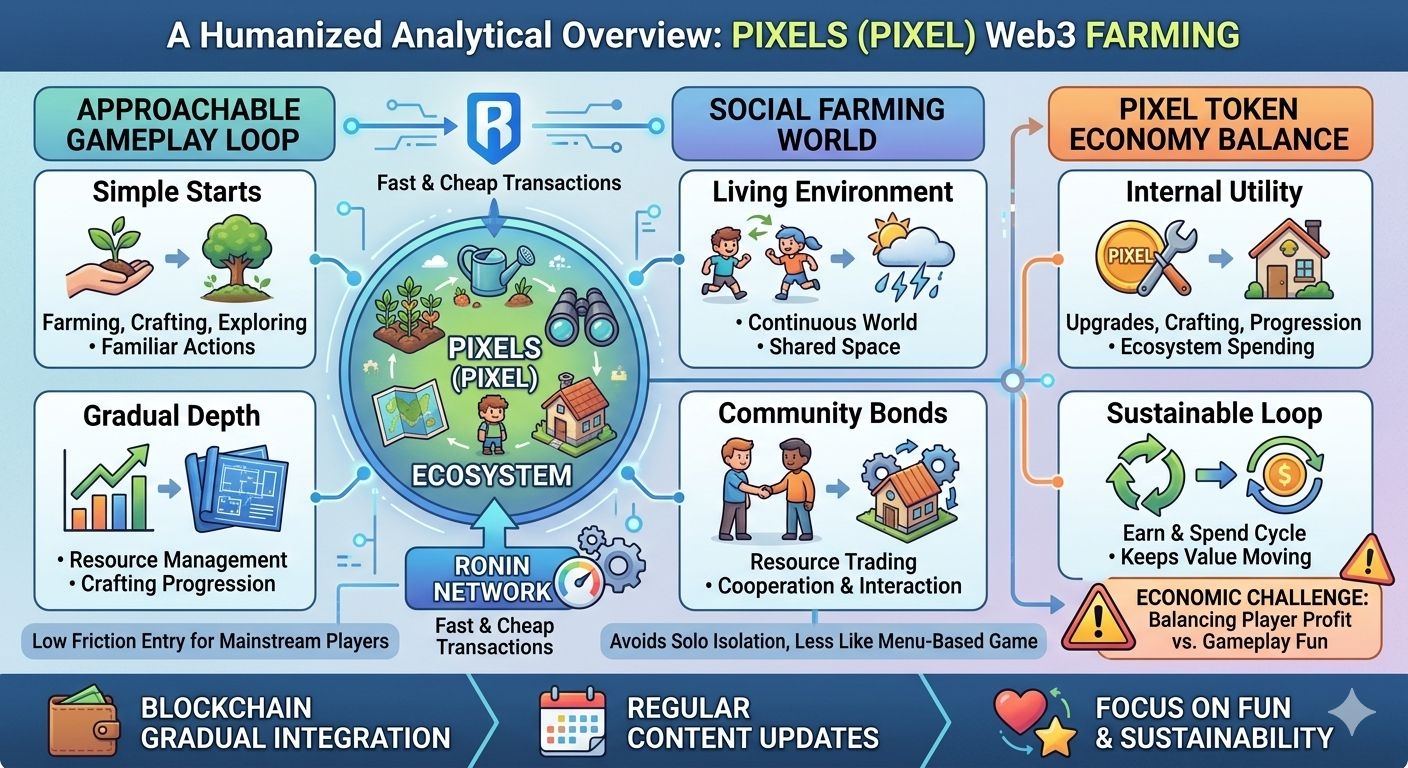
Pixels (PIXEL) is a Web3 game that mixes simple farming gameplay with blockchain ownership in a way that feels surprisingly approachable.
Instead of forcing players into complex crypto systems, it quietly builds those systems underneath familiar game actions like planting, harvesting, and exploring.
The game runs on the Ronin Network, which is known for keeping transactions fast and cheap for users.
This technical choice matters because it removes a lot of the friction that usually turns new players away from blockchain games.
At its heart, Pixels feels like a living online farming world rather than a purely financial experiment.
Players don’t just log in to earn—they actually move through a shared space that keeps changing based on what everyone is doing.
The open-world structure makes the experience feel less like a menu-based game and more like a continuous environment.
You can walk around, meet other players, and interact with different parts of the world instead of staying isolated in your own space.
One of the strongest parts of Pixels is how it builds social connections between players.
People often visit each other’s farms, trade resources, and cooperate on small in-game goals that naturally create interaction.
These social moments are not just decoration; they actually shape how the game feels over time.
When players depend on each other, the world starts to feel more alive and less like a solo farming simulator.
The PIXEL token is tied into the game economy in a way that tries to feel useful rather than purely speculative.
Instead of existing only as a reward, it is used inside the game for upgrades, crafting, and progression systems.
This design helps create a cycle where players earn tokens and also spend them back into the game world.
The idea is to keep value moving inside the ecosystem instead of letting it flow out too quickly.
Still, balancing this economy is not easy at all.
If rewards become too generous, players may start focusing only on profit instead of enjoying the gameplay itself.
On the other hand, if rewards feel too small, players might lose interest and stop playing altogether.
Finding the right middle ground is something most Web3 games struggle with, and Pixels is no exception.
The gameplay itself is intentionally simple, which helps new players settle in quickly.
Farming, crafting, and exploring are easy to understand, even if someone has never used crypto before.
As players progress, more systems gradually open up, including deeper resource management and crafting options.
This slow introduction helps avoid overwhelming people in the early stages of the game.
Another important part of Pixels is how it tries to keep the world active over time.
Live events, updates, and community activities are needed to stop the gameplay from feeling repetitive.
Without regular changes, farming-based games can start to feel predictable after a while.
Pixels depends on ongoing development to keep players curious and engaged in the long run.
In the wider Web3 gaming space, Pixels sits in a more balanced position than many earlier projects.
It does not rely only on hype or financial excitement, but instead tries to build a real game loop first.
This approach reflects a shift in the blockchain gaming industry toward more sustainable designs.
Developers are increasingly learning that fun gameplay has to come before token rewards if they want long-term survival.
From a user perspective, Pixels is relatively easy to enter compared to many other blockchain games.
Players can start without deep technical knowledge, which helps lower the barrier for mainstream audiences.
The blockchain elements are introduced gradually, so they feel like part of the experience rather than a separate system.
This makes the transition into Web3 gaming feel smoother and less intimidating.
Overall, Pixels (PIXEL) stands out because it tries to blend comfort, community, and ownership in one shared world.
Its future will depend on how well it can maintain balance between gameplay enjoyment and economic stability as it grows.