
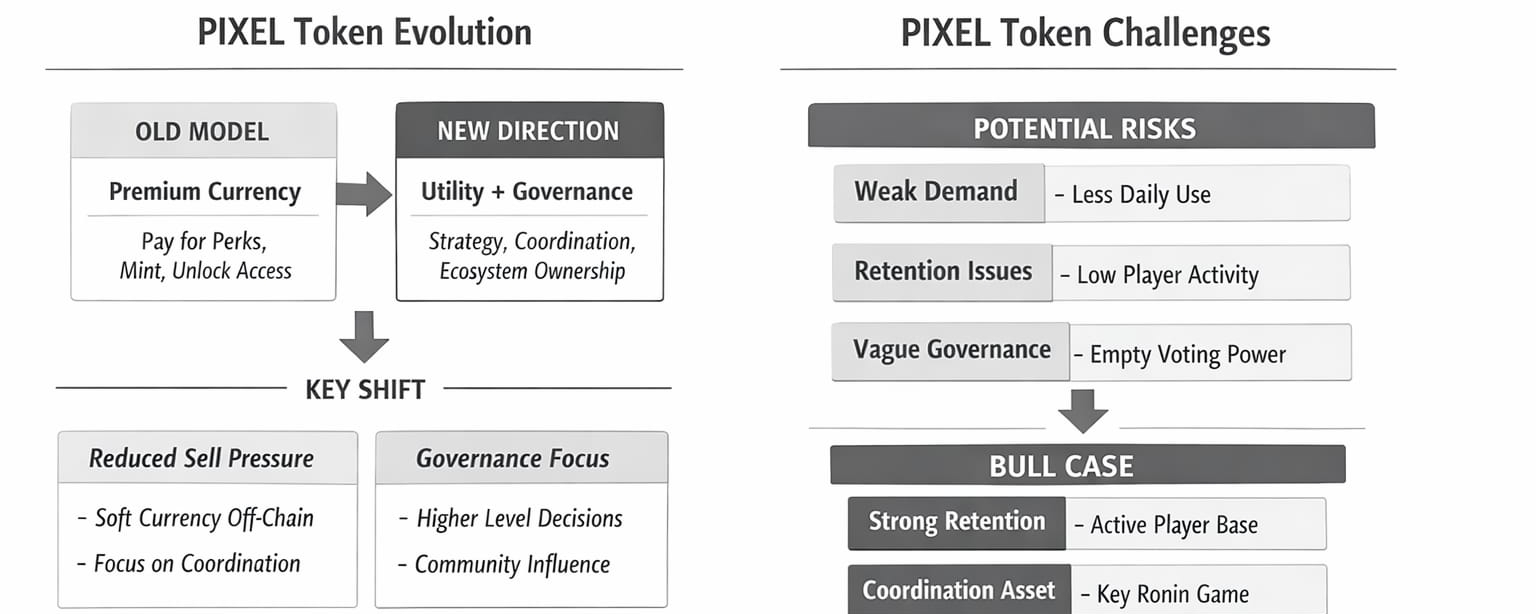

@Pixels i stopped looking at PIXEL like a normal premium game token the day I realized most of the real economic tension in Pixels had moved somewhere else. I was checking the token page, then reading through how Chapter 2 changed the loop, and it hit me that the old “pay for perks, mint stuff, unlock access” framing no longer explained the whole asset. That version still exists, sure. But it doesn’t feel like the center anymore. What I’m seeing now is a token trying to grow out of its premium currency skin and into something closer to governance, coordination, and higher-level ecosystem ownership.
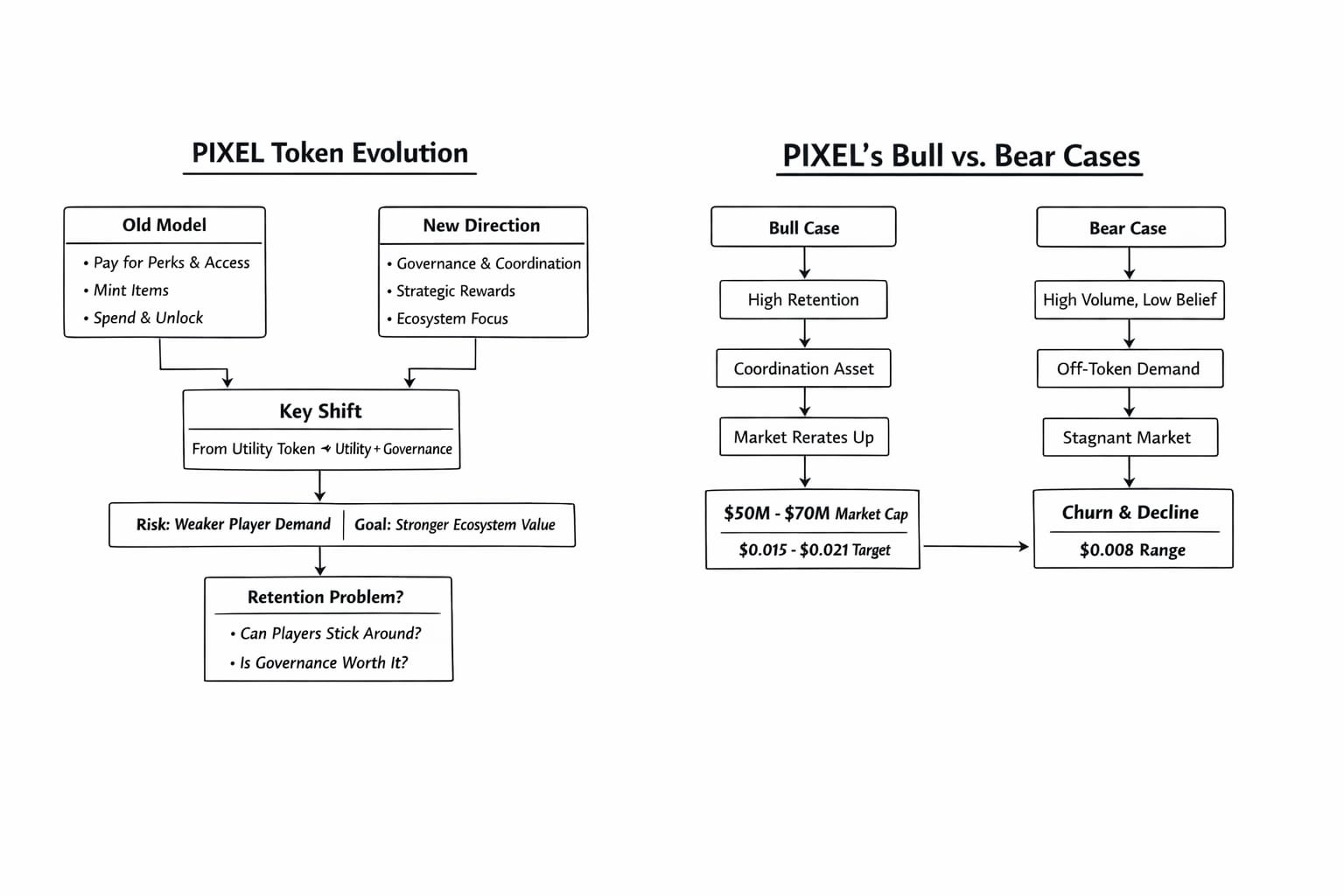
That shift matters more than people think. Premium currency gets valued like a spend chip. You ask how often players need it, what sinks keep demand alive, whether cosmetic and access demand can offset emissions. Governance gets valued differently. Not magically better, just differently. The token starts leaning on whether holders believe the world is worth shaping, not just spending in. PIXEL today is still a utility token, but market descriptions now increasingly label it as utility plus governance, and that tells you where the project wants the narrative to go.
The current numbers make this setup interesting. PIXEL is trading around $0.0087 to $0.0088, with a market cap close to $29 million, roughly 3.38 billion tokens circulating, a 5 billion max supply, and about $32 million in 24 hour trading volume on Binance’s price page. CoinMarketCap is in the same zone. In practice, that means this thing trades nearly its own market cap in a day. That’s not quiet conviction. That’s a token being actively churned, tested, flipped, and constantly repriced by a market that still hasn’t fully decided what it is.
Now here’s the thing. I actually think the design direction makes sense. Pixels itself says Chapter 2 was meant to protect PIXEL by requiring more strategy and cooperation for token rewards while moving the inflation-heavy soft currency off-chain to reduce sell pressure and simplify the game economy. That’s a serious choice. It means they’re trying to stop the main token from being chewed up by low-quality daily extraction. In simple terms, they’re separating the arcade tickets from the thing that’s supposed to matter more. Good. Because too many game tokens die from being used for everything and respected for nothing.
But this is also where my caution kicks in. If you reduce PIXEL’s role in the everyday grind too much, you can accidentally weaken direct transactional demand before governance demand is real enough to replace it. That’s the tradeoff. Cleaner token design can make the economy healthier, but it can also make the token feel more distant from ordinary player behavior. And governance, let’s be honest, is one of the most abused words in this market. A token does not become valuable just because people say holders can vote. It becomes valuable if the thing being governed is active, sticky, and worth caring about.
That’s why the Retention Problem still sits right in the middle of this trade. Not downloads. Not social chatter. Not a temporary gameplay spike after a patch. Retention. Do players keep showing up when rewards get harder, when coordination matters more, and when the easy farming loop is gone? If they do, PIXEL’s move toward governance starts to look smart because the token gets attached to a living world instead of a disposable reward cycle. If they don’t, then governance becomes a fancy label sitting on top of fading engagement.
The bull case is not crazy. At roughly $29 million market cap and about $43 million fully diluted value, PIXEL does not need absurd assumptions to rerate. If the market starts treating it as the coordination asset of a still-relevant Ronin game, and retention proves stronger than the usual GameFi decay curve, I can see a move back toward a $50 million to $70 million market cap. That roughly points to something around $0.015 to $0.021 on current circulating supply. Not moon math. Just a different multiple on the same asset.
The bear case is simpler, and honestly more common. Volume stays high, belief stays shallow, gameplay demand shifts off-token, governance stays vague, and the market keeps treating PIXEL like a churn-heavy gaming coin with a cleaner story than actual follow-through. In that case, cheap stays cheap.
So don’t trade the label change by itself. Trade the proof. Watch whether players stay. Watch whether the token’s higher-level role becomes tangible. Watch whether this world creates people who want influence, not just rewards. If you’re looking at PIXEL here, make it earn your conviction, because the market won’t pay up for a new identity until the behavior underneath it stops looking temporary.