
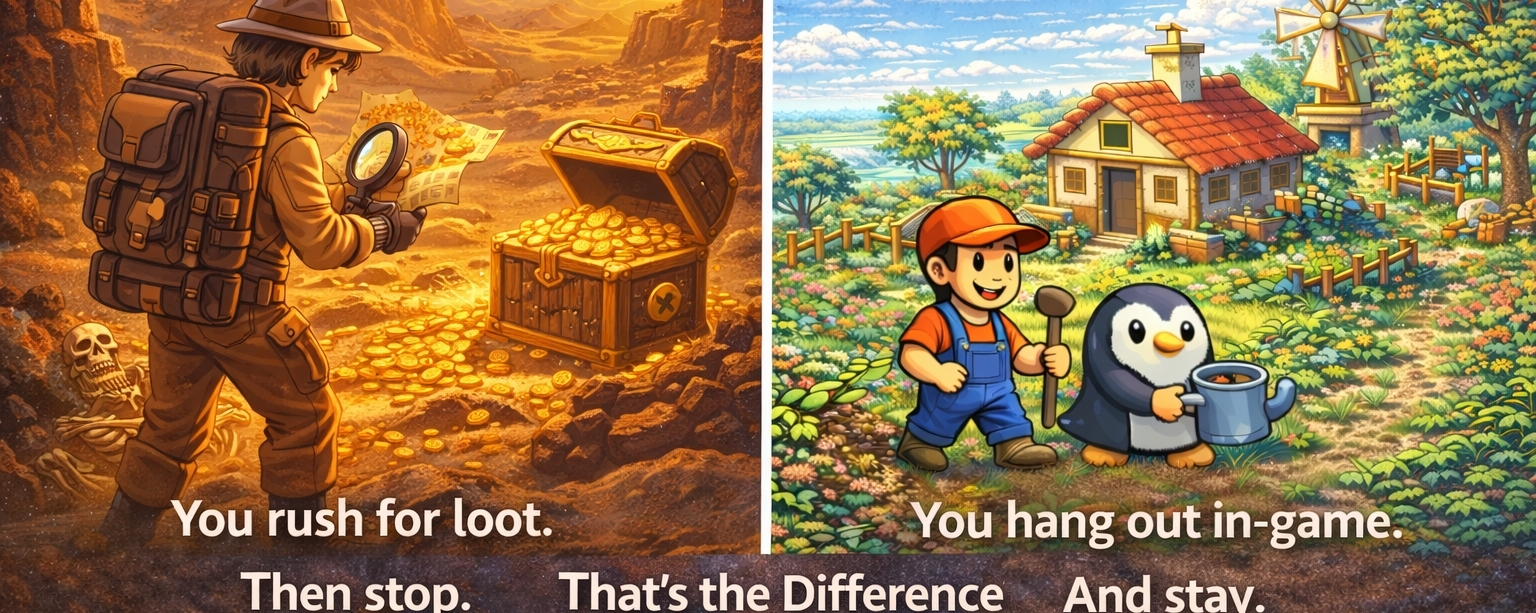

Most Web3 games don’t lose you slowly. They lose you the moment you understand them. You open the game, spend a few minutes exploring, and suddenly the entire loop becomes clear. Do this, earn that, repeat. It’s efficient… but it’s also predictable. And once something feels predictable, it stops feeling interesting. That’s been the pattern for a long time.
So when I came across Pixels again, I wasn’t expecting anything different. Another farming game, another token loop, another system trying to keep users through incentives. But something didn’t match that expectation. Because Pixels didn’t try to explain itself. There was no immediate pressure to understand mechanics or optimize strategies. I just started playing. Walking around, planting crops, interacting with the environment, slowly figuring things out without thinking too much about it. And that’s when I realized something.
I wasn’t trying to “figure the game out.” I was just… playing it. That’s a rare feeling in Web3.
Most projects demand your attention before they earn it. They want you to understand everything upfront. Tokens, systems, loops, rewards. You’re expected to think before you feel. Pixels flips that completely. It lets the experience come first.
The gameplay loop is simple, almost familiar. Farming, collecting, trading, exploring. It doesn’t overwhelm you, and it doesn’t rush you either. It just gives you enough to stay engaged without forcing you to overthink. And because of that, time starts to pass differently. You don’t measure it in rewards or efficiency. You measure it in how long you stayed without realizing it. That’s where the real difference is.
In most Web3 games, the economy leads everything. The gameplay exists to support extraction. And when rewards slow down, engagement disappears just as quickly. Pixels doesn’t feel built around that same urgency. The economy is there, but it feels secondary. It grows around the experience instead of controlling it. You’re not constantly asking, “What do I earn next?” You’re just doing things… and value forms naturally around that behavior. That changes the entire dynamic.
Because when people stay for the experience, the economy becomes more stable. It’s not driven purely by short-term incentives. It’s supported by actual engagement. Another thing that stands out is how seamless everything feels. Pixels runs on Ronin, but you barely notice it. There’s no constant friction, no interruptions reminding you that you’re interacting with blockchain infrastructure. It stays in the background, where it belongs. And that’s probably one of the most important decisions. Because the next wave of users won’t come for technical innovation. They won’t stay because something is on-chain.
They’ll stay because something feels good to use.
Pixels seems to understand that.
It’s not trying to educate users about Web3. It’s trying to remove the need for that entirely. Still, there are questions that can’t be ignored. Can a simple loop like this hold attention over a long period of time? Will the economy remain balanced as more users enter and start extracting value? Can it avoid the usual cycle where early engagement fades once incentives shift? Those challenges are real. But Pixels feels like it’s solving the right problem first. Not how to make Web3 games more complex. But how to make them feel normal. Because if Web3 gaming is going to work, it won’t come from systems that demand attention. It will come from experiences that quietly keep it. And that’s what Pixels is getting closer to. Not by doing something louder. But by doing something simpler… and actually making people stay.
