
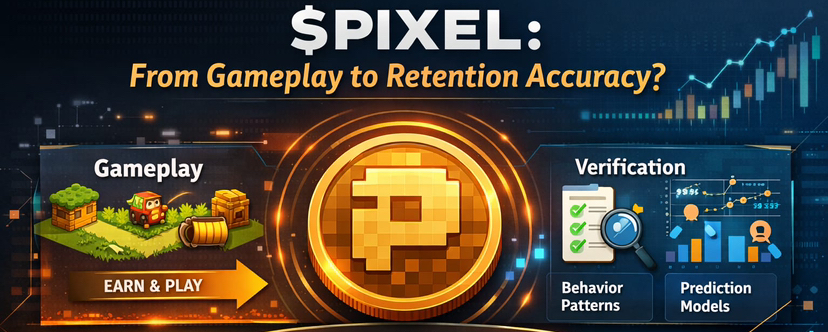
I used to think retention in games was mostly about content. More features, more loops, more reasons to stay. But after watching how some of these systems behave over time, it starts to feel less about what players do, and more about how accurately the system can predict whether they will keep doing it.
At the surface, $PIXEL looks like it’s tied to gameplay. You play, you earn, you progress. The structure feels familiar. But the longer I look at it, the more it seems like the token is quietly attached to something else. Not the activity itself, but the system’s confidence in that activity repeating. That’s a different layer. Harder to see, but probably more important.
Because recording player behavior is easy. Every action, every loop, every reward can be logged. That’s just data. But data by itself doesn’t do much. It sits there. The shift happens when the system has to decide what that data means. Who gets rewarded again. Who stays eligible. Who is no longer worth incentivizing. That’s where things stop being neutral.
And this is where the idea of verification starts to matter more than gameplay. Verification, in simple terms, is just the system checking whether something is true. Did this player complete the task? Did they meet the requirement? But in practice, it becomes more than that. It turns into a filter. Not just checking what happened, but deciding what counts.
Once that layer is introduced, distribution changes too. Token distribution is no longer just movement from system to player. It becomes a decision. A judgment about which behaviors deserve to continue being funded. And that decision depends on how reliable the system believes the player is.
This is where retention accuracy starts to quietly take over. Not retention as a metric, but retention as a prediction problem. The system isn’t just asking “did this player show up?” It’s asking “will they keep showing up in a way that aligns with the system’s expectations?”
That sounds subtle, but it creates pressure. Because now the value of $PIXEL isn’t only tied to what players do, but to how predictable their behavior becomes over time. If a player is consistent, easy to model, easy to rely on, they become easier to reward. Not necessarily because they contribute more, but because they reduce uncertainty.
And uncertainty is expensive for any system that has to distribute value.
The issue is that this doesn’t stay clean when the system scales. At small scale, it feels smooth. Rewards flow. Players feel recognized. But as more players enter, the system has to become stricter. It can’t reward everyone equally. So it leans more heavily on signals. Patterns. Repeatability. Things it can verify quickly without manual checks.
That’s where friction starts to appear, even if it’s not visible. Some players get filtered out without clear explanation. Others keep getting rewarded in ways that seem disproportionate. From the outside, it looks random. But internally, it’s probably just the system prioritizing what it can confidently predict.
And this is where the gap between information and usability becomes obvious. The system might have all the data it needs. Full history of player actions. Complete records. But turning that into decisions that feel fair, consistent, and explainable is much harder.
Because a record is not the same as a claim.
A player’s history is just data. A claim is what the system believes about that data. “This player is valuable.” “This behavior should continue.” Those are not facts. They’re interpretations. And once tokens are distributed based on those interpretations, the system is no longer just tracking activity. It’s shaping it.
This becomes even more complicated when multiple systems start relying on the same signals. If another game or platform starts using $PIXEL-related behavior as a reference point, then the question shifts again. Not just “was this player active?” but “can this behavior be trusted across contexts?”
That’s where trust starts to break or hold.
Because verification inside one system doesn’t always translate cleanly to another. What counts as meaningful behavior in one environment might look irrelevant somewhere else. And if the token is tied to those internal definitions, then its value becomes dependent on how transferable those definitions are.
In theory, credentials or verified records should help here. A credential is just a structured claim about something that happened. But even then, the problem doesn’t disappear. Because another system still has to decide whether it accepts that claim. Whether it trusts the verification process behind it. Whether it sees the same meaning in the data.
So the problem shifts again. From verifying actions to verifying the verification itself.
And this is where the experience for users starts to feel uneven. Repeated checks. Inconsistent outcomes. One platform accepts your history, another ignores it. Eligibility changes without clear reasons. From the player’s perspective, it doesn’t feel like a retention system. It feels like a moving boundary.
All of this makes me question what Pixel is really pricing over time.
It might look like it’s tied to gameplay loops. But underneath, it seems closer to pricing how well the system can identify and maintain reliable participants. Not just who plays, but who behaves in a way that can be continuously verified, predicted, and reused.
And if that’s the case, then the real constraint isn’t content. It’s accuracy. How well the system can turn raw behavior into decisions that hold up under scale, across contexts, and over time.
I’m not sure that’s something players ever fully see. It’s not presented that way. It just shows up indirectly. In who keeps getting rewarded. In who quietly stops mattering.
Which makes me wonder if the system is becoming less about the game itself… and more about how confidently it can decide who is still worth keeping inside it.