
Look, most people talk about Web3 games like they’re stock charts with avatars. DAU up, token up, vibes good. DAU down, panic. That’s the surface. I don’t think that tells you anything useful.
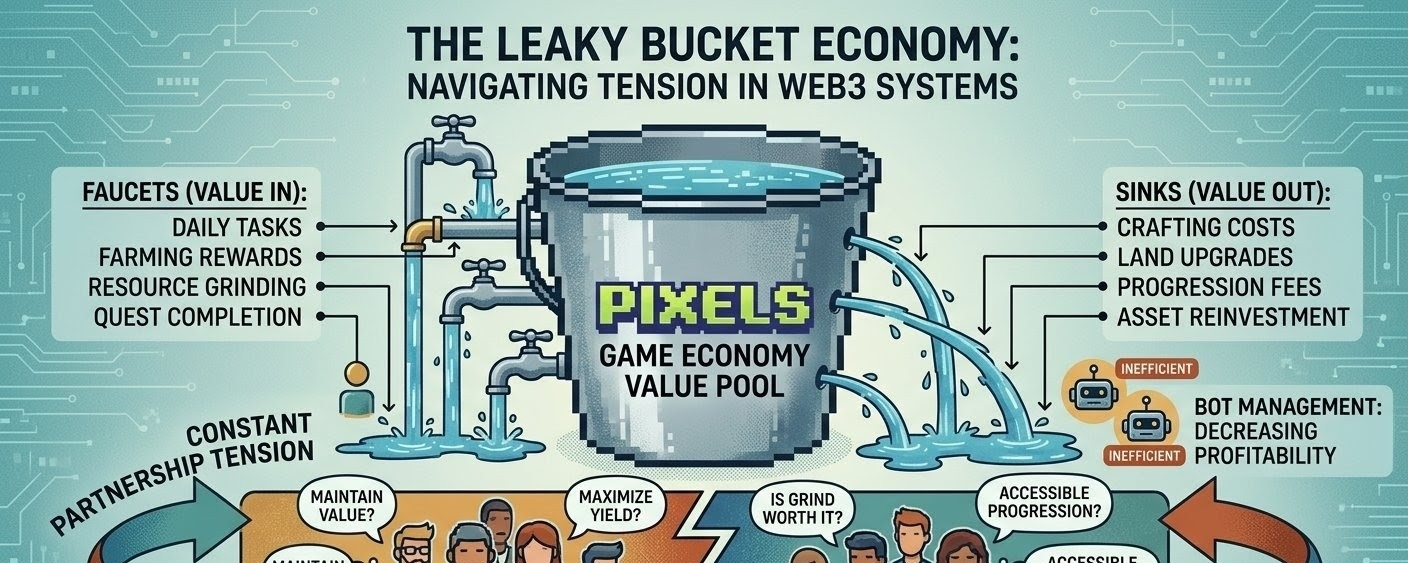
If you actually want to understand something like Pixels, you’ve gotta zoom out a bit and think in systems. I always come back to this one idea it’s basically a bucket with holes. Value comes in through faucets, leaks out through sinks, and the whole game is just… trying not to empty the thing.
Sounds simple. It’s not.
Pixels runs on that exact tension. And honestly, it’s still figuring itself out.
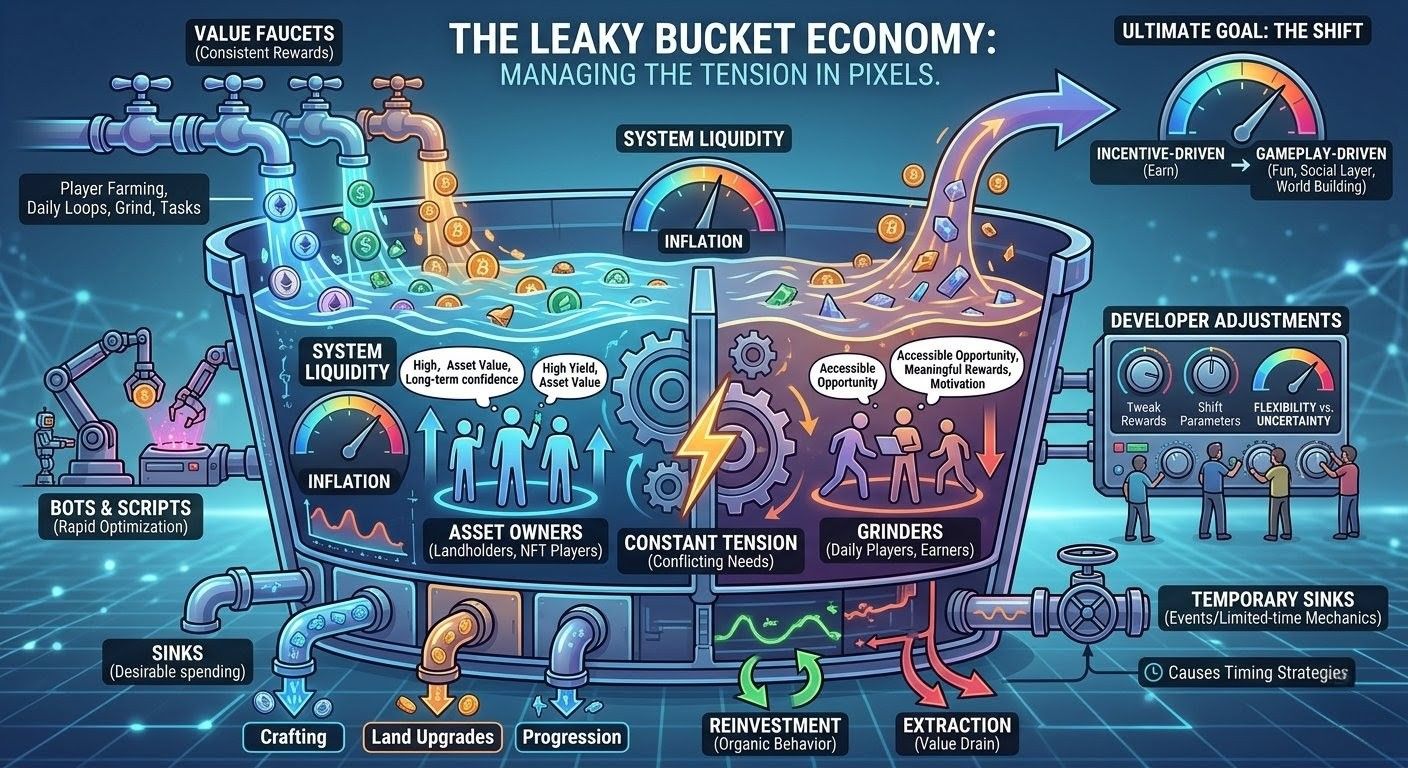
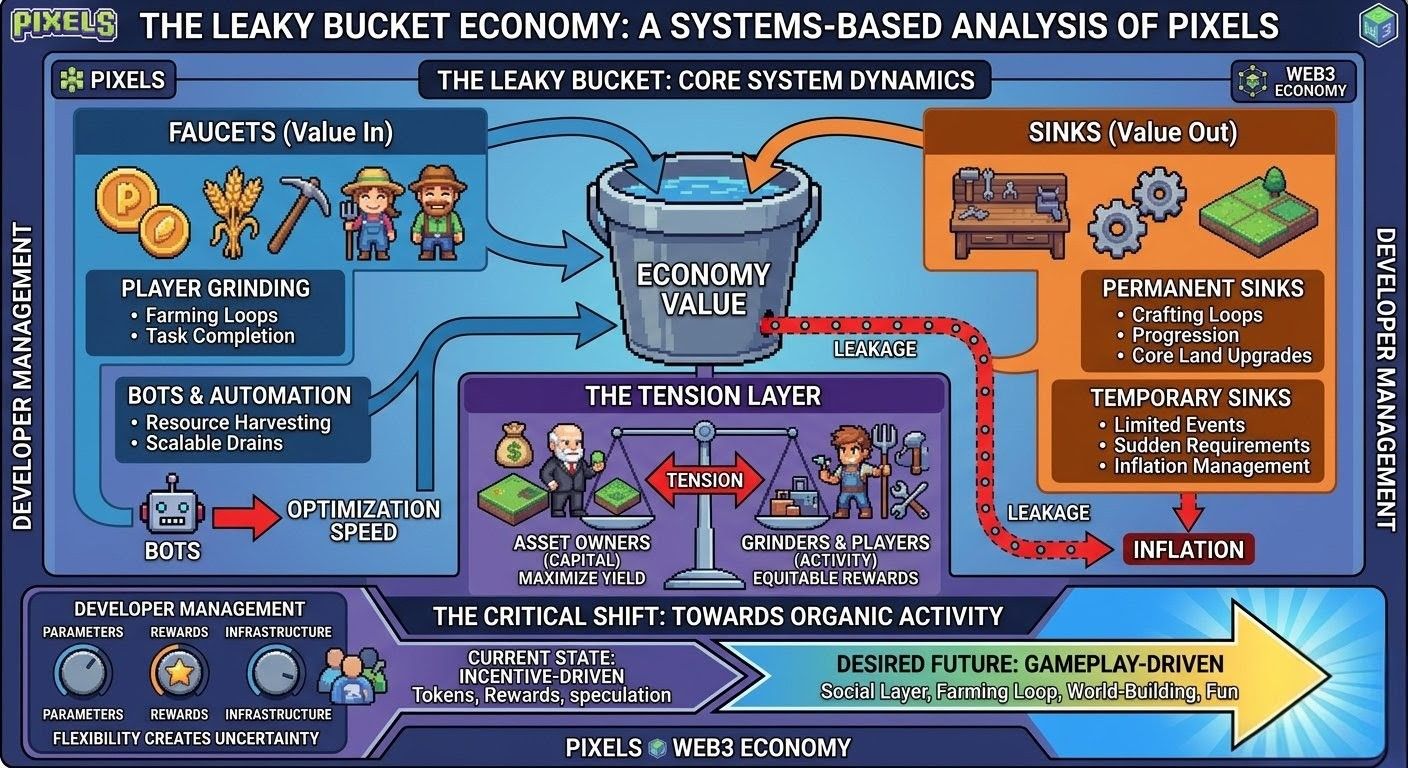
So yeah, faucets first. That’s the easy part. Players farm, grind, complete tasks, do their daily loops boom, rewards come out. Tokens, resources, whatever the system’s pushing. It’s designed to feel consistent. Show up, do the work, get paid.
And that works. At least in the beginning.
But here’s the thing when you tie rewards too tightly to repetitive actions, people optimize. Fast. And not just players. Bots. Scripts. Entire setups built to drain the system as efficiently as possible. I’ve seen this before. It never takes long.
So now you’ve got value pouring in. Constantly. The question becomes where does it go?
That’s where sinks come in. Crafting eats resources. Land upgrades cost real value. Progression isn’t free. You want to move forward? You’ve gotta spend.
On paper, that loop makes sense. Earn → spend → grow → repeat.
But reality doesn’t follow neat loops.
Some players reinvest. Others extract. Some just sit on assets and wait. And unless your sinks are strong and more importantly, desirable the whole system starts to inflate. Quietly at first. Then all at once.
I’ll be honest, Pixels looks like it’s still tuning this balance. You can feel it. Adjustments happen. Parameters shift. Rewards get tweaked. That usually means one thing the system hasn’t settled yet.
And to be fair, nobody gets this right on the first try. Or the second.
Now here’s where it gets more interesting sinks aren’t all the same. People don’t talk about this enough.
You’ve got permanent sinks. These are baked into the game. Stuff like upgrades, core crafting loops, long-term progression. They scale naturally. Players accept them. No friction there.
Then you’ve got temporary sinks. Events. Limited-time mechanics. Special requirements that suddenly show up when inflation starts creeping in.
Pixels uses both. Which makes sense.
But there’s a catch.
Players notice patterns. Always do.
If they start thinking, “Alright, I’ll just wait for the next event to spend,” then your economy shifts from organic behavior to timing strategies. People stop playing the game they start playing the system.
That’s not a great place to be.
Now let’s talk about the part that really matters. The part most teams try to smooth over.
The player hierarchy.
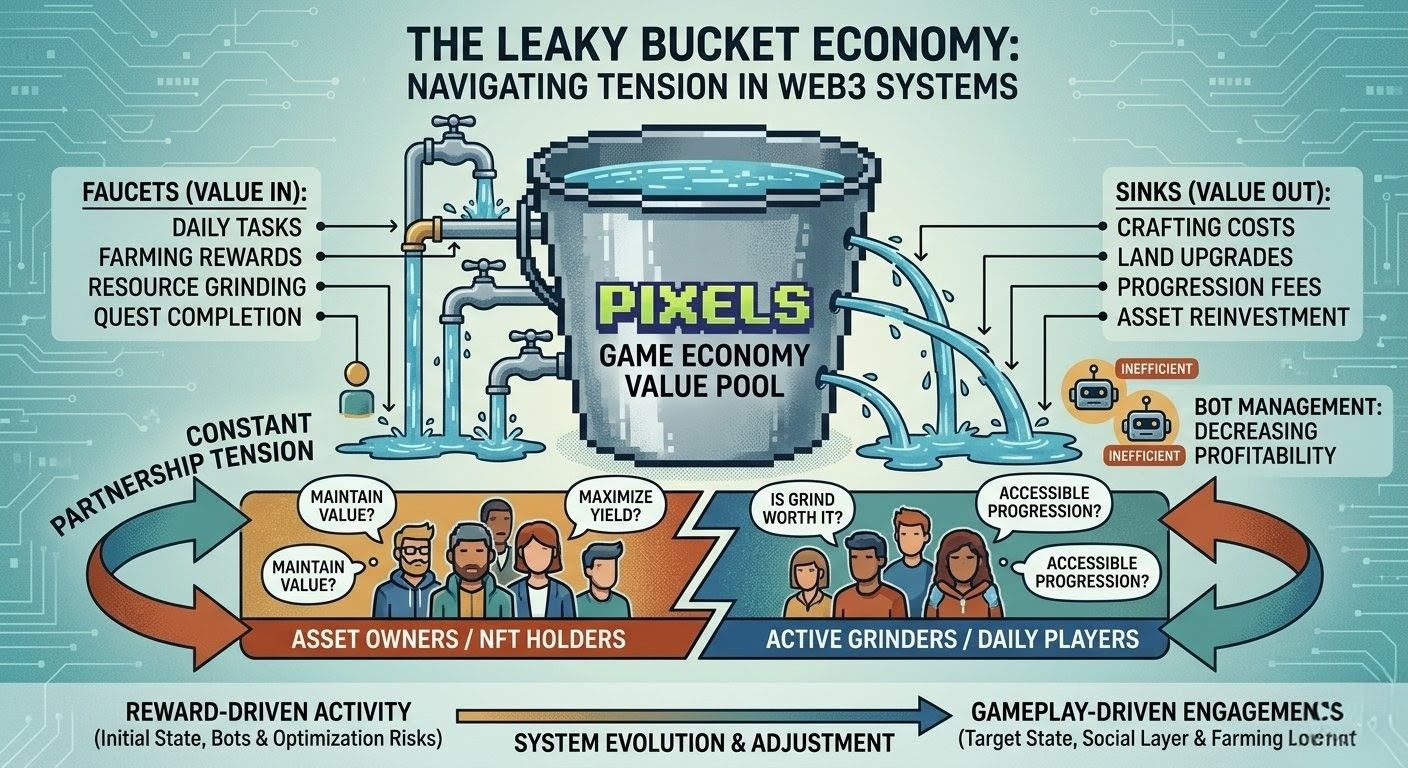
You’ve got two groups, whether anyone says it out loud or not. Asset owners at the top landholders, NFT players, people with capital in the system. And then everyone else. The grinders. The daily players. The ones actually generating activity.
In theory, it’s a partnership. Owners need players. Players need opportunity.
In practice? It’s tension. Constant tension.
Because what helps one side usually hurts the other.
If asset owners earn too much, players feel drained. Like they’re working for someone else’s upside. That kills motivation fast.
If players earn too much, asset value drops. Investors lose confidence. Liquidity dries up.
There’s no clean fix here. There never has been.
Pixels tries to soften this. Wraps the economy inside gameplay loops farming, social stuff, crafting so it doesn’t feel like pure extraction. And honestly, that helps.
But it doesn’t remove the problem. It just makes it less obvious.
And yeah, it’s still there.
Another thing I’ll give them credit for they’re not stubborn.
A lot of projects stick to their original design like it’s sacred. Even when it’s clearly not working. Pixels doesn’t seem to do that. They adjust. Rewards, mechanics, even infrastructure decisions they’re willing to move.
That’s good. It really is.
But it also makes things… unpredictable.
If you’re a player, you’re thinking: “Is this grind still worth it next month?”
If you’re holding assets, you’re thinking: “What changes next?”
Flexibility solves problems. It also creates uncertainty. You don’t get one without the other.
And then there’s bots.
Yeah. Always bots.
Pixels took an interesting route here. Instead of trying to wipe them out completely which, let’s be real, never works they’ve tried to make them less profitable. Basically turning bots into inefficient participants instead of banning them outright.
Smart idea. In theory.
But this only works if you stay ahead. If bot operators adapt faster than the system? You’re back where you started. Rewards flowing to automation instead of actual players.
That’s a dangerous loop.
Because once real players feel like they’re competing with machines, they stop showing up. Simple as that.
Now zoom out for a second.
What’s actually driving activity here?
A lot of it maybe most of it is still incentive-driven. People are here because there’s something to earn. That’s fine early on. Almost every system starts that way.
But it raises the real question… what happens when rewards normalize?
Do people stay?
That’s the part nobody can answer yet. Not confidently.
Pixels clearly wants to move toward a more gameplay-driven model. You can see it in the design. The social layer, the farming loop, the world-building it’s not just a reward engine.
But wanting that and achieving that? Two very different things.
Building a game people play without needing constant economic incentives that’s hard. Way harder than designing token flows.
And this whole system… it’s balancing on that shift.
So where does that leave things?
Honestly, in the middle.
Not broken. Not solved.
Just… in motion.
You’ve got faucets pushing value in. Sinks trying to pull it out. Players optimizing everything. Bots testing the edges. Developers adjusting knobs behind the scenes.
And underneath all of it, the same unsolved problem every Web3 game runs into.
Earners vs players.
People who want yield. People who want fun.
Sometimes they overlap. Most of the time, they don’t.
That tension doesn’t disappear. It just moves around.
So yeah, if you’re judging Pixels purely on metrics or token price, you’re missing the point. That stuff changes fast.
The real question is simpler. And harder.
Are they actually getting better at managing the tension?
Not solving it. Nobody’s done that.
Just… managing it better over time.
That’s the game behind the game.
