
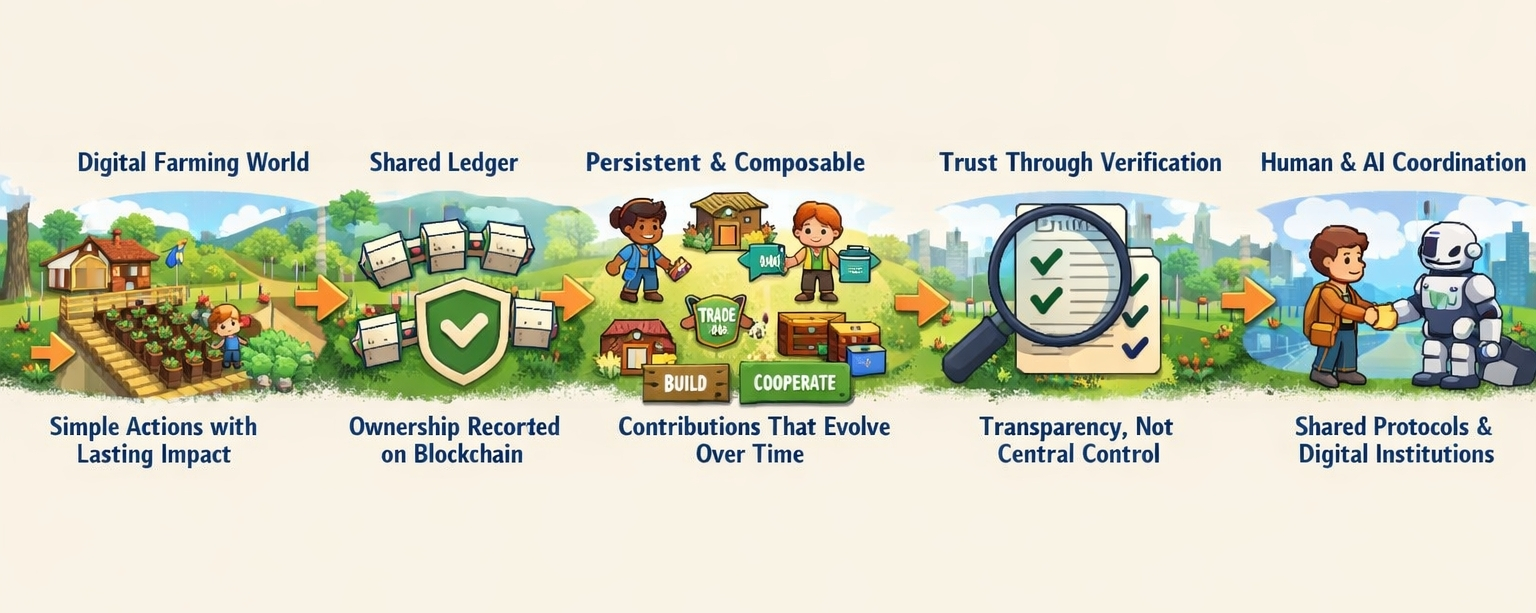
I’ve been watching Pixels for a while now, not in the way one watches a game for entertainment, but in the way you observe a system trying to reorganize how people coordinate with each other through code. At first glance, it looks disarmingly simple—a farming game, soft edges, familiar loops of planting, harvesting, crafting. But the longer I look at it, the more it feels like a quiet experiment in how digital spaces can function as economic and social substrates rather than just environments for play.
What caught my attention wasn’t the mechanics themselves, but how they are embedded in a network that remembers. Every action, every asset, every piece of land exists within a shared ledger. This changes something subtle but important: the game is no longer just a simulation run by a central authority; it becomes a space where persistence is guaranteed not by trust in a company, but by verification across a distributed system. That shift—from permission to verification—alters the relationship between the participant and the world they inhabit.
I keep looking at how Pixels handles ownership, and it doesn’t feel like traditional ownership in games. It’s less about possession and more about continuity. When a player cultivates land or builds something, the value isn’t locked inside a server that can be reset or modified at will. Instead, it becomes part of a broader network state. This introduces a kind of durability that begins to resemble institutions in the real world. Not because it mimics them directly, but because it starts to provide the same function: a shared memory that participants can rely on when making decisions.
What’s interesting is how this affects cooperation. In most games, cooperation is temporary and bounded by the rules of the session. Here, cooperation can extend beyond immediate gameplay because the outputs of that cooperation persist. If someone contributes to a shared resource or builds something of value, that contribution doesn’t dissolve when they log off. It remains legible to others, verifiable, and therefore usable as a basis for further interaction. Over time, this begins to resemble a primitive form of digital commons.
I’m noticing that Pixels doesn’t try to force complexity. Instead, it builds on familiar human behaviors—farming, trading, exploring—and places them in a system where the consequences of those behaviors are recorded and composable. This composability is where things become more interesting. Assets and actions are not isolated; they can interact with other systems, other players, and potentially other applications. The game becomes less of a closed loop and more of a node in a larger network of interactions.
This is where the role of the underlying network becomes crucial. By operating on a blockchain infrastructure, Pixels inherits a form of neutrality. The rules of the system are not entirely dictated by a single entity but are instead enforced by a broader consensus mechanism. This doesn’t eliminate control or governance, but it redistributes it. The game becomes a shared protocol rather than a product in the traditional sense.
I keep coming back to the idea of trust. In conventional online environments, trust is outsourced to the platform. You trust that your progress will be saved, that your assets will remain yours, that the rules won’t change arbitrarily. In Pixels, some of that trust is replaced by verification. You don’t need to trust that something exists or belongs to you; you can verify it. This subtle shift has larger implications. It suggests a model where digital interactions can be grounded in systems that are transparent and auditable, rather than opaque and controlled.
There’s also something quietly significant about how this affects time. In most games, time is cyclical—events reset, seasons repeat, progress is often temporary. In Pixels, time feels more linear. Actions accumulate. The world evolves in a way that is recorded and cannot easily be undone. This creates a sense of history, not just gameplay progression. It’s as if the game is slowly building its own archive of human and machine interaction.
As I watch this unfold, I start to see Pixels less as a game and more as a coordination layer disguised as one. It provides a low-friction environment where people can experiment with ownership, collaboration, and economic behavior without the high stakes of traditional systems. But the patterns that emerge—how people trade, how they cooperate, how they assign value—are not trivial. They are signals of how similar systems might function at larger scales.
What’s particularly intriguing is the potential interaction between systems like Pixels and emerging AI agents. If AI systems begin to operate within environments where assets and actions are verifiable and persistent, their behavior could be shaped by the same constraints and incentives as human participants. This creates the possibility of shared spaces where humans and machines coordinate not through direct instruction, but through interaction with a common protocol.
In that sense, Pixels hints at a broader idea: that games might become testing grounds for new forms of digital institutions. Not institutions in the bureaucratic sense, but in the foundational sense—structures that enable coordination, enforce rules, and store shared knowledge. By embedding these functions into a playful, accessible environment, Pixels lowers the barrier to participation while still exploring complex ideas about trust and cooperation.
I’m still watching, still trying to understand what exactly is emerging here. It doesn’t feel revolutionary in the loud, disruptive way that new technologies are often framed. Instead, it feels incremental, almost quiet. But there’s a depth to it that becomes more apparent over time. The more I look at it, the more it seems like an early glimpse of how digital worlds might evolve from places we visit into systems we rely on—systems where the boundaries between play, work, and coordination begin to blur, and where the underlying question is no longer just what we can do in these spaces, but how we can trust them to persist