

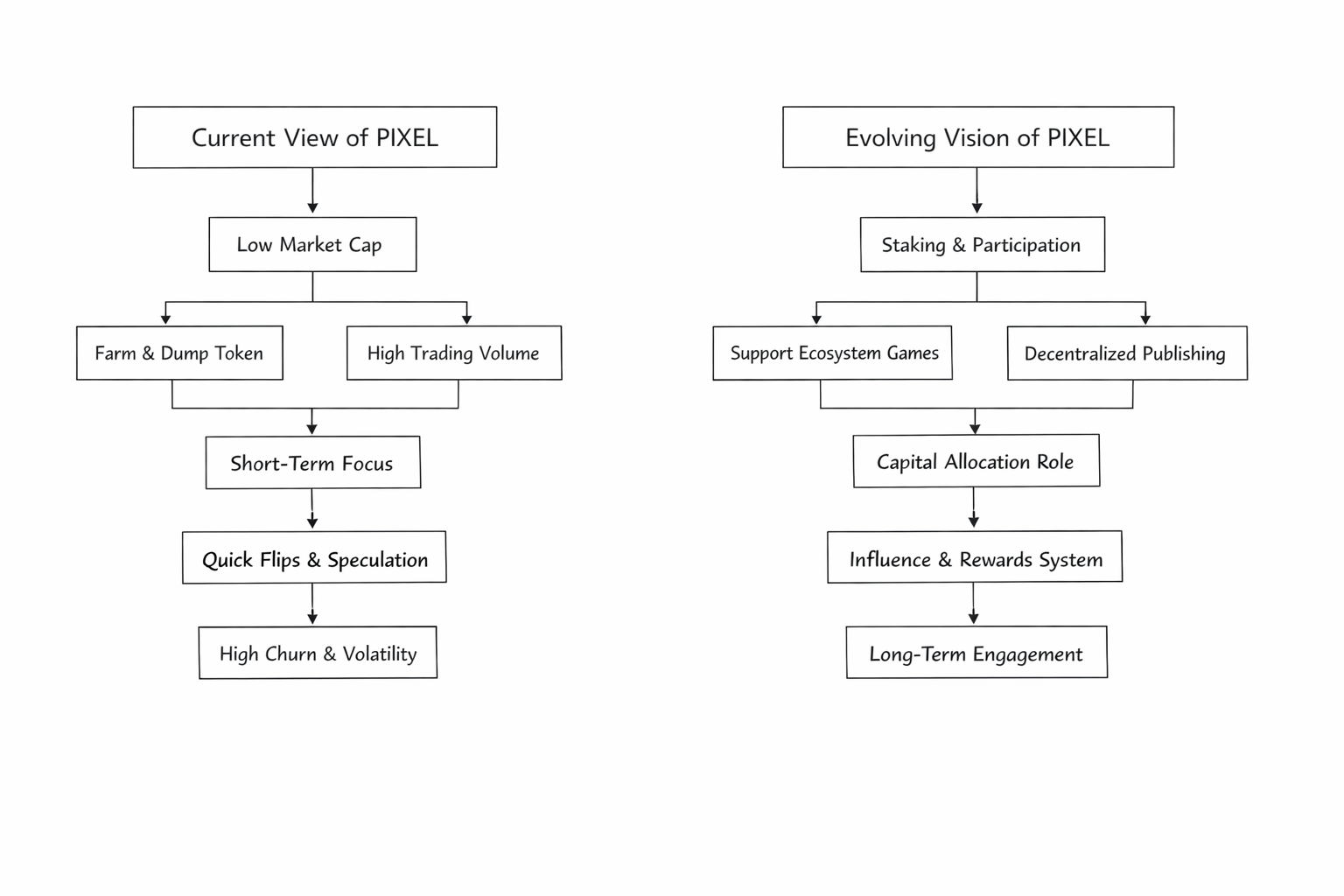
@Pixels i remember looking at $PIXEL after one of those ugly pullbacks and feeling annoyed because the market was still pricing it like a tired farming token while the project itself had already started moving somewhere else. The chart was weak, volume was loud, and the whole thing felt like another GameFi name people only touch when it bounces. But when I went back through what Pixels was actually building, the part that stuck with me was not crops or casual gameplay. It was the slow shift from token-as-reward toward token-as-participation. That’s where I think the gap is. A lot of $PIXEL holders still aren’t valuing the fact that this thing is trying to become a way to direct attention, rewards, and eventually influence across a broader gaming network, not just a chip you farm and dump.
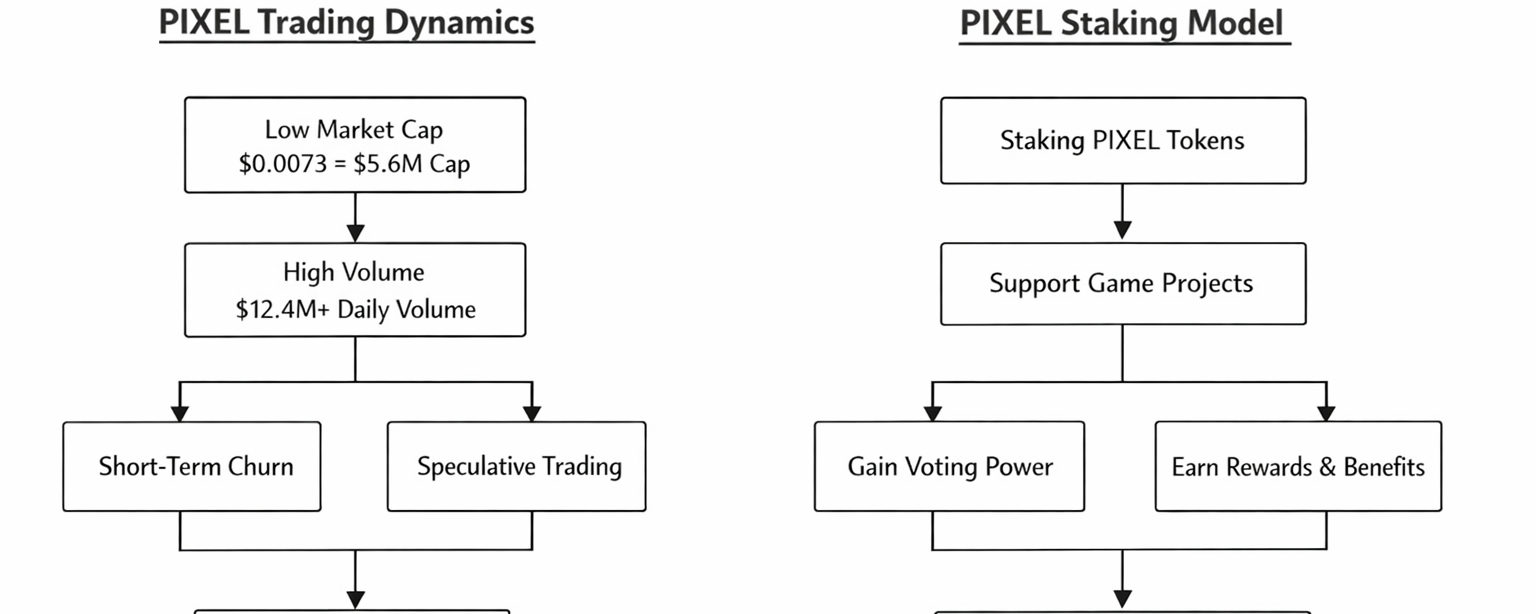
Right now the market cap is tiny. CoinGecko shows PIXEL around $0.0073 with roughly 770 million tokens circulating, a market cap near $5.6 million, and about $12.4 million in 24 hour trading volume. That number matters more than people think. When daily volume is more than double the market cap, you are not looking at a calm holder base. You’re looking at a token that is still being churned, traded, and recycled hard. For traders, that means attention is there, but conviction probably isn’t. It also means the market is still treating PIXEL like something to flip, not something to own for access to a growing decision layer inside the ecosystem.
Now here’s the thing. Pixels has been pretty open that the old reward loop had problems. Its FAQ says Chapter 2 was designed to protect $PIXEL by making rewards more strategic and cooperative, while moving $BERRY into an off chain coin model to reduce sell pressure and simplify the economy. That is not some minor balancing tweak. That is the team admitting that if players can extract value faster than the game creates reasons to stay, the economy gets hollowed out. Traders should care because that same logic applies to the token. If the only reason to hold PIXEL is to catch a bounce, then the market will keep acting like a revolving door.
What makes me pay attention is the newer staking structure. Pixels’ help docs frame staking as a way to support different game projects and earn future benefits, while the main site goes even further and says staking helps shape the Pixels universe. The official Pixels X post describing the rollout was even more explicit, saying the model is a decentralized publishing system where games replace traditional validators. That’s a weird sentence at first, but the simple version is this: your token is starting to act less like a reward coupon and more like a vote weighted by capital allocation. You stake toward games. Games that attract stake and activity get more visibility and reward flow. That is much closer to network participation than most people seem to price in.
The realistic bull case is not “PIXEL goes up because gaming comes back.” That’s lazy. The real bull case is that the market starts recognizing PIXEL as the asset that sits at the center of a broader publishing and incentive layer. Third party reporting around the staking rollout said more than 176 million PIXEL had already been staked by over 10,000 users, and that staking was already live across multiple games. If those figures are directionally right, that is meaningful against a circulating supply of roughly 770 million. It suggests a decent chunk of liquid supply is being locked into participation rather than sitting fully available for exit. For a token this small, that can matter fast if the ecosystem proves it can attract new games and keep players engaged.
But I’m still cautious. The retention problem has not gone away. It has just become more important. A participation token only deserves a premium if people keep participating. The Pixels website says it has over 10 million players, which is a strong top of funnel number, but top of funnel is not the same thing as durable involvement. We’ve all seen GameFi projects put up huge wallet counts and still fail to keep real users around once rewards cool off. If staking turns into passive farming with better branding, or if ecosystem games fail to convert curiosity into habit, the governance participation story weakens fast. Then you’re back to a low cap token with high turnover and limited pricing power. That’s the tradeoff I can’t ignore.
That’s why I think the governance participation gap is real, but it’s not free alpha yet. Holders may be early in seeing that PIXEL is drifting toward a capital allocation role inside a game network. The market may also be right to demand proof first. I’m watching whether staking keeps growing, whether more games actually matter, and whether users stay involved when extraction gets harder. If you trade small caps and you’re not looking at that angle yet, you’re probably still valuing PIXEL like the old version of itself. That’s the mistake I almost made too. Keep it on your screen, but make it earn your trust.