
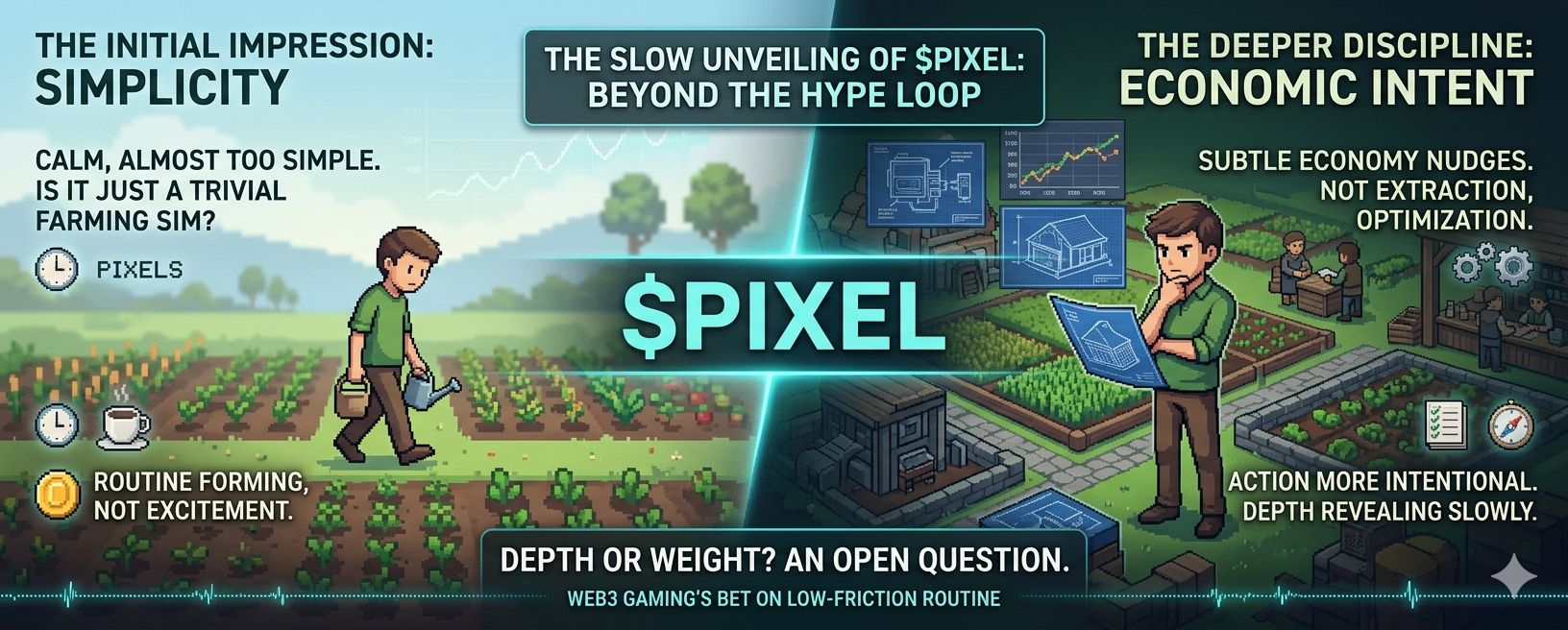
I’m watching, I’m waiting, I’m looking at how this world unfolds without rushing to decide what it is. I’ve seen enough of these systems to know that first impressions usually lie, or at least simplify something that takes time to reveal itself. I focus less on what Pixels says it is and more on what it becomes when people settle into it—when the novelty fades and routine takes over. There’s always a moment where a game stops presenting itself and starts exposing itself, quietly, through behavior.
At a distance, it looks simple enough. Farming, gathering, crafting—familiar loops arranged in a bright, approachable world. But when you stay a little longer, the rhythm begins to matter more than the features. The way players move, the way they return, the way they optimize without talking about optimization. It’s not loud. It doesn’t push urgency. Instead, it seems to rely on a kind of passive gravity, something that pulls you back not because you’re excited, but because you’re already involved.
I’ve noticed how people interact with it in fragments. Short sessions stretched across a day. Small decisions repeated often enough to feel meaningful. There’s a certain quiet discipline forming beneath the surface, like players are slowly adapting to the system rather than reacting to it. And that’s where it becomes harder to read. Because when a game encourages routine instead of spikes of excitement, the question shifts. It’s no longer about whether it’s fun in bursts, but whether it can hold attention without demanding it.
The presence of a token—$PIXEL—sits in the background like a constant, subtle pressure. Not overwhelming, not entirely defining, but always there. You can feel it shaping decisions in ways that aren’t immediately obvious. Players don’t always talk about it directly, but it influences how they approach time, effort, and progress. It introduces a layer of intention that feels different from traditional games, where inefficiency is harmless. Here, inefficiency feels noticed, even if no one points it out.
What stands out to me is how the game doesn’t rush to explain itself fully. There are systems within systems, and they reveal themselves gradually, sometimes unevenly. At times, it feels like you’re learning the structure not because it’s clearly presented, but because you’ve spent enough time inside it to recognize patterns. That can be engaging, but it can also create distance. Not everyone wants to learn a system by living in it.
I keep coming back to the idea of weight. Not physical weight, but systemic weight. Each new layer, each added mechanic, each economic loop—it all builds on top of what’s already there. And while that can create depth, it also risks slowing things down in a way that isn’t immediately visible. The game doesn’t feel heavy at first, but over time, you start to sense the accumulation. The question becomes whether that weight adds meaning or just friction.
There’s also something interesting about how it feels socially. It’s labeled as a social game, and in some ways it is, but the interaction often feels indirect. People share space more than they share experience. You see others, you recognize activity, but collaboration isn’t always necessary. It’s more like a shared environment than a shared journey. That can work, but it changes the kind of connection players form with both the game and each other.
I’ve seen players settle into roles without being told to. Some focus on efficiency, others on exploration, others on simply maintaining presence. It creates a kind of organic distribution of behavior that feels less designed and more emergent. But even that raises a quiet question—whether the system is guiding these roles intentionally, or if players are just finding ways to adapt to constraints.
What keeps me watching is not whether it succeeds in the traditional sense, but whether it sustains itself in a quieter way. Not through hype or constant updates, but through consistency. Through the ability to become part of someone’s routine without demanding their full attention. That’s harder to measure, but easier to feel over time.
I don’t see it as something to judge quickly. It doesn’t present itself that way. It unfolds slowly, sometimes almost reluctantly. And maybe that’s the point. Or maybe it’s just a byproduct of a system still figuring itself out.
For now, I’m still watching. Not convinced, not dismissive. Just paying attention to how it holds up when no one is trying to prove anything about it.
