
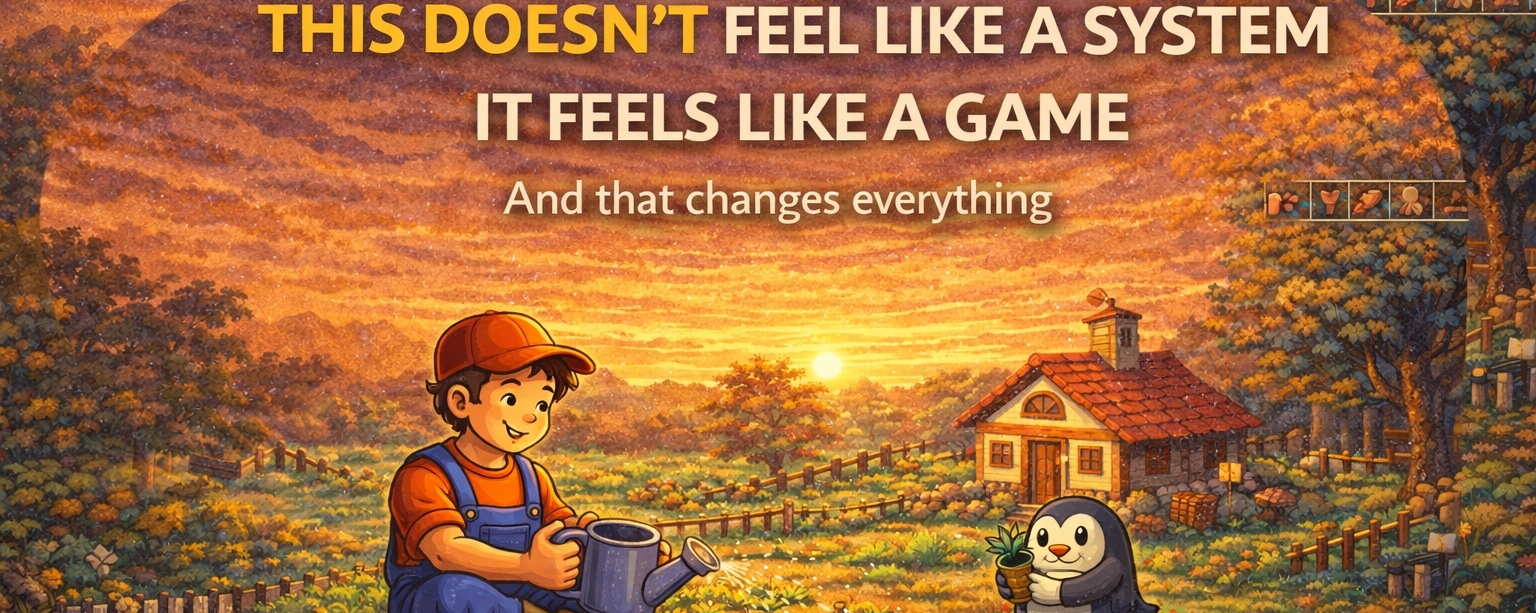

I used to think Web3 gaming just needed better mechanics. Better economies. Better rewards. Better systems. But the more I looked at it, the more it felt like everyone was solving the wrong problem. Because most Web3 games aren’t failing due to lack of features. They’re failing because they feel like systems… not experiences.
You log in, and within minutes you already know what the game wants from you. Grind here, earn this, optimize that. It becomes predictable fast. And once something feels predictable, it becomes hard to care. That’s the part no one talks about enough. So when I looked at Pixels, I wasn’t expecting much. Another farming game. Another token loop. Another attempt to make something “sticky” through incentives. But something felt different almost immediately. Not because it was more advanced.
But because it felt… lighter.
I didn’t feel like I had to understand everything before starting. I wasn’t thinking about tokens or strategy. I just started moving, planting, interacting, exploring small things at my own pace. And somehow, I stayed longer than I expected. That’s when it clicked. Pixels doesn’t try to hook you. It just doesn’t push you away. That sounds simple, but it’s actually rare.
Most Web3 games create friction through over-design. Too many systems, too many decisions, too much pressure to “play correctly.” You feel like you’re doing something wrong if you’re not optimizing. Pixels removes that pressure. The loop is simple, but it’s comfortable. Farming, collecting, trading, slowly building over time. There’s no urgency forcing you forward. No feeling that you need to rush or maximize everything. And because of that, you don’t feel like you’re playing against the system.
You feel like you’re inside it.
That changes how engagement works.
In most Web3 games, engagement is tied to rewards. The moment rewards slow down, so does interest. People leave because the reason they stayed disappears. Pixels doesn’t rely entirely on that. The experience holds you first. The economy comes after. You’re not constantly checking what you earned. You’re just doing things… and value forms around that naturally. It feels less like extraction and more like participation. That shift matters more than it seems. Because sustainable systems don’t come from forcing users to stay. They come from giving users a reason not to leave. Another thing that stood out is how seamless everything feels.
Pixels runs on Ronin, but you don’t feel it interrupting your experience. There’s no constant reminder that you’re interacting with blockchain infrastructure. No friction pulling you out of the loop. It just works quietly in the background. And that’s probably the right approach. Because most users don’t care about chains or technical design. They care about how something feels. Whether it’s smooth, whether it’s enjoyable, whether it’s worth their time. Pixels understands that. It doesn’t try to educate users about Web3. It tries to remove the need for that entirely. Still, it’s not without risks.
The biggest question is sustainability.
Can a simple, relaxed loop hold attention long-term without relying too heavily on incentives? Will the economy stay balanced as more players enter and start extracting value? Can it avoid the usual cycle where engagement fades once rewards shift? These are real concerns. But Pixels feels like it’s solving the right layer first.
Not complexity.
Not tokenomics.
But experience.
Because if Web3 gaming is going to work, it won’t be because systems get smarter. It’ll be because they feel simpler. Because people won’t stay for rewards alone. They’ll stay for something that feels natural to come back to. Pixels is moving in that direction. Not loudly. Not aggressively. Just by quietly making something people don’t want to leave. And honestly… that might be exactly what Web3 gaming needed all along.
