
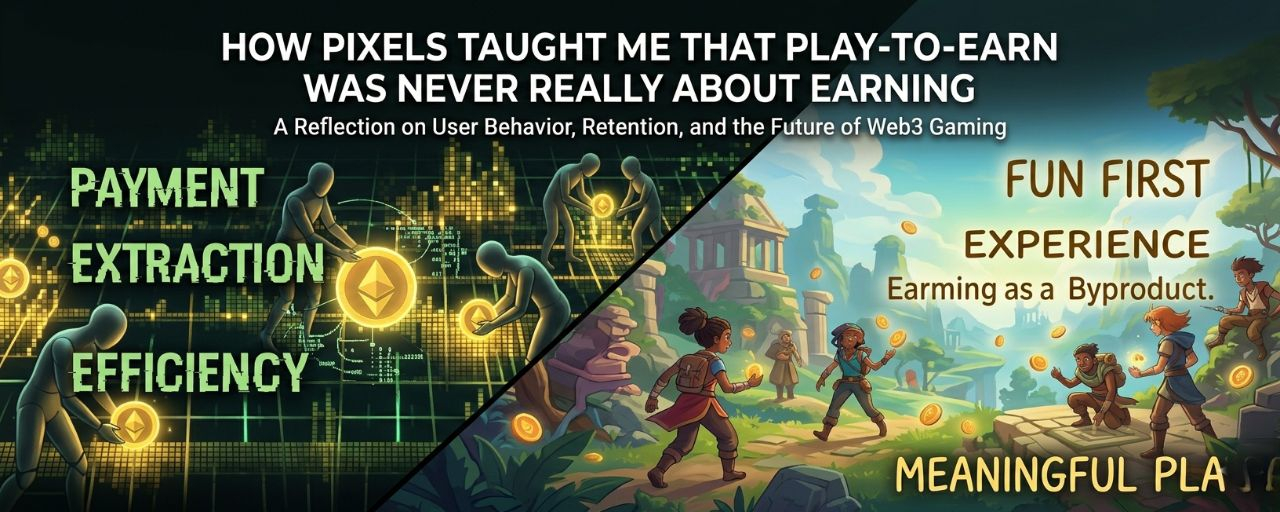

I have spent time watching how players behave when incentives are placed in front of them and the pattern is always the same. At the beginning there is curiosity and excitement. People explore. They experiment. They connect with the world. But slowly something changes. The focus shifts from experience to output. From enjoyment to efficiency. And eventually many of those same players disappear.
Not because the rewards stopped but because the experience stopped feeling meaningful.
This is where my perspective on play to earn changed.
At first it looked like a perfect system. Play the game earn tokens and turn time into value. It attracted millions of users and created strong early growth. But the model carried a hidden flaw. When earning becomes the main reason to participate it stops being a bonus and becomes an expectation. That expectation reshapes behavior.
Players stop playing for discovery and start optimizing for extraction. Every action becomes calculated. Every decision is driven by return. The game slowly transforms into a system of outputs rather than an experience of engagement.
I have realized that no economy can sustain itself if the primary intention of its users is to take more than they give.
This is why I believe the foundation must shift.
Fun must come first.
Not as a slogan but as a design principle. When a game is genuinely enjoyable players return because they want to. They invest time because it feels natural. In that environment earning can exist but it becomes a byproduct of participation rather than the purpose of it.
This also connects to how value moves across ecosystems. I see a future where assets are not locked into a single experience. Instead they travel across different games and environments creating continuity for the player. This kind of interoperability creates deeper attachment and reduces the need for constant extraction.
Control also plays a role in this evolution. I do not believe in instant decentralization. Shifting power too quickly can break systems that are not ready. Instead I see it as a gradual process where control moves carefully from developers to players and eventually into a balanced ecosystem where incentives align more naturally.
There is a clear pattern that continues to repeat itself. When money becomes the focus players become farmers. And when systems are built for farming games become economies before they ever become enjoyable experiences.
That tradeoff is difficult to manage.
There is always tension between fun and earning. Between structure and freedom. Between control and decentralization. Moving too far in any one direction creates imbalance.
Looking at the current state of GameFi I do not see failure. I see a system correcting itself. Many projects focused on growth metrics without understanding retention. They built reward systems before building meaningful gameplay. And now they are facing the consequences of that order.
What I see now is a quieter shift. Less emphasis on noise and more attention on design. More focus on sustainability rather than short term spikes.
It makes me think about a simple question.
Is this evolution or is it correction.
For me the answer is both.
The strongest ecosystems will not be the ones that promise the highest rewards. They will be the ones that create the strongest reasons to stay. Systems that respect player behavior instead of trying to force it. Experiences that feel alive rather than transactional.
In the end I believe something very simple.
Players do not stay because they are paid to stay.
They stay because something about the experience matters to them.
And the ones who stay the longest were never chasing tokens in the first place.
