
That morning I only meant to log in for a few minutes to check some unfinished progress, but the longer I looked, the more it felt like Pixels was no longer running on its old rhythm. It felt like a workshop keeping the machines on during its busiest hour while still choosing to take apart the whole transmission system and rebuild it.
I think this is the most research worthy point about this project. A product that still manages to keep people coming back regularly is very easily seduced by the feeling of stability. When tasks are still being done and the community has not left yet, the safest choice is always to keep everything as it is. But Pixels touched exactly the part that most projects avoid, which is the structure that creates behavior inside the game.
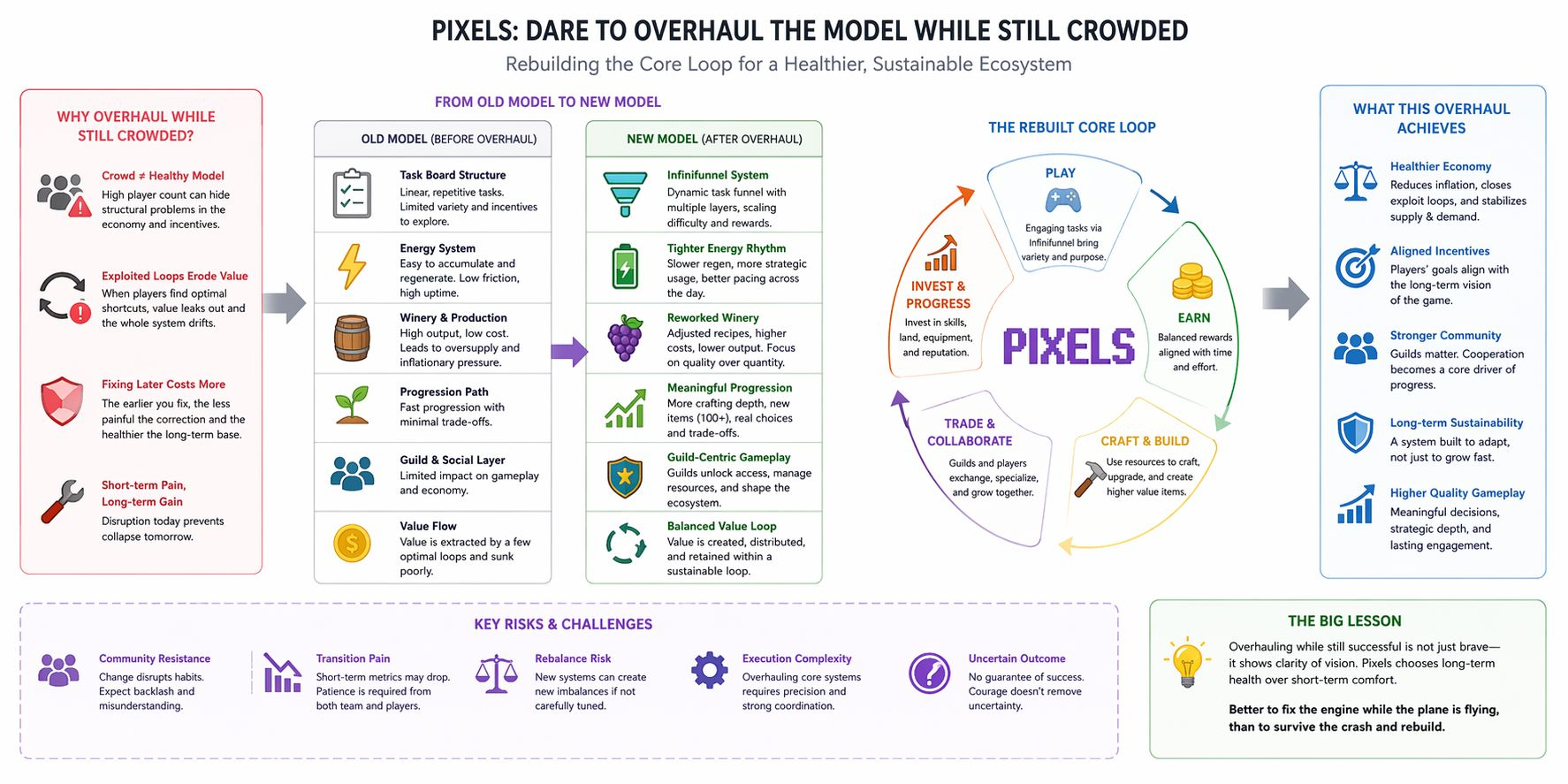
To put it more precisely, the problem of an economic game rarely starts with a lack of content. It usually begins when rewards no longer lead players toward the kind of behavior the designers actually want to preserve. When time spent, resources earned, task rhythm, and optimization potential no longer sit inside the same logic, the system gradually drifts even while it can still look lively on the outside. Honestly, many teams only realize that when the community is already exhausted. Pixels chose to fix it earlier, right when the pressure of player reaction was still fully there.
That is why I do not see the adjustments in Pixels as a few disconnected updates. When tasks are redesigned, when the energy rhythm is tightened again, when the winery gets touched, when crafting is expanded, and when the progression path is rearranged, the project is intervening in the operating framework rather than just adding more things to keep players busy. Once players are already used to earning through a certain loop, any attempt to bring the system back to a more balanced state will hurt.
Truly ironic, that short term discomfort is exactly the signal that the team still holds decision making power over the product. If a project only keeps catering to community inertia, it will gradually be led by the groups that optimize the best rather than by the design goal itself. In Pixels, I read a very clear choice, they are willing to remove some old advantages in order to stop the economy from being bent by loops that are too easy to exploit. This is not the kind of adjustment made to look good on the surface, it is an adjustment made to reclaim the right to define value inside the game.
Perhaps the point most people overlook is that Pixels does not see the community as a pure mass of players, but as a social structure that has to be reorganized around the right incentives. When guilds, access rights, upgrade progression, and the distribution of benefits are placed closer together inside the design, the game begins to shift away from a model where whoever optimizes individual play better wins, toward one where coordination and position inside the system matter more. I think this is the part that shows the project is truly changing its model.
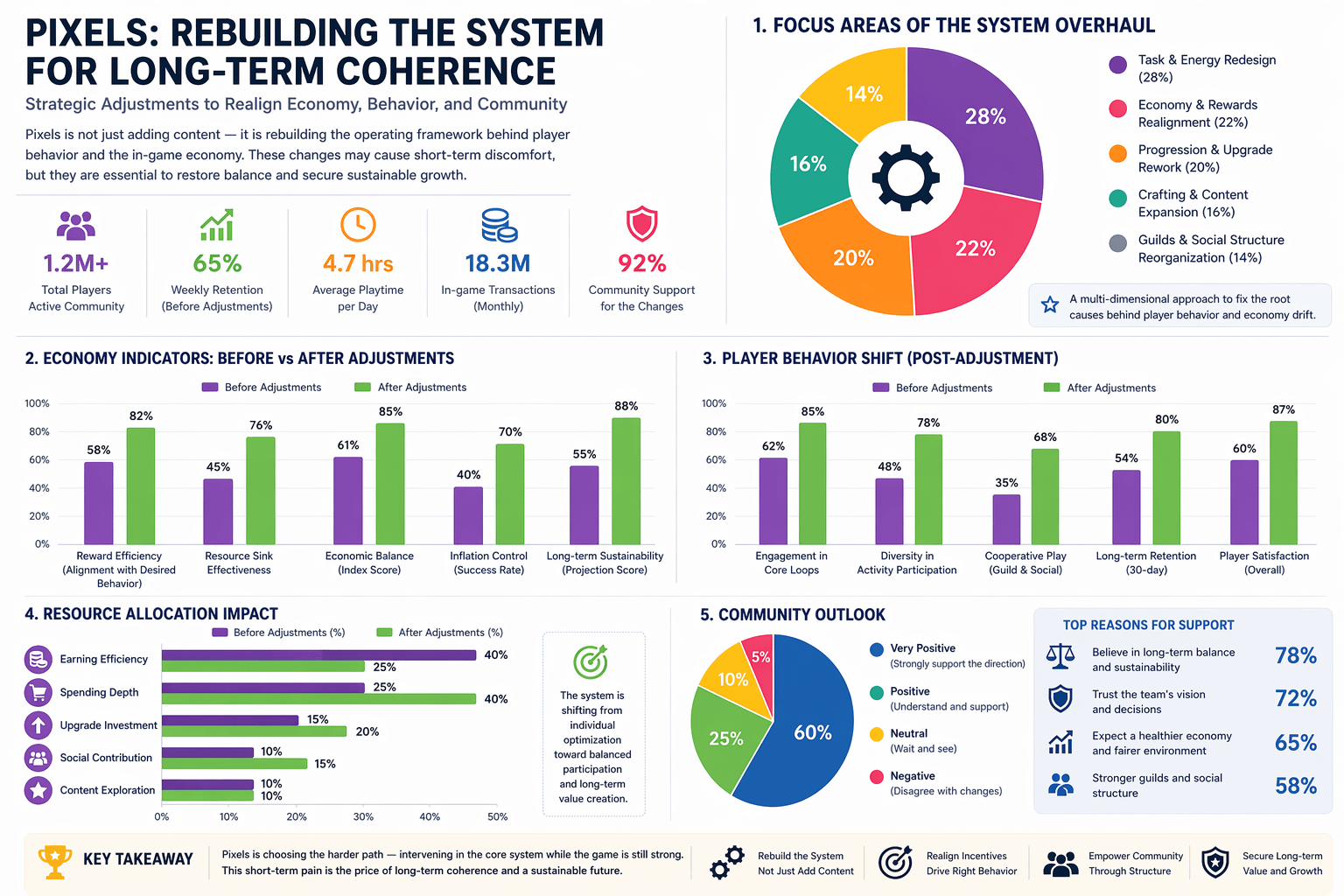
No one would have guessed that the hardest thing for a project with a large player base is not bringing in more new people, but daring to disturb the people who are already inside. Or maybe I have watched too many cycles, so now the moment I see a team willing to cut into the very part that is creating a sense of safety, I immediately pay attention. Pixels may not have solved every problem correctly. But the fact that they still dare to operate on the most sensitive area while the product has not yet fallen into exhaustion shows that this project still retains a rare quality, the willingness to pay a short term price to save long term coherence.
What I keep after watching Pixels is not excitement, but a harsher standard for every economic game I will look at from now on. I will trust a project more when it dares to readjust its earning mechanics, spending logic, upgrade paths, and benefit distribution at the moment outsiders still think everything is running well. If a team is still clear headed enough to break apart the very part that makes them look stable in order to save the structure underneath, is that not the rarest sign worth following for the long run.