What stood out to me in Pixels wasn’t the farming or the token part at first. It was the waiting.
Not forced waiting. Not the kind that blocks you. Just the quiet kind that sits in the background.
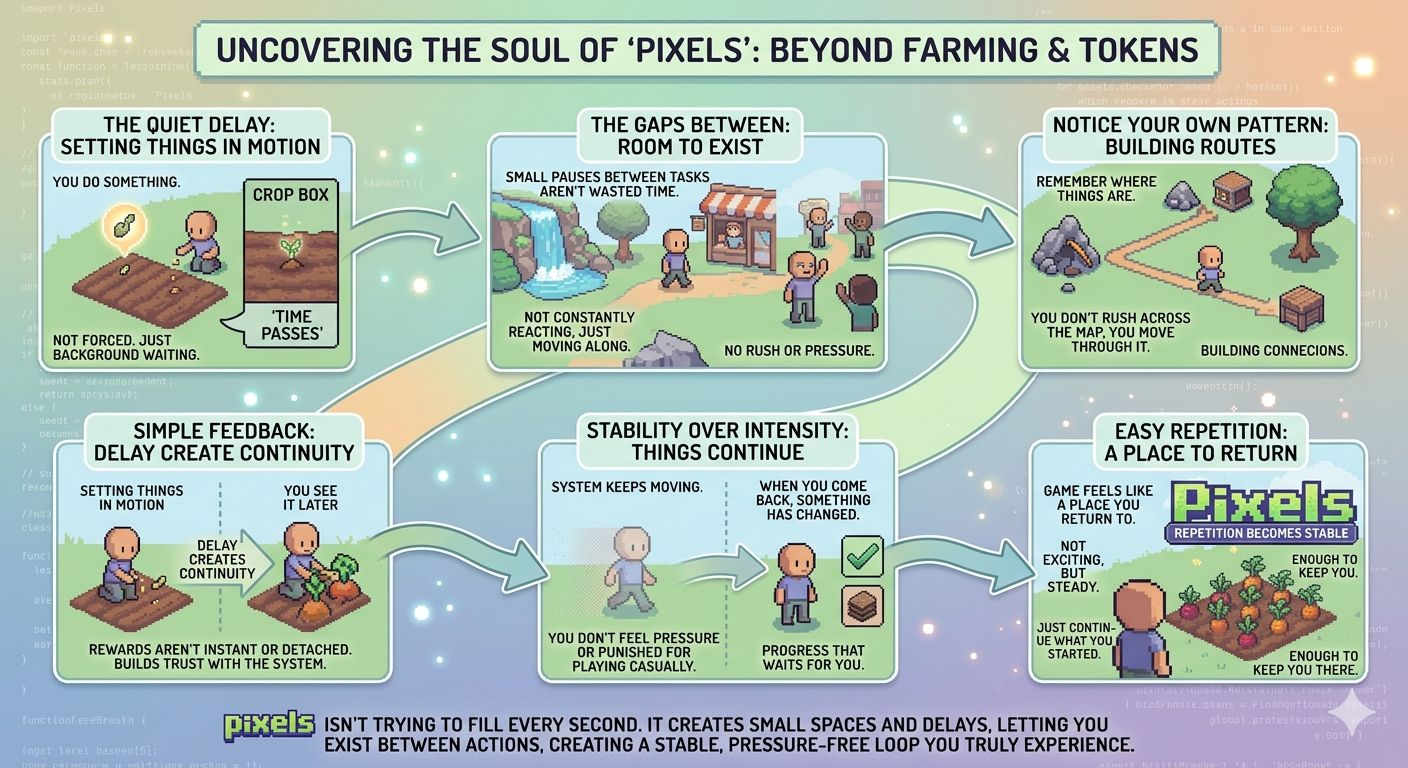
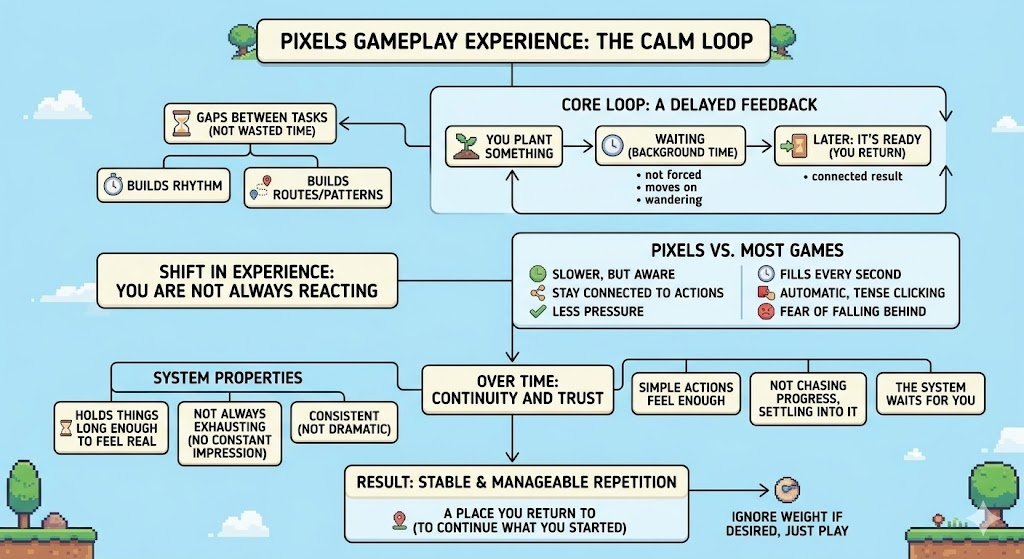
You plant something, and then there’s nothing to rush. You move on. You check something else. You wander a bit. Then later, you come back. It’s ready.
That loop sounds very basic when you say it out loud. Almost too basic. But inside the game, it doesn’t feel empty. It feels spaced out in a way that gives you room to exist between actions.
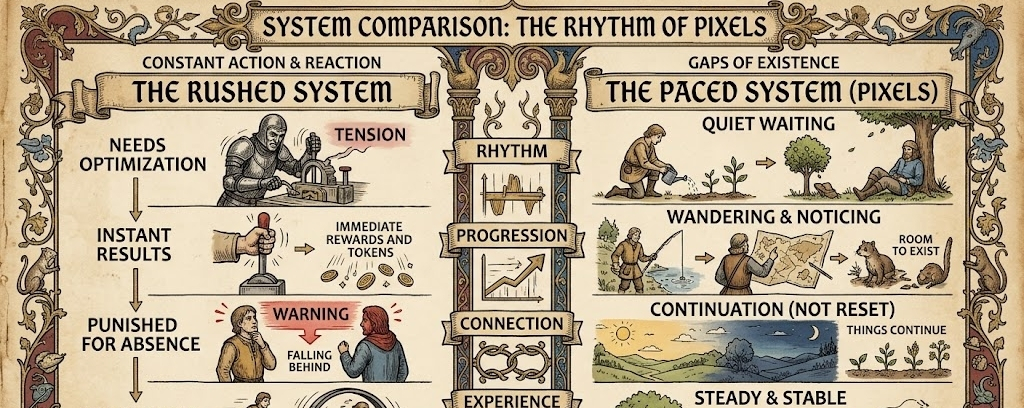
Most games try to fill every second. Pixels doesn’t.
There are small gaps everywhere. Small pauses between tasks. And those pauses don’t feel like wasted time. They feel like part of the rhythm.
You’re not constantly reacting. You’re just moving along.
That changes how you experience the game more than anything else.
Because when a game is always pushing, you start playing faster than you think. You click, react, decide, repeat. It becomes automatic in a tense way. Pixels is slower, but not in a boring way. Just in a way that lets you stay aware of what you’re doing.
You notice your own pattern.
You start remembering where things are without checking. You build your own routes. You don’t rush across the map, you move through it.
And over time, those small movements start to connect.
That’s when the game begins to feel less like a set of tasks and more like a place you return to.
Not because something big is happening, but because things continue.
You leave, and when you come back, something has changed. Not dramatically. Just enough.
A crop finished. A resource stacked up. A space became usable again.
It’s all very small. But it adds up in a quiet way.
And I think that’s what Pixels does differently. It doesn’t try to make every moment important. It lets moments stay small.
That might sound like a weakness, but it actually removes a lot of pressure.
You don’t feel like you’re falling behind if you step away. You don’t feel punished for playing casually. The system keeps moving, but it doesn’t run away from you.
So instead of chasing progress, you settle into it.
That’s a different feeling.
In a lot of systems, progress feels like something you have to keep up with. Here, it feels like something that waits for you.
And because of that, even simple actions feel enough.
You don’t need big rewards every minute. You don’t need constant upgrades or surprises. The game works on smaller feedback.
You do something → you see it later.
That delay matters more than it seems.
Because it makes the result feel connected to your earlier action. Not instant, not detached. Just slightly removed in time.
That creates a sense of continuity.
You’re not just clicking and getting results. You’re setting things in motion and returning to them.
And over time, that builds a kind of trust with the system.
You believe that what you do will still matter later.
That belief is simple, but not every game manages it well.
Some systems feel like they reset too quickly. Like nothing really stays. Pixels holds onto things just long enough for them to feel real.
Even if they’re small.
And that’s probably why the game doesn’t feel exhausting.
It’s not trying to impress you all the time. It’s not trying to pull you in with intensity. It just gives you a space where actions connect, time passes, and results show up.
Nothing dramatic. Just consistent.
That consistency becomes the reason you come back.
Not for a big event. Not for a huge reward. Just to continue what you started.
And there’s something steady about that.
You log in, you pick up where you left off, you do a few things, and you leave again.
No rush. No pressure. No feeling that you missed something important.
That kind of loop doesn’t sound exciting on paper. But in practice, it feels stable.
And stability is rare in games that also involve tokens and systems underneath.
Because those systems usually add tension. They make every action feel like it needs to be optimized or measured.
Pixels softens that.
It keeps the surface simple enough that you can ignore the weight behind it if you want.
You can just play.
And maybe that’s the point that sticks with me the most.
The game doesn’t remove repetition. It doesn’t hide it. It just makes repetition easier to sit with.
Not exciting. Not dramatic. Just manageable.
And sometimes, that’s enough to keep you there a little longer than you expected.