
At first, I thought I had it figured out.
Log in. Plant stuff. Harvest. Walk around. Do it again.
Simple loop. Chill, even.
But then… something didn’t reset the way I expected. And I couldn’t quite explain it. The world kept moving, sure but it felt like it was remembering me. Not in a flashy way. No pop-ups, no “hey we tracked you.” Just… subtle shifts. Like my actions weren’t disappearing anymore.
That’s when I paused.
Because that’s not normal game behavior.
And that’s where Pixels (PIXEL) starts to feel less like a game… and more like a system watching what you do.
Here’s the thing most people get wrong.
They think this kind of system rewards effort.
Put in more time → get more out.
Makes sense, right? That’s how most games train you to think.
But honestly? That’s not what’s happening here.
Not really.
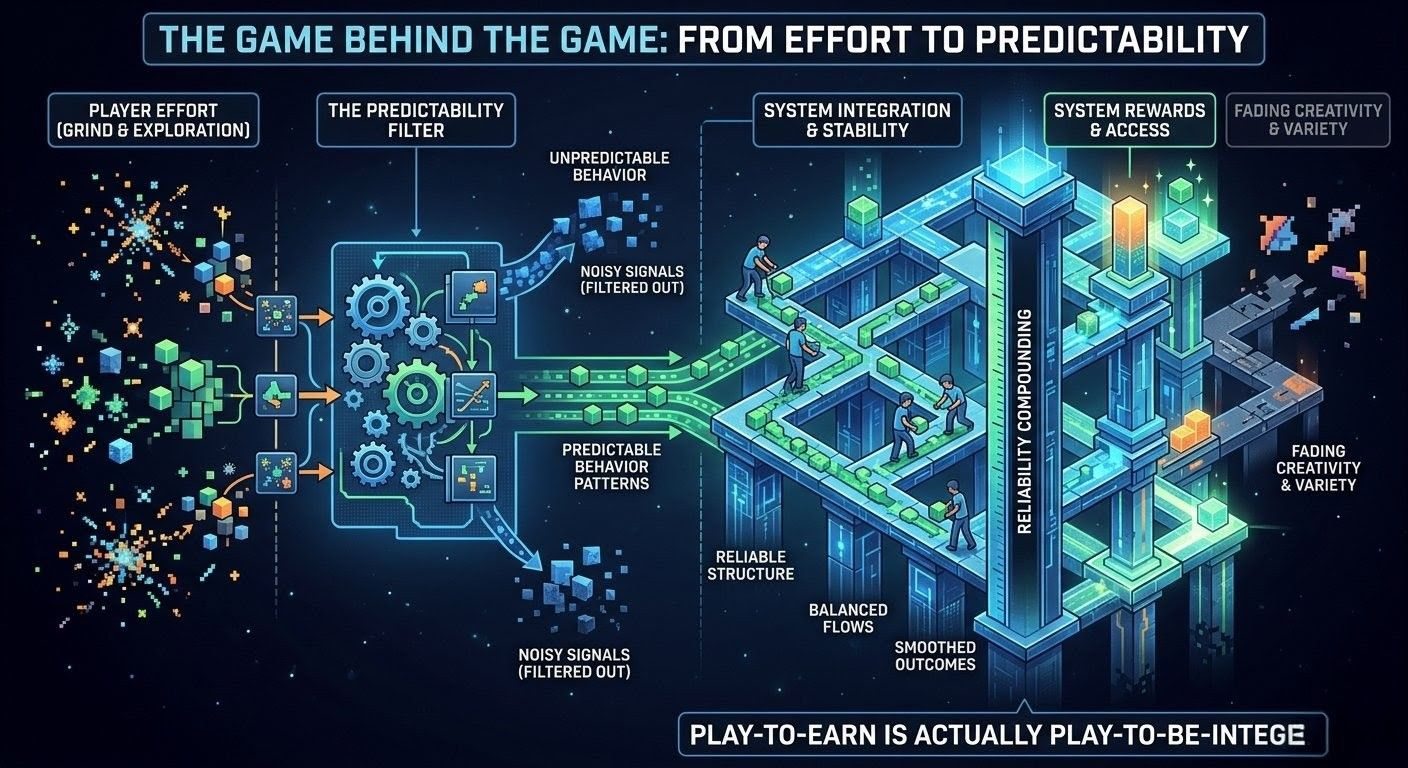
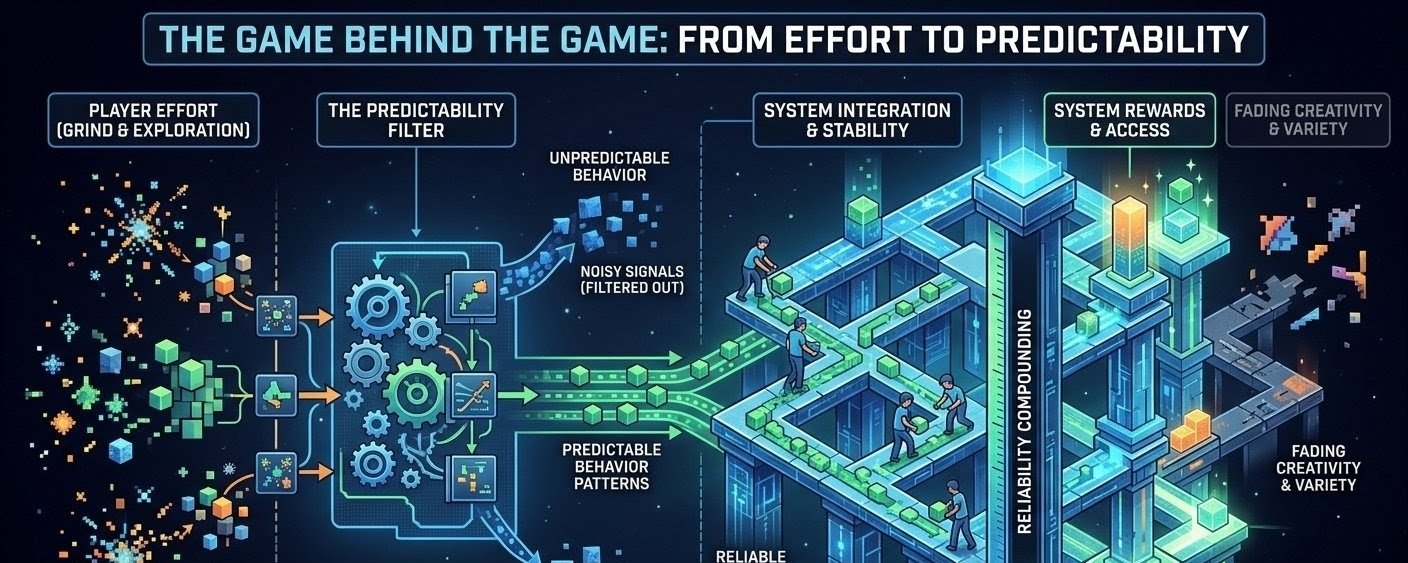
This system doesn’t care how hard you play. It cares how predictable you are.
Yeah. That’s the part people don’t talk about enough.
Because predictability is useful.
Effort? That’s noisy. It’s inconsistent. One day you grind, next day you disappear. Systems can’t rely on that.
But predictable behavior? That’s gold.
You show up. You do similar things. You follow patterns.
Now the system can actually use you.
Let me explain what I mean.
Every system game, market, whatever has one big problem: uncertainty.
Who’s logging in tomorrow?
Who’s going to act the same way twice?
Who can the system depend on?
Most environments just deal with the chaos. They throw rewards around and hope things balance out.
But here’s where this gets interesting.
Instead of fighting uncertainty, the system quietly filters for people who reduce it.
So you’ve got two types of players:
The random ones jump in, try everything once, disappear.
And the consistent ones same loops, same routes, same timing.
Guess which one the system prefers?
Yeah.
Not because one is “better.” But because one is easier to predict.
And predictable behavior creates something super valuable: patterns.
Patterns can be reused.
This is where things shift.
Because once your behavior becomes predictable, you stop being just a player.
You become… part of the structure.
Sounds weird, I know. But stick with me.
If the system knows what you’re likely to do, it can start building around that. It can stabilize things. Balance flows. Smooth out outcomes.
You’re not just playing anymore you’re contributing to how the whole thing holds together.
And that’s where rewards start to change.
Not visibly. That’s the sneaky part.
On the surface, it still looks like you’re just earning stuff and moving on.
But underneath?
The system starts recognizing you as reliable.
And reliability compounds.
I’ve seen this before, by the way. Not just in games.
Same pattern shows up in markets, social platforms, even workplaces. The people who behave consistently predictably end up getting more access, more stability, more upside.
Not because they’re the smartest.
Because they’re dependable.
And that’s exactly what’s happening here.
Now here’s where it gets tricky.
If predictability is what gets rewarded… what do you think players start doing?
They optimize for it.
Of course they do.
They find the best loops, the most efficient routes, the safest patterns and then they repeat them. Over and over.
And yeah, it works. That’s the point.
But let’s be real for a second.
What happens to creativity?
What happens to experimentation?
If trying something new risks breaking your efficiency… most people just won’t do it.
And slowly, without anyone announcing it, everyone starts playing the same way.
That’s the trade-off.
Stability goes up.
Variety goes down.
You get a cleaner system but maybe a less interesting one.
There’s another angle people miss.
Growth.
Everyone wants more users. More players. Bigger ecosystem.
Cool. Sounds great.
But more users = more chaos.
New players don’t follow patterns. They explore, they mess up flows, they do unpredictable stuff.
From the system’s point of view, that’s noise.
So what happens?
It doesn’t reject them. That would kill growth.
It filters them.
Some leave. Some stay random.
And a small group? They adapt. They become consistent. They turn into signal.
And over time, those are the ones that actually shape the system.
Not the loud ones. Not the flashy ones.
The predictable ones.
Now let’s not pretend this is perfect.
It’s not.
If the system leans too hard into predictability, things get… mechanical.
Players start feeling replaceable. Like anyone could run the same loop and get the same result.
That kills personality.
But if it leans too far the other way too much randomness you get chaos. Broken rewards. No stability.
So it’s this constant balancing act.
And honestly? I don’t think it ever gets fully solved.
What I find interesting about Pixels (PIXEL) isn’t that it nailed the balance.
It’s that it exposes the game behind the game.
You think you’re just farming, exploring, crafting.
But really?
You’re being measured on how reliable your behavior is.
Not how exciting. Not how creative.
Reliable.
And once you see that… you can’t unsee it.
Because the goal stops being “play more” or “earn more.”
It becomes something else.
Something quieter.
You start thinking: how do I become part of the system itself?
How do I become… predictable enough to matter?
That’s why calling this Play-to-Earn feels off.
That’s not the real loop.
If anything, it’s closer to this:
You’re not playing to earn.
You’re playing to be integrated.
And yeah… that’s a very different game.
