

I didn’t think much of it at first.
I just saw it as another GameFi setup, something familiar, something I assumed I already understood.
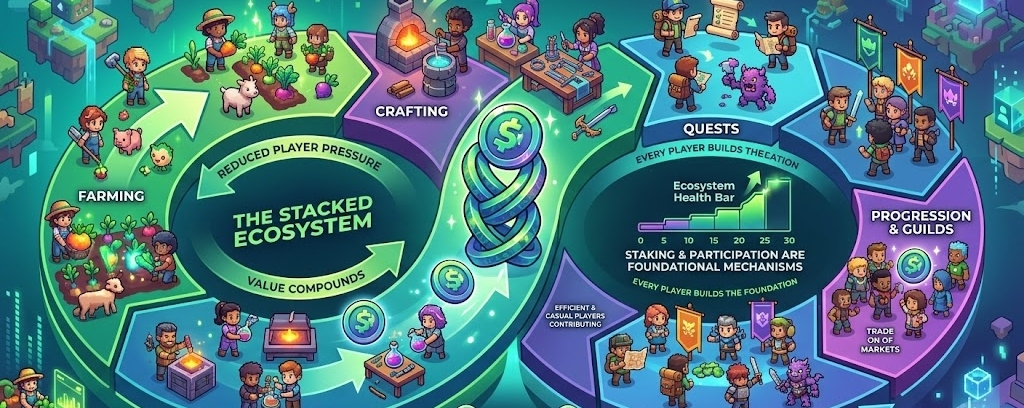
At first glance, the $PIXEL ecosystem in @Pixels feels like just another layered GameFi design — farming, crafting, quests, guilds. But the deeper you go, the more you realize it’s not about any single feature… it’s about how everything stacks together.
The “Stacked” ecosystem isn’t just a buzzword. It’s a design philosophy. Every action — no matter how small — feeds into something larger. Farming isn’t just resource generation; it connects to crafting. Crafting feeds into quests. Quests tie into progression, and progression loops back into token utility. It’s a circular system where value doesn’t just flow — it compounds.
What’s interesting is how this reduces pressure on players. You don’t have to perfectly optimize every move to stay relevant. Even inefficient or casual play still contributes to the ecosystem in subtle ways. That creates a more forgiving, yet deeply engaging environment — something most Web3 games struggle to balance.
But this also raises an important question: is staking and participation in $PIXEL just passive income… or is it a mechanism to stabilize and grow the entire economy? Because when rewards are tied to ecosystem health, every player becomes more than a participant — they become part of the system’s foundation.
And honestly, the more I think about it, the more it feels like if this balance keeps improving, Pixels might slowly reshape what a sustainable GameFi economy actually looks like.