
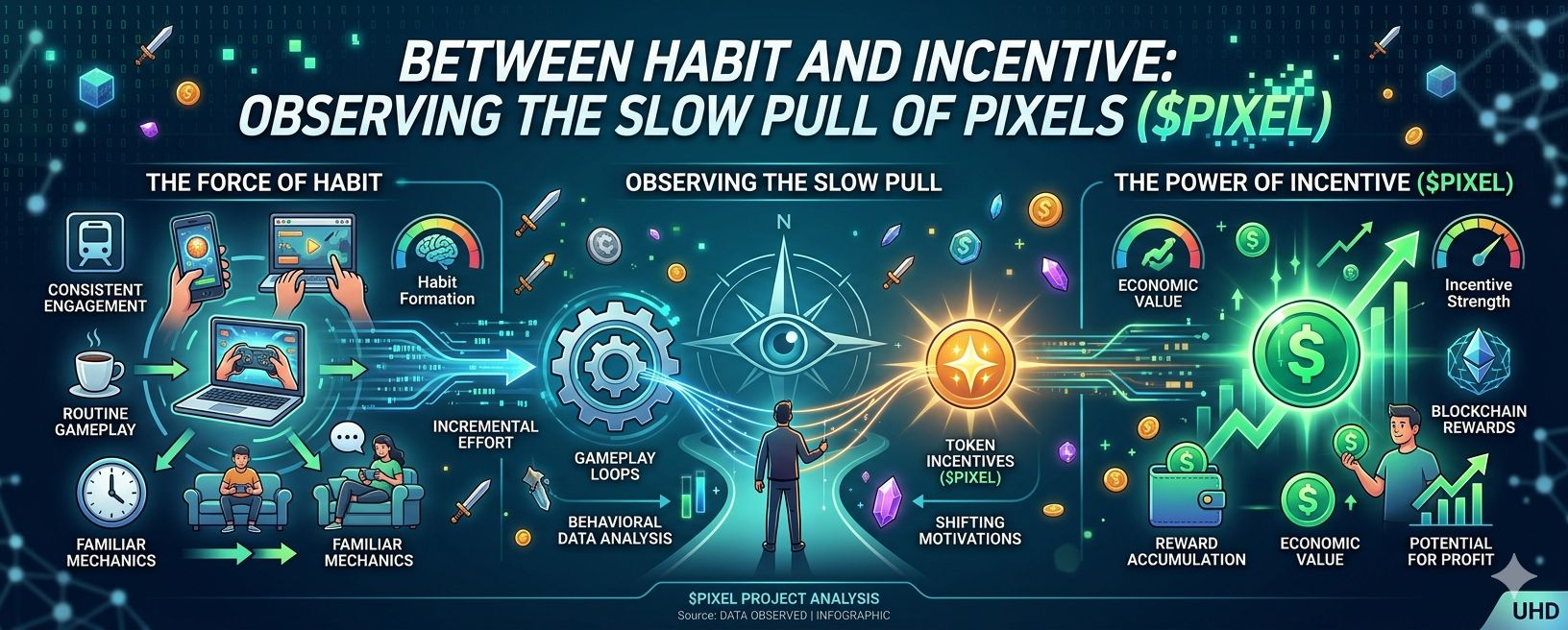
I’m watching, I’m waiting, I’m looking at how people move through Pixels, and I’m trying to understand what actually keeps them there. Not the promise of tokens or the surface-level charm, but the quieter reasons—the habits that form when no one is really paying attention. I’ve seen games like this before, where the first impression feels simple, almost too simple, and yet something underneath keeps pulling you back. So I focus less on what it claims to be and more on how it behaves when you spend time inside it.
At a glance, it sits comfortably within the growing ecosystem tied to Ronin Network, but that label doesn’t really explain the experience. What stands out isn’t the technology itself, but how lightly it tries to carry it. Farming, crafting, small loops of effort and reward—it all feels familiar, almost intentionally so. There’s a kind of restraint in the design, like it’s not trying to overwhelm you with complexity upfront. And that’s where the first question quietly appears: is this simplicity a strength, or is it just delaying something heavier underneath?
When I spend more time with it, I start noticing patterns in behavior. Players don’t rush as much as you’d expect in a token-driven environment. There’s movement, but it’s slower, more routine-based. People log in, tend to tasks, interact briefly, and leave. It doesn’t feel like a space built for constant intensity; it feels more like something you return to out of habit. That kind of engagement is difficult to measure because it doesn’t create obvious spikes of excitement. Instead, it builds a low, steady presence.
But that’s also where a bit of doubt starts to settle in. Habit can hold attention for a while, but it doesn’t always translate into long-term depth. I keep asking myself whether the systems here are evolving fast enough to justify that repeated attention. There are signs of expansion—new mechanics, subtle economic adjustments, ongoing updates—but they don’t announce themselves loudly. You have to look for them. And even then, they feel incremental rather than transformative.
There’s something interesting about how value is perceived inside this environment. The $PIXEL token exists, of course, and it shapes behavior in ways that aren’t always obvious at first. Players optimize, they calculate, they adjust their routines. But it doesn’t dominate the experience completely. In some ways, it sits in the background, influencing decisions without becoming the sole reason to play. That balance is fragile. If the token becomes too central, the game risks feeling like a mechanism. If it fades too far into the background, it loses part of its incentive structure.
I’ve also noticed how the social layer functions here. It’s present, but not overwhelming. Interactions feel casual, almost incidental. People cross paths, trade, share small pieces of information. It doesn’t push you into constant collaboration, but it leaves the door open. That kind of design can go either way—it can quietly foster community over time, or it can remain a collection of isolated routines that never fully connect.
What keeps me paying attention is not what the game is right now, but what it’s trying to become. There’s a sense that it’s still adjusting itself, still finding the right balance between being a game and being an economic system. Every update feels like a small shift in that direction, but not a final answer. And maybe that’s intentional. Maybe it’s not supposed to resolve cleanly.
Still, I can’t ignore the underlying tension. As more layers are added, the simplicity that makes it approachable could start to fade. Systems tend to accumulate weight over time, and not all of that weight is visible immediately. I’ve seen projects reach a point where they stop feeling like spaces to explore and start feeling like structures to manage. Pixels isn’t there yet, but the possibility is always in the background.
So I keep watching. I keep returning, not out of excitement, but out of curiosity. There’s something here that hasn’t fully revealed itself yet. Whether that turns into something lasting or something that slowly drifts into routine fatigue is still unclear. For now, it sits in that in-between space—quietly active, subtly evolving, and not entirely easy to define.
