
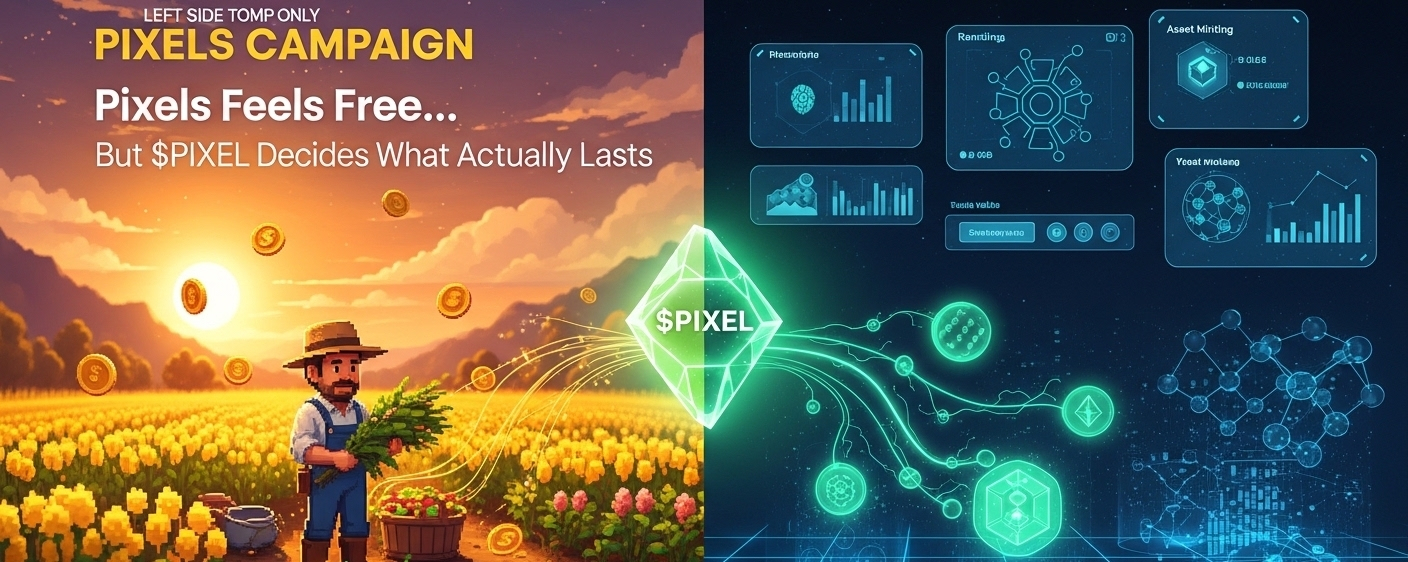
For a long time, I never really questioned free-to-play systems.
They all follow a familiar pattern.
You start, everything feels open, progress comes easy… and then eventually, something shifts. Progress slows. Rewards fade. And suddenly, the “premium layer” stops feeling optional.
It’s predictable.
But Pixels doesn’t feel like that at least not at first.
And that’s exactly what made me stop and look closer.
You can spend hours inside the game without ever touching $PIXEL.
The farming loop works. Coins flow in and out. Everything feels smooth, almost self-contained. No pressure. No obvious wall.
It feels… comfortable.
But after a while, something starts to feel slightly off.
The effort you put in doesn’t always match what actually stays.
Coins run most of the visible economy.
You earn them. Spend them. Repeat.
Simple.
But they don’t really go anywhere.
They don’t carry weight beyond the moment they’re used.
It’s activity without memory.
And that’s where Pixels quietly enters the picture.
Not everywhere.
Not constantly.
But in very specific places.
Minting.
Upgrades.
Guild-level interactions.
Moments where something doesn’t just happen… but persists.
That’s when it clicked for me:
This isn’t about paying to move faster.
It’s about choosing where your time actually lands.
Two players can spend the same number of hours.
One stays inside the Coin loop—active, consistent, always moving… but mostly resetting.
The other steps into $PIXEL occasionally not more effort, just different placement.
And over time?
Those small differences start to separate outcomes.
You don’t notice it immediately.
And maybe that’s the point.
It actually feels similar to how some blockchain systems work.
You can have constant activity… but only some of it gets finalized in a way that matters long-term.
In Pixels:
Most gameplay = execution
Pixel interactions = something closer to settlement
It’s subtle. But it changes everything.
At first, it just looks like another dual-currency system.
But the more you look, the less it behaves like a typical “premium token.”
It’s not forced.
It’s not aggressively pushed.
You can ignore it for a long time.
And that’s unusual.
Because most systems want you to feel that gap early.
Pixels lets that gap form slowly.
Almost like a quiet drift.
The real question is:
Do players even notice this?
Most people don’t think in layers when they’re playing.
They react to what’s in front of them.
If the difference between Coins and Pixel stays abstract…
a large part of the player base might never cross that line.
And if that happens?
Pixel starts to feel disconnected useful, but not essential to most behavior.
There’s also another side to this.
Supply doesn’t wait.
Unlocks happen.
Distribution continues.
If the parts of the game that actually use $PIXEL don’t expand at the same pace… pressure builds.
I’ve seen systems like this before.
Where the design made sense but timing didn’t.
Still… there’s something here that’s hard to ignore.
If Pixels grows beyond a single loop into multiple connected systems
this separation could become its biggest strength.
Coins stay local.
They serve the moment.
But Pixel could become the thread that connects everything.
Not just a currency—
but a way to carry outcomes forward.
And that’s where things shift.
From a simple game economy…
to something closer to infrastructure.
But there’s also an uncomfortable edge to it.
If most players stay in the visible loop…
while value quietly accumulates somewhere deeper…
then the system isn’t exactly neutral.
It’s selective.
Not through paywalls.
But through what it decides is worth keeping.
I’m not sure if that’s intentional.
Or just something that emerged from the design.
But one thing is clear:
Pixels doesn’t force you to see this.
You can play for a long time without ever noticing.
And maybe that’s why it works.
It doesn’t interrupt you.
It just… routes things differently underneath.
From the outside, it still looks like a free economy.
But after sitting with it for a while
it doesn’t feel entirely free.
It feels layered.
And depending on where you operate…
the same effort might not mean the same thing at all.
