
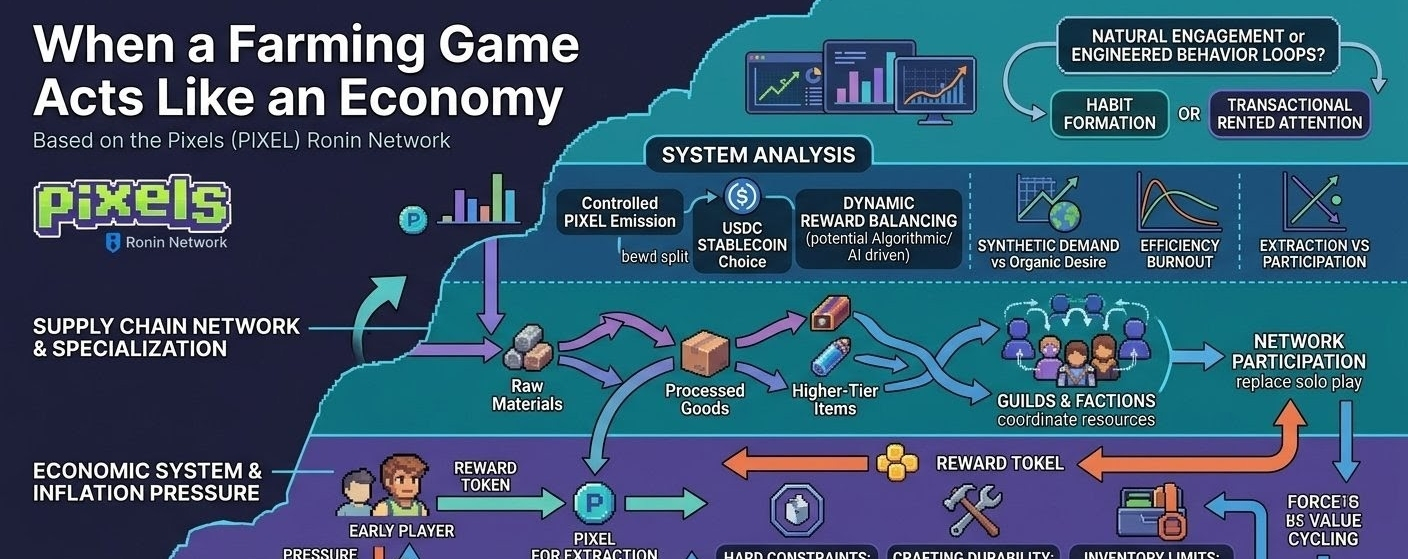
So here’s the question I keep coming back to: when does a chill farming game quietly turn into a full-blown economic system that’s shaping how people behave?
Because that’s exactly what’s going on with Pixels (PIXEL) on the Ronin Network.
On the surface, it looks harmless. Plant crops, gather stuff, wander around. Simple. Almost too simple. But give it some time and you start noticing something else underneath. This thing isn’t just about gameplay. It’s about keeping value moving, keeping players looping, and yeah keeping the whole system from breaking under its own weight.
And honestly, I’ve seen this pattern before.
Let’s get straight to the problem no one can avoid: inflation.
You’ve got a reward token PIXEL and the game keeps handing it out. That’s the hook. That’s what pulls people in. But here’s the thing… if everyone’s earning and no one’s spending, it breaks. Fast.
Early players? They usually play it smart. They farm hard, optimize everything, and extract as much value as they can. Not reinvesting. Not cycling it back. Just pulling it out.
Can you blame them? Not really.
But that behavior creates pressure. A lot of it.
Then comes the second issue, and people don’t talk about this enough: the end-game problem. You grind, you optimize, you get efficient… and then what?
Nothing changes. The loop just gets tighter. Smaller gains. Same actions.
That’s where most systems start to feel hollow.
Now here’s where Pixels gets interesting. It doesn’t pretend these problems don’t exist. It leans into them and builds guardrails.
Not soft ones either. Hard constraints.
Take expansion costs. You want to grow? Cool. Pay up. And not just a little. Costs scale. The more you progress, the more it asks from you.
And yeah, it’s intentional.
You’re not meant to sit on resources. The system pushes you almost forces you to reinvest. Otherwise, you stall.
Same story with crafting durability. Your tools? They don’t last. They wear out. You fix them or replace them. Over and over again.
It sounds annoying. And sometimes it is.
But it solves a real problem: permanent efficiency. If tools lasted forever, demand would die. Simple as that.
So the game keeps pulling you back into the loop. Produce → consume → repeat.
Then there’s inventory limits. You can’t just hoard everything and chill. You hit a cap, and suddenly you’ve got decisions to make. Use it. Trade it. Dump it.
You stay active whether you want to or not.
That’s not accidental design. That’s control.
But Pixels doesn’t stop at solo loops. That’s actually where it starts shifting gears.
At first, you’re just farming your own land. Easy. Self-contained. But over time, the system nudges you into something bigger supply chains.
Yeah, actual production layers.
Raw materials turn into processed goods. Those turn into higher-tier items. And suddenly doing everything yourself stops making sense. It’s inefficient.
So players specialize.
And that’s where things get tricky.
Now you’ve got dependency. You need other players. They need you. Guilds start forming, factions, coordinated groups controlling resources and optimizing output.
It stops feeling like a solo game.
It starts feeling like a network.
Honestly, at that point, you’re not really “playing” anymore in the traditional sense. You’re participating in a system. A production system.
Call it what it is.
Let’s talk numbers and structure for a second.
Token supply isn’t dumped all at once. They stagger it. Controlled emission. It slows things down, spreads out the pressure.
But let’s be real it doesn’t fix inflation. It just delays it.
Then there’s USDC in the mix. Stable value inside the system.
Sounds good, right?
Yeah… but it creates a split. Players now have a choice: stay in the PIXEL loop or extract stable value and walk away. And guess what a lot of people choose?
Exactly.
There are also signs of dynamic reward balancing. The system adjusts output depending on activity, maybe even broader economic conditions. Some of it feels algorithmic. Maybe even AI-driven.
The goal is obvious match rewards with what the system can actually handle.
Smart idea.
But here’s the catch: if players don’t understand how rewards change, trust starts slipping. And once that goes, it’s hard to get back.
Now let’s get real about the risks.
First one? Synthetic demand.
Most of the “need” in the system comes from forced sinks repairs, upgrades, limits. Not organic desire. Not actual player-driven demand.
That works… until it doesn’t.
If people start feeling like they’re being pushed instead of choosing to engage, the whole thing turns transactional. And transactional systems don’t build loyalty.
Second issue: efficiency burnout.
Players optimize everything. That’s what they do. But the better they get, the less they gain per unit of effort.
That’s where frustration creeps in.
You’re doing more. Getting less. And the loop doesn’t evolve fast enough to compensate.
I’ve seen systems stall right there.
Then there’s the social layer. Guilds sound great. Coordination sounds powerful. But it’s fragile.
Take away strong rewards, and people drift. Fast.
No incentive, no structure. It falls apart.
And finally this is the big one extraction vs participation.
Are players actually building something inside this system?
Or are they just farming it and leaving?
Because if it’s mostly extraction, no amount of clever design will save it long term.
Now zoom out for a second.
What Pixels is really doing isn’t just building a game. It’s building behavior loops.
That’s the part people underestimate.
It starts simple. Low pressure. Easy actions. Then slowly, layer by layer, it adds structure, incentives, constraints. Before you realize it, you’re not just playing you’re managing time, resources, output.
You’re working a system.
Sounds dramatic? Maybe. But look at it closely.
Why do players keep logging in? Is it because they love farming mechanics?
Or because the reward loop keeps nudging them back?
Be honest.
And that leads to the uncomfortable question.
Is this engagement actually natural?
Or is it engineered?
Because if players stay even when rewards shrink, then yeah something deeper is happening. Habit formation. Maybe even conditioning.
If they leave the moment rewards dip, then the system never really worked. It just rented attention.
Either way, that answer matters.
Pixels isn’t a finished product. Not even close.
It’s an experiment. A pretty ambitious one.
It’s testing whether you can hold together a closed-loop economy using controlled scarcity, social coordination, and adaptive rewards… without everything collapsing into pure extraction.
Maybe it works. Maybe it doesn’t.
But one thing’s clear.
This isn’t just a game anymore.
