
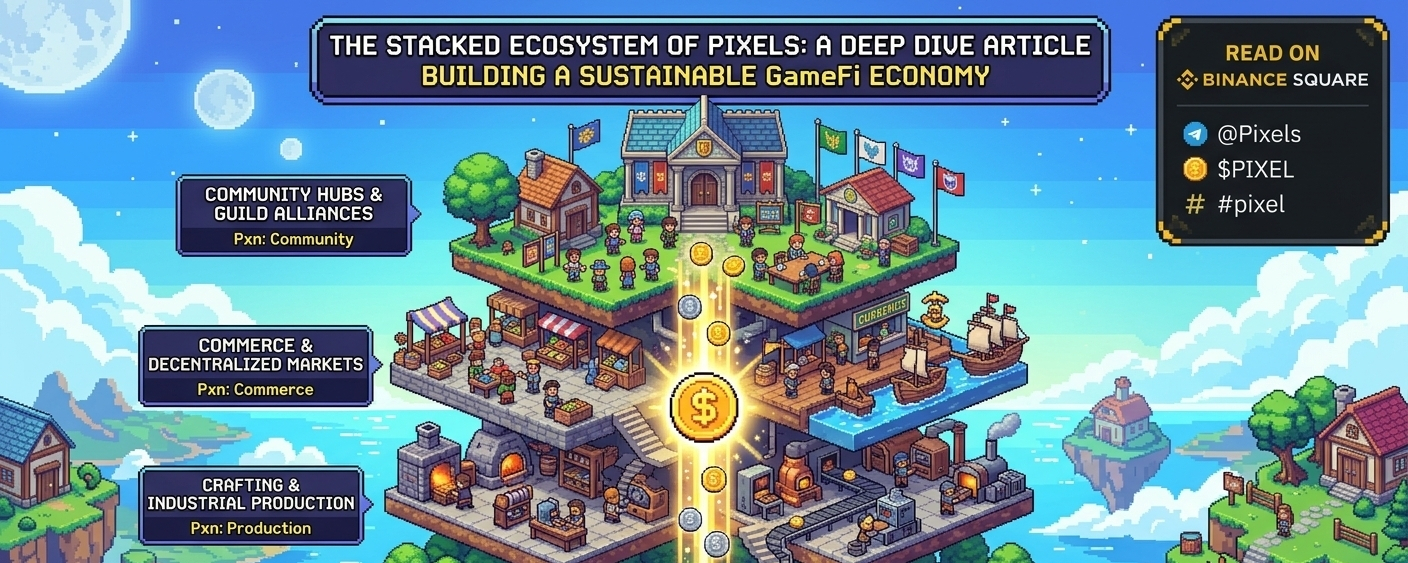
The world of Pixels is undergoing a profound transformation, moving beyond its delightful farming roots to build something far more complex and enduring. The concept of the "Stacked Ecosystem" is a deliberate, strategic architectural blueprint that @Pixels is executing, designed to create deep interconnectedness between various in-game activities, resources, and player actions. This shift isn't just about adding new features; it's about layering mechanics in a way that fosters a thriving, interdependent economy and immersive long-term gameplay.
So, what does this "Stacked" approach actually mean for players and the future of the game? Let’s break down the layers.
Layer 1: The Core Foundation – Farming & Gathering
At the base of everything is the core loop that Pixels perfected: resource gathering and farming. This layer provides the essential raw materials—crops, wood, stones, and basic components. Every player, regardless of their progression, interacts with this level to obtain the building blocks of the ecosystem. It's the engine that powers the initial stages.
Layer 2: The Creation Engine – Crafting & Industry
This is where the stacking truly begins. The simple materials collected in Layer 1 become crucial inputs for the creation engine. This layer introduces industrial mechanics, refining raw resources into specialized items, tools, components, and eventually, highly valuable crafted goods. Instead of just selling basic crops, players must decide whether to consume them, refine them, or trade them to craftspeople who require specific ingredients. This adds strategic depth to production.
Layer 3: The Engine of Commerce – Global Trade & Markets
A vibrant economy needs efficient exchange. This layer is represented by integrated, dynamic, decentralized markets. It allows specialized resource gatherers and craftspeople to find each other, creating a frictionless global commerce system. Players are no longer isolated nodes; they are active participants in a macroeconomy. Decisions on what to produce and trade become critical, as the demand for advanced goods from higher layers ripples back to the base layers.
Layer 4: The Social Fabric – Community, Guilds & Collaboration
Pixels has always been a social experience, but the Stacked Ecosystem takes it further. Through Guilds and advanced community tools, this layer incentivizes collaboration. Players can pool resources, share technology, coordinate large-scale industrial projects, and compete or cooperate with other groups. Social structures add massive utility to land and resources, and the success of a guild often depends on how effectively its members can utilize all layers of the stack. Interoperability and social coordination are multipliers.
The Economic Glue: How $PIXEL Ties it All Together
Crucially, $PIXEL is the lifeblood and utility token that permeates all these layers. It isn't just a currency for simple purchases; it is deeply integrated into the "Stacked" architecture. $PIXEL is used for interacting with key systems, powering advanced processes, unlocking premium content and boosts, participating in governance, and facilitating trade on decentralized marketplaces. The interconnectedness of the layers means that actions in one area often create demand for $PIXEL to be used in another, fostering a continuous and sustainable economic loop that aligns player incentives with the long-term growth of the Pixels universe.
The "Stacked Ecosystem" is a bold statement about the future of Pixels. It signifies a move towards deep, systemic complexity that provides meaningful utility for all players and stakeholders, making every choice, every resource, and every $PIXEL XEL have real impact in a vast, interconnected, layered world.