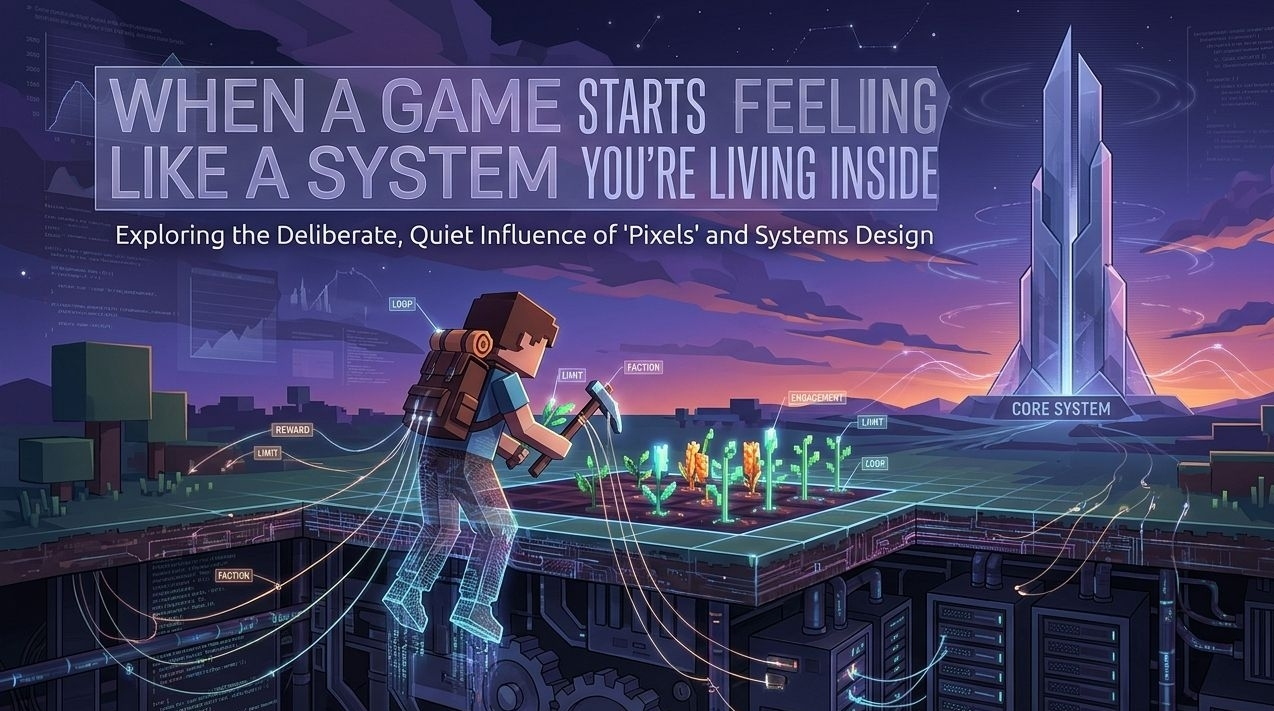
@Pixels There’s this thought that keeps coming back to me every time I spend a little longer in Pixels, and no matter how I try to simplify it, it never really settles into a clear answer. At first glance, everything looks exactly how you’d expect—planting crops, crafting items, earning tokens—it all fits neatly into that familiar loop we’ve seen so many times before. But the deeper I go, the more it starts to feel like that surface is just a layer, and underneath it, something more structured is quietly running the show. It stops feeling like I’m just playing for the sake of it, and starts feeling like I’m navigating a system that’s constantly adjusting how I behave inside it.
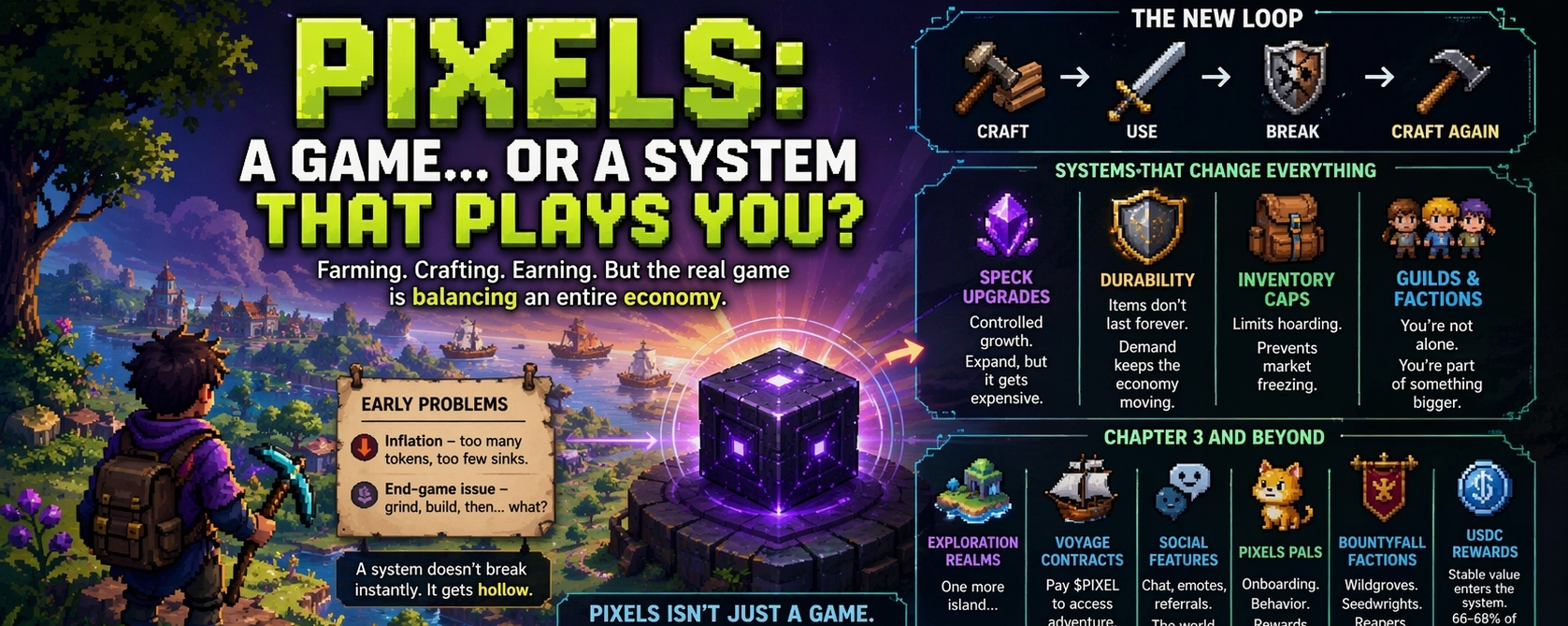
In the beginning, it didn’t take long to notice where things felt off. Rewards were coming in, but there wasn’t enough pressure to use them in meaningful ways, and progress itself felt like it was building toward something unclear. You could keep going, sure, but the “why” behind it started to fade after a while. It wasn’t a sudden collapse, more like a slow emptiness creeping in. What’s interesting now is how that emptiness is being filled—not with flashy updates, but with small, deliberate changes that quietly reshape everything. Growth is still there, but it’s no longer effortless. Expansion demands more, tools don’t last forever, and even the limits placed on what you can hold start to make sense when you realize they’re keeping the entire system from stalling.
The loop has become tighter, more intentional. You create something, you use it, it wears out, and then you’re back to creating again. It sounds basic, but it keeps things moving in a way that feels controlled without being obvious about it. And then, just when you get comfortable with that rhythm, the experience starts to stretch beyond your own actions. It’s no longer just about individual progress. With factions, shared goals, and coordinated roles coming into play, there’s this quiet shift where your actions start to feel connected to something bigger. Even if you’re still doing the same tasks, they carry a different weight because they’re no longer isolated.
Exploration adds another layer to that feeling. There’s this subtle pull that makes you want to go just a bit further, check one more area, spend a little more time than you planned. It doesn’t force you—it just nudges you in a way that feels natural. Even the idea of spending tokens to access certain parts of gameplay, which sounds restrictive at first, begins to feel like part of the system’s internal logic. Everything feeds back into itself. Nothing exists in isolation. And strangely, that consistency makes it feel more deliberate than limiting. At the same time, the social side of things starts to come alive in small but meaningful ways. Interactions that were once missing now give the world a sense of presence, making it feel less like a solo experience happening in a shared space and more like something actually inhabited.
What really shifts my perspective, though, is realizing how much of this design is focused on shaping behavior rather than just adding content. Some features seem simple, even unnecessary at first, but when you step back, they start to look like tools guiding how often you return, how you spend, and how you stay engaged. It’s not loud or aggressive—it’s subtle, almost invisible—but it’s there. And that subtlety is what makes the whole experience feel less like a traditional game and more like something experimental, something carefully tuned to see how players move within a structured environment.
As the system evolves, the introduction of more stable rewards alongside the existing token economy adds a different kind of weight to everything. It feels less chaotic than before, more grounded, like there’s an effort to create balance rather than just growth. Holding assets starts to matter in a different way, influencing how you play instead of just sitting in the background. At that point, it becomes harder to describe the experience as “just a game,” because the reasons for playing aren’t purely about enjoyment anymore—they’re mixed with strategy, timing, and a sense of participation in something larger.
And that’s where the thought lingers for me. When everything is designed this carefully—every loop, every limitation, every reward—it makes me wonder where the natural, unstructured fun fits into it all. I still find moments that feel genuinely enjoyable, moments where I’m not thinking about efficiency or outcomes, but they exist alongside a system that clearly knows how to keep me engaged whether I’m aware of it or not. It doesn’t feel manipulative, just very intentional, and maybe that’s what makes it harder to define.
So I stay somewhere in between, not fully convinced in either direction. It’s more than a game, but not something entirely separate either. It exists in that in-between space where gameplay, economy, and social design overlap, creating something that feels alive in a very structured way. Whether that structure is what keeps people invested long-term or what eventually pushes them away is still uncertain. For now, I’m still inside it, still experiencing it, still trying to understand if I’m the one playing… or if the system, in its own quiet way, is playing me right back.