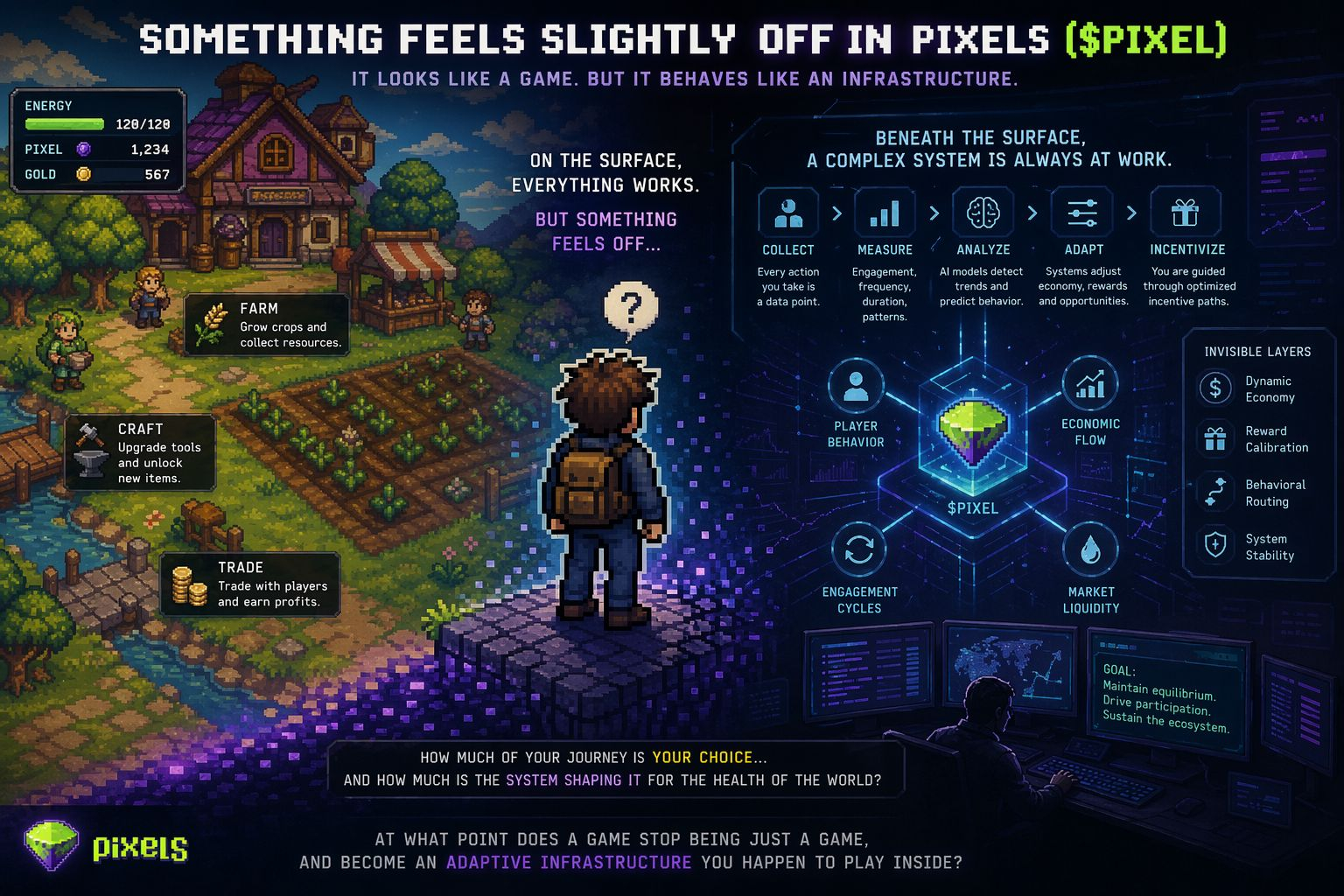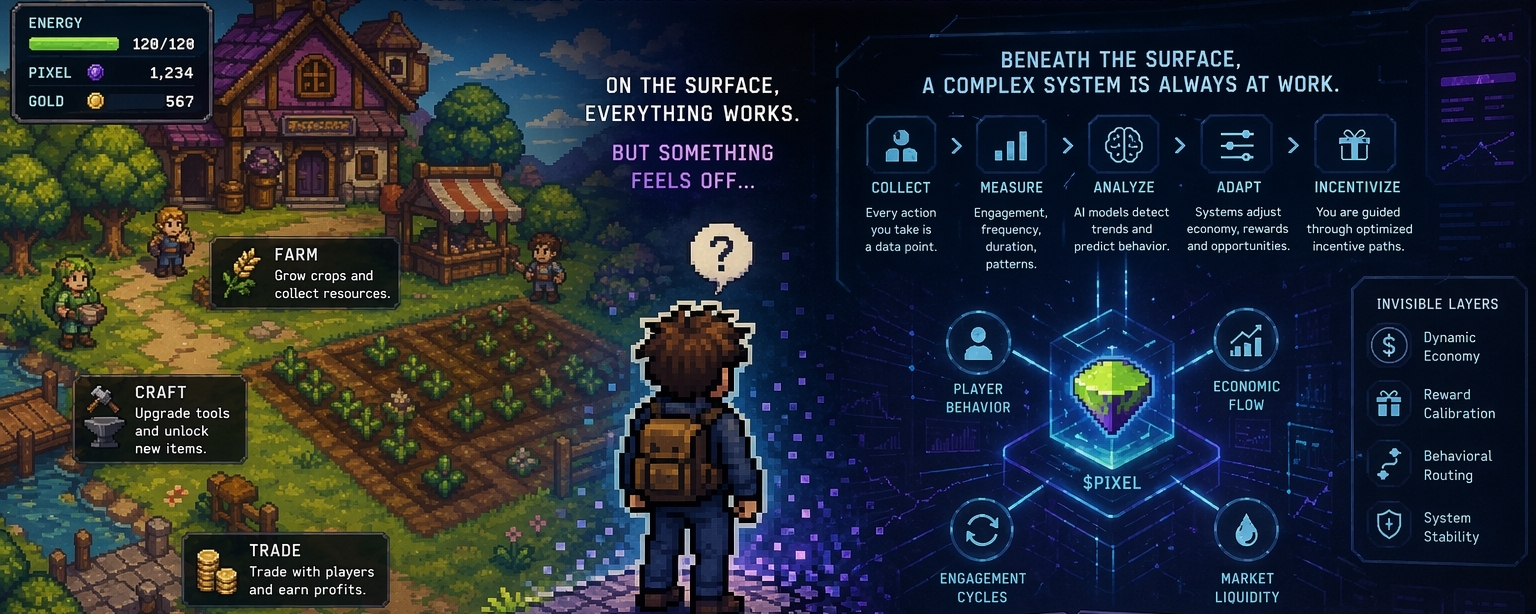

There’s this feeling in $PIXEL that just doesn’t sit right, even though you can’t put your finger on why. You jump in, go through your usual routine farm, collect, upgrade, trade a bit and honestly, everything seems fine. The animations don’t glitch, rewards still show up, the economy keeps rolling along. Nothing looks broken. But if you hang around a little longer, something heavy starts to creep in. The whole thing feels less like a world you inhabit and more like a carefully monitored experiment watching how you move inside it.
It’s almost too faint to call out, but it lingers.
So, why does everything work as planned and yet still feel… off?
Not in a dramatic, “the game’s busted” kind of way. It’s more like things are slightly out of sync. You do the right actions, but they don’t quite feel connected anymore. Rewards appear, but they don’t carry the same feeling. Progress is there, but it’s stretched across layers you can’t see. That leaves you in this weird spot: the game reacts, but not in the grounded way older games used to. The feedback loop feels distant, almost numbed out.
And that tension says a lot it hints that something deeper than just gameplay mechanics is going on.
If you look a bit closer, one thing jumps out: Pixels isn’t just a cycle to keep you busy it’s a stack of behavioral incentives. Every move you make is not just for the game, but also a data point. You’re not only farming resources; you’re feeding a larger system that watches how often, how long, and how you engage. That shifts the feeling fast. What used to be simple play now turns into ongoing participation, like you’re scoring points in a system designed to analyze how you play more than what you achieve.
But there’s another layer.
The weirdness isn’t about the rewards themselves it’s about being detached from real consequences. In the old games, effort and reward were directly linked. Mine, get ore. Fight, earn XP. In Pixels, that bond is fuzzier. Some rewards show up right away. Others are delayed, or they get shuffled around in ways that don’t always make sense while you’re playing. Your brain tries to apply old patterns, but they don’t quite fit and that mismatch is where the off-kilter feeling sticks.
It’s not that things are inefficient. It’s more like value is getting spread across hidden layers.
Here’s the tougher part: the game starts acting less like a closed-off world, and more like an underlying system. The main gameplay is just a shiny front-end. Underneath, mechanics track everything when you play, how often, what you interact with, how you affect the economy. Rewards aren’t just prizes they’re tiny nudges, constantly adjusting based on big-picture trends. Once you see that, the illusion of reactive play slips. Suddenly, the game feels adaptive in a way you can’t really see, and that’s unsettling.
You can’t escape the “infrastructure” lens at this point.
From that angle, Pixels isn’t just asking, “What did you do?” It’s silently steering you: “What do we need you and everyone else to do now, so the whole thing keeps humming?” It subtly morphs the gameplay loop into feedback systems that are both personal and collective. Sure, you’re progressing. But you’re also being nudged down certain paths so the whole ecosystem stays alive, liquid, and stable.
And that creates this odd split.
Things feel dynamic, almost alive. At the same time, you sense a kind of gentle scripting behind your choices. You’re making real decisions, but they’re always inside boundaries the system sets to maintain balance. It doesn’t feel fake. Just… tuned. Most people don’t notice outright. It’s that background feeling nothing looks wrong, but something’s not fully right.
What really matters goes beyond Pixels itself. More and more, games like this act like early economic simulators wearing a game’s mask. Every player is both user and data generator. Every click and action helps steer future updates or conditions. The game isn’t just a place to play anymore it learns how you play, then quietly updates itself on the fly.
At that point, here’s a big question: when a system becomes this responsive, does it start predicting you instead of playing with you?
Because once prediction sneaks in, the emotional flavor of the whole thing changes. It’s less about surprise or finding new outcomes, and more about walking down optimized paths the game predicts you’ll take. Nothing is forced, but everything feels quietly steered. That’s exactly why it’s so hard to explain.
Back to where we started.
Something’s off, not because anything’s broken, but because your freedom and impact are blurred across layers you don’t see. Sure, the game responds when you play, but now it feels like the system also responds through you reacting to the crowd, to the economic flow, to all those hidden patterns