
That morning I closed my laptop earlier than usual, not because I was done, but because I could feel I had just spent too much energy on tiny context switches. That was exactly when Binance AI Pro caught my attention, not because it answered better right away, but because it made me rethink where the real value of multi model systems actually lies.
After many years in this market, I am no longer easily persuaded by descriptions of technology that sound powerful. Multi model is a clear example. Having 3 models or 7 models does not create value on its own. Value only appears when the integration is tight enough for the user to move from asking, to reading, to comparing, and then to deciding the next step within one continuous rhythm. I think Binance AI Pro is worth noticing because the hard part is not having many brains, but not forcing the user to become the coordinator for them.
The first thing I pay attention to is that a good usage flow must preserve the original intent. Users do not open a tool to admire the architecture underneath. They open it because they need to clarify something unfinished. If after the first question the system branches off, and by the second question the user has to rebuild the context from scratch, then the experience is already broken. Binance AI Pro has value because it makes the transition between steps less visible, and reduces those 20 seconds a user loses each time they have to return to the earlier idea.
The second point lies in role separation without showing off the roles. Many products love making users see which layer is being called, which reasoning mode is being switched, which answer style is being changed. Honestly, that is a technically flashy habit that drains the user. A mature usage flow should know how to hide the shift changes backstage. Binance AI Pro stands out to me because what I feel is continuity, not the feeling of being pushed across multiple processing counters. Ironically, the more a product makes the user see the machinery changing gears, the less intelligent it feels in the actual experience.
From a builder’s perspective, the real problem here is orchestration. It is about the system knowing when to widen the frame, when to compress it so it stays close to a decision, and when to preserve the context of the previous 5 exchanges. If it cannot handle that layer, then multi model is just a bundle of capabilities placed side by side. Binance AI Pro is showing that value only appears when that orchestration layer is compressed into a natural usage behavior.
I also notice a point that few people talk about, which is accumulated cognitive cost. Every time the user has to restate the context, every time they have to change the way they ask, every time they have to adjust their wording so the system understands correctly, they lose a bit of energy that they cannot even measure clearly. After 10 interactions, that loss is much larger than most people think. Perhaps this is where Binance AI Pro is moving in the right direction, because it treats the usage flow as the place where the sense of intelligence and reliability is decided.
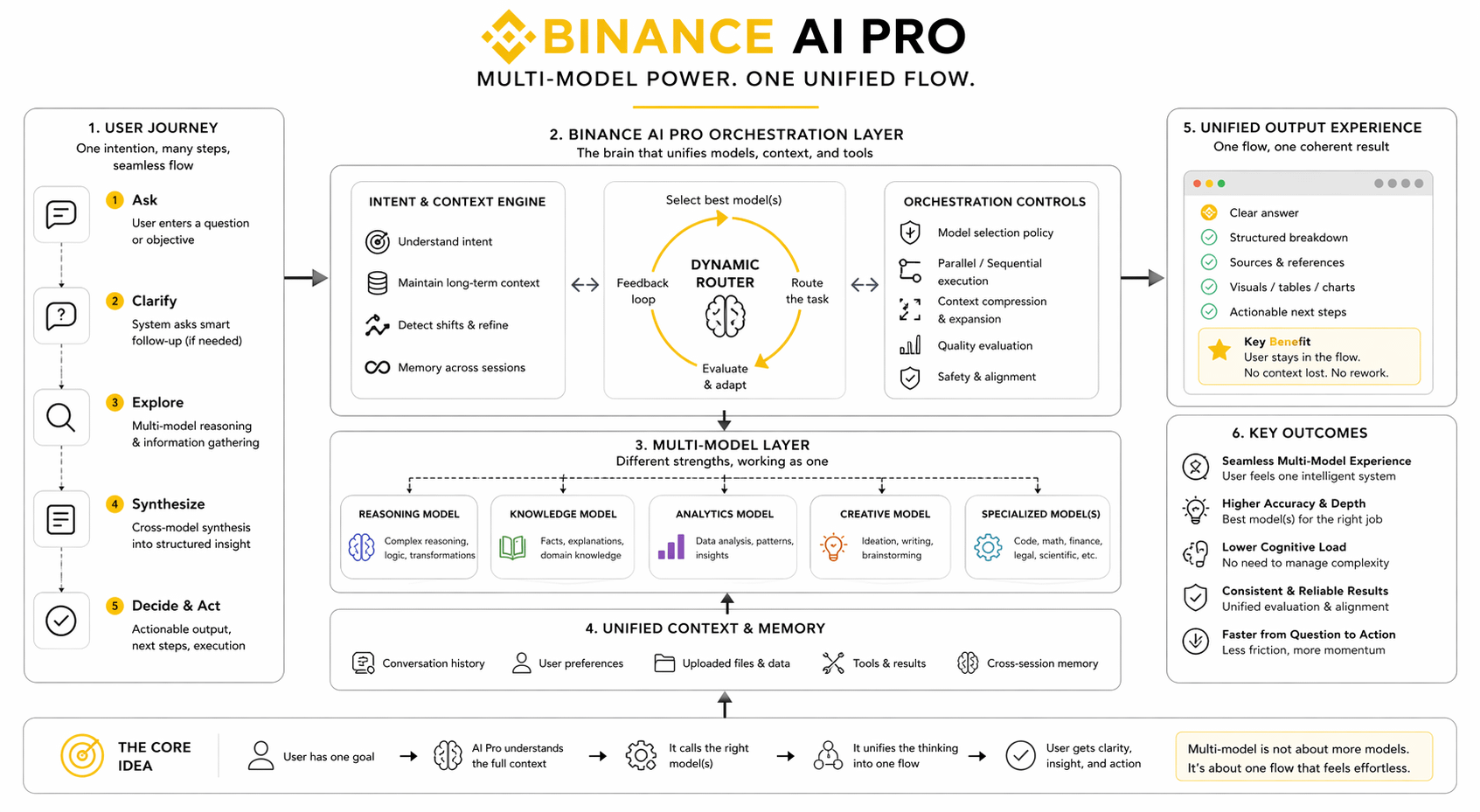
Few would expect that a tool called intelligent is often judged incorrectly at exactly the point where the user feels tired. People tend to look at the best answer in one impressive trial, but a real product is scored over 15 minutes of continuous use, over 8 connected questions, at the moment when the user changes direction halfway through and does not want to start over. I rate Binance AI Pro highly because it touches exactly this middle stretch. It does not turn multi model into a slogan, it turns it into the ability to preserve momentum and direction.
After moving through many cycles, I have come to see that a tool only becomes truly mature when it takes the mess onto itself and returns clarity to the user. Binance AI Pro gives me the sense of a system moving in that direction, where the value does not lie in exposing how many layers of processing it has, but in whether the user can continue thinking without having to bend down and pick up each piece of context that has fallen away. Maybe the most important question to ask about a multi model system now is no longer how powerful it is, but whether it has become seamless enough for people to forget, at least a little, the presence of the machinery behind it.