
I’m watching the way people move through Pixels, not rushing, not chasing anything too loudly. I’m waiting to see if their behavior changes over time or if it settles into something repetitive. I’m looking at the small habits forming—how often someone returns to their land, how long they stay, what they choose to ignore. I’ve seen games like this before, or at least versions of this promise, where the surface feels calm but underneath there’s a quiet question about how long that calm can hold. I focus less on what Pixels says it is, and more on what it becomes when no one is explaining it anymore.
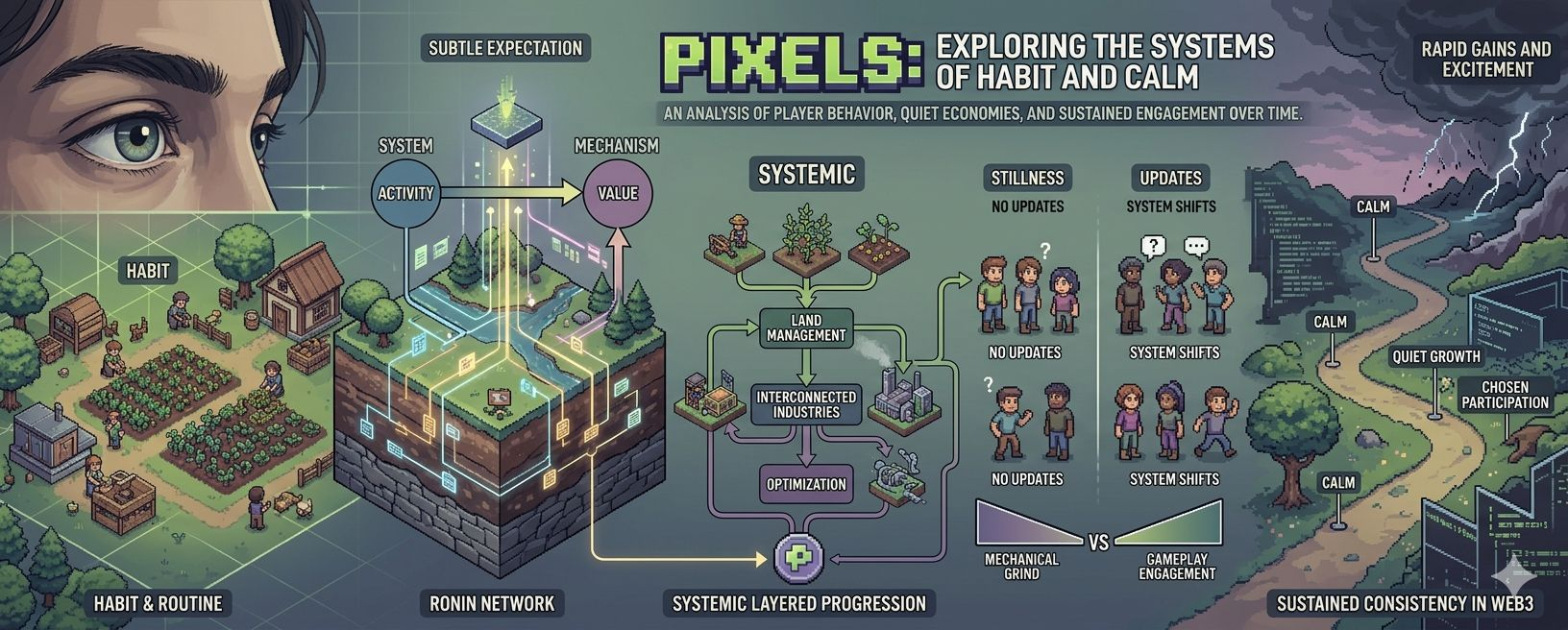
At first glance, Pixels presents itself gently. Farming loops, resource gathering, simple interactions—nothing aggressive, nothing demanding immediate mastery. But that softness can be misleading. The real structure isn’t in the visuals or the tasks themselves; it’s in how the systems begin to layer over time. The Ronin Network gives it a kind of efficiency and accessibility that lowers friction, but it also introduces a subtle expectation: that activity should eventually translate into value. Not immediately, not loudly, but gradually enough that players begin to feel it rather than question it.
What stands out isn’t the gameplay alone, but the behavior it encourages. Players don’t just play—they optimize, they adjust, they observe each other. There’s a quiet economy forming, not just in tokens or assets, but in time and attention. Some players treat it casually, checking in like a daily ritual, while others lean into it with a kind of calculated patience. That difference creates an interesting tension. Pixels doesn’t force you into one approach, but it quietly rewards those who stay longer, who notice patterns, who are willing to repeat actions without immediate feedback.
The recent updates seem to be pushing this even further. There’s a noticeable shift toward deeper systems—more layers in land management, more interconnected industries, more reasons to stay engaged beyond simple farming. On paper, it looks like growth. In practice, it feels like weight. Not necessarily a bad kind of weight, but something that changes how the game is experienced. It asks for more attention, more planning, more awareness. The question is whether that added depth strengthens the experience or slowly turns it into something more mechanical than it first appeared.
I find myself paying attention to how people react to these changes rather than the changes themselves. Some adapt quickly, almost instinctively, as if they were already expecting this direction. Others seem to hesitate, continuing with old patterns even when the system has moved forward. That gap is where the real story of Pixels exists—not in the updates, but in how players absorb them.
There’s also something worth noticing in how the world feels when nothing significant is happening. When there’s no update, no announcement, no external push—does Pixels still hold attention? For some, it does. They return to their land, complete their routines, make small adjustments. For others, the absence of momentum becomes noticeable. This is where many projects start to reveal their limits, not during growth, but during stillness.
The token itself, PIXEL, sits quietly within all of this. It isn’t constantly demanding attention, but it’s always present in the background, influencing decisions in subtle ways. Players might not think about it directly while planting crops or managing resources, but it shapes their long-term behavior. It introduces a layer of intention that goes beyond gameplay. The challenge is whether this layer enhances the experience or slowly shifts the focus away from it.
What makes Pixels interesting isn’t that it’s trying to be something entirely new. It’s that it’s trying to sustain something familiar in a space that often struggles with consistency. The calm, the routine, the sense of slow progression—these are not new ideas. But maintaining them in a Web3 environment, where expectations often lean toward rapid gains and constant excitement, is a different kind of challenge.
I don’t think Pixels is trying to impress in obvious ways. It doesn’t need to. Its strength, if it has one, lies in its ability to hold attention quietly. But that also means its weaknesses are less visible at first. They appear over time, in repetition, in the moments when players begin to question why they’re still there.
For now, I’m still watching. I’m still waiting to see if the patterns deepen or flatten out. I’m still looking at how the balance between game and mechanism evolves. Pixels hasn’t fully revealed what it wants to be, and maybe that’s the point. It exists in that in-between space—part game, part system, part experiment.
And the real question isn’t whether it works today. It’s whether people will still move through it the same way weeks or months from now, not because they’re told to, but because they quietly choose to.
