
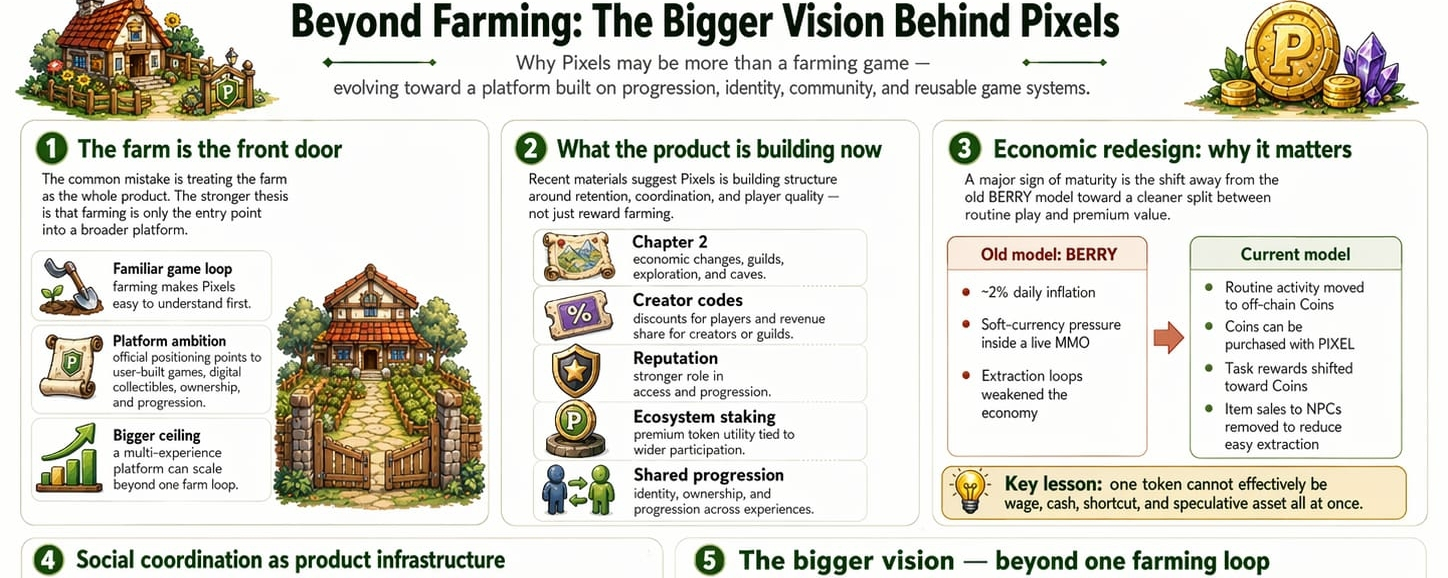

@Pixels I think the biggest mistake people make with Pixels is assuming the farm is the product because to me the farm is only the front door. What matters now is that Pixels presents itself as more than a farming game. Its official site describes a platform where users can build games that integrate digital collectibles ownership and progression. That shift changes how I look at it. A farming loop can stay popular for a while but a platform that carries identity assets and community behavior across multiple experiences has a much larger ceiling.
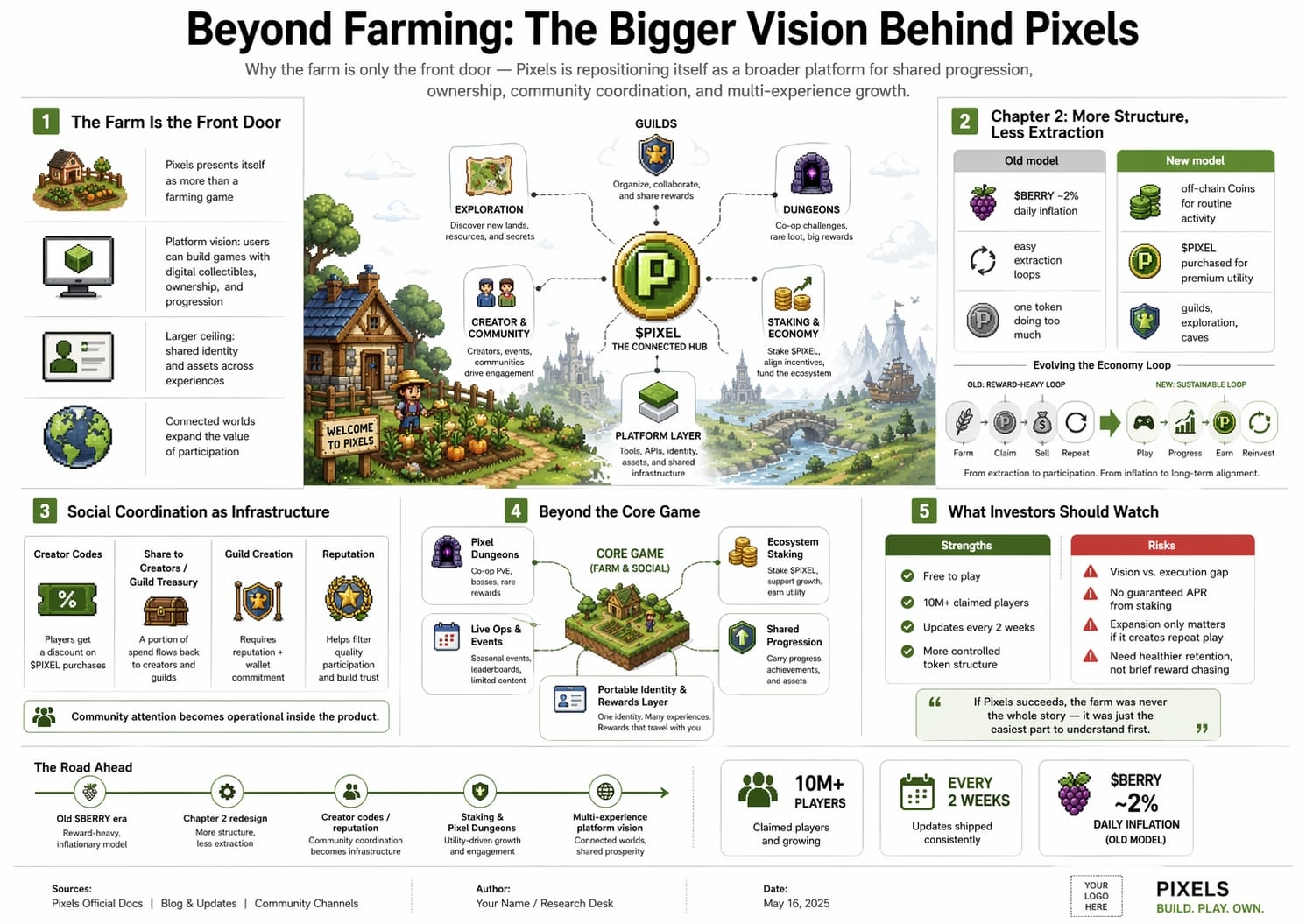
What makes Pixels relevant now is that recent development has moved away from the most basic reward farming narrative. The project’s FAQ says Chapter 2 is built around economic changes guilds exploration and caves. Current product materials also show creator codes a stronger role for reputation and ecosystem staking. I read that as a serious attempt to build structure around player quality social coordination and retention rather than simply chase activity numbers. That feels healthier than pretending a token can carry the whole game on its own.
The clearest sign of maturity in my view is the economic redesign. Pixels said the old $BERRY model had roughly 2 percent daily inflation and then moved routine activity toward an off chain Coin system that can be purchased with $PIXEL. Task rewards shifted toward Coins and item sales to NPCs were removed to reduce easy extraction loops. I like that choice because it admits a basic truth. One token cannot serve as wage spending cash progression shortcut and speculative asset all at once without eventually putting pressure on the game around it.
I also think the bigger vision becomes clearer when I look at how Pixels handles social coordination. Guild creation requires reputation and a wallet commitment. Creator codes give players a discount on $PIXEL purchases while sending a share to a creator or guild treasury. That matters more than it may seem at first. It turns community attention into something operational inside the product itself. Instead of treating creators and guild leaders as outsiders Pixels is trying to make them part of the economic system.
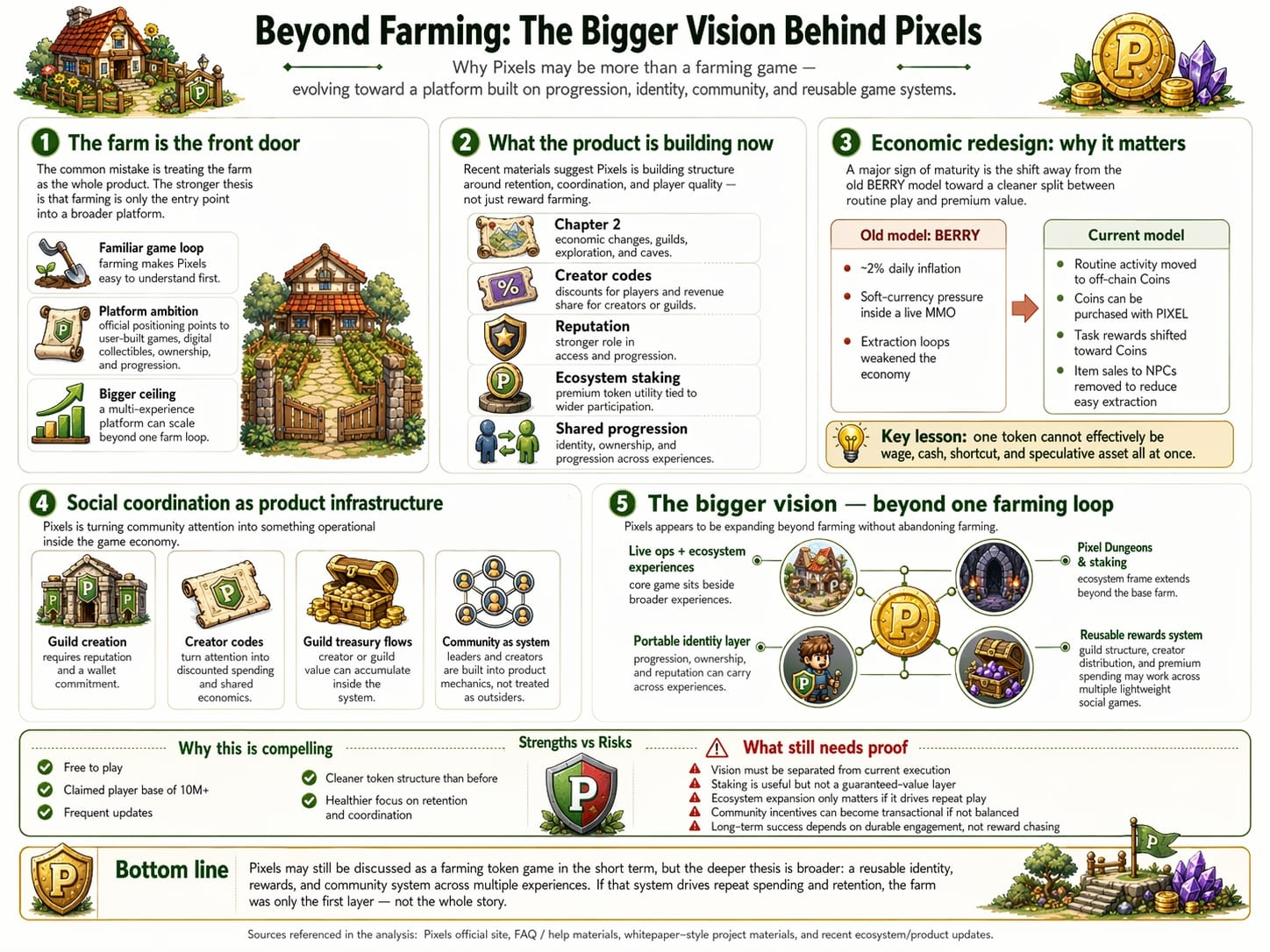
What keeps me interested is that Pixels is expanding beyond farming without trying to erase farming. Its help center groups live ops and ecosystem experiences alongside the core game and it already highlights Pixel Dungeons and staking as part of that broader frame. The platform site also keeps leaning into a world where communities come to life and where users can build on top of shared progression and ownership. To me that is the real thesis. Pixels wants to become a portable identity and rewards layer for lightweight social game experiences that can extend beyond one farming loop.
That does not make the case easy. The strengths are real. Pixels is free to play. It claims a player base of over 10 million and says it ships updates every two weeks. The token model is also moving toward a more controlled structure. The risks are real too. Some public materials are older than others so investors still need to separate long term vision from current execution. Staking does not offer a flat or guaranteed APR which is sensible but it also limits how much value can be assumed from that layer. And ecosystem expansion is hard because new modes only matter if they create repeat play instead of brief reward chasing.
My takeaway is simple. In the short term Pixels may still be discussed like a farming token with seasonal events but I think that view is too narrow. The longer term question is whether Pixels can turn reputation creator distribution guild structure and premium spending into a reusable system across multiple experiences. If it can then the farm was never the whole story. It was only the easiest part to understand first. If it cannot then the market’s skepticism will be justified. That is the lens I would use to judge Pixels from here.