
I’ve seen this play out before.
A new GameFi system launches, someone draws a neat circular diagram—players come in, grind, earn tokens, tokens go up, more players arrive—and for a moment, it feels convincing. I even bought into one of those loops early last year. I farmed efficiently, optimized my routes, cashed out rewards. For about two weeks, it worked beautifully.
Then rewards dipped slightly. Not collapsed—just softened. And I remember logging in one morning, staring at the same loop, and thinking, “Why am I still doing this?” That was it. I didn’t quit dramatically. I just… didn’t come back.
That’s the part most “flywheels” ignore. They don’t spin on their own. They’re pushed.
So when I started looking at Stacked inside Pixels, I didn’t immediately buy the narrative. I’ve seen too many layers added to fix the same problem—staking, burns, sinks, utilities. More complexity rarely fixes behavioral simplicity. Players still ask one question: what do I get today?
But Stacked feels like it’s trying something different. Not adding more parts, but changing how the parts relate.
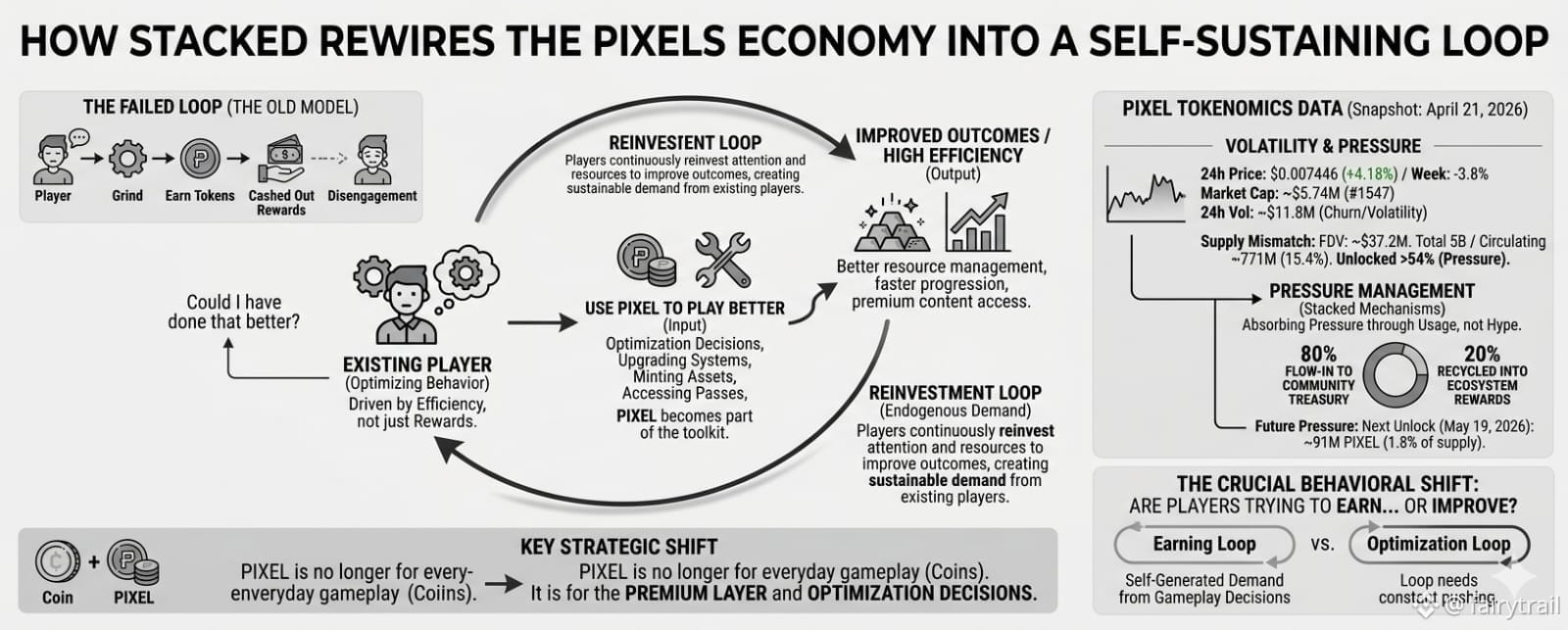
What I noticed is subtle but important. It shifts the role of the token. Instead of being the output of gameplay, PIXEL starts to become part of the input. Not “play to earn,” but “use to play better.”
That sounds small. It’s not.
Because when a token moves into the behavior loop, demand changes. It stops relying purely on new players entering the system and starts being driven by existing players trying to optimize themselves.
I saw a version of this firsthand. I tried adjusting my setup in Pixels—rearranging resources, tweaking how I used premium actions, timing things differently. And I realized something: I wasn’t chasing rewards anymore. I was chasing efficiency. The token wasn’t the finish line—it was part of the toolkit.
That’s a very different psychological loop.
Instead of asking, “How much did I earn today?” I started asking, “Could I have done that better?”
And that question is dangerous—in a good way. Because it pulls you back in.
From a structural perspective, this is where the idea of an economic flywheel becomes more believable. If players continuously reinvest attention and resources to improve their own outcomes, you get endogenous demand. Not perfect, not infinite—but real.
And the data around the PIXEL token gives context to how necessary this shift is.
As of April 21, 2026, PIXEL is trading at around $0.007446, up roughly 4.18% in the last 24 hours but still down about 3.8% over the past week. Market cap sits at approximately $5.74 million, ranking near #1547, with a 24-hour trading volume of about $11.8 million. That volume-to-market-cap ratio tells you something immediately—there’s activity, but also volatility and churn.
The fully diluted valuation is around $37.2 million, with a max supply of 5 billion tokens. Only about 771 million are circulating (~15.4%), though unlocked supply is already over 54% depending on how you measure vesting and distribution timing. That mismatch matters. It creates pressure.
And that pressure doesn’t disappear. The next unlock on May 19, 2026 will release around 91 million PIXEL, roughly 1.8% of total supply. Emissions continue monthly, with full unlock projected around early 2029.
I’ve learned to respect that kind of supply curve. It doesn’t care about narratives.
So if Stacked works, it has to absorb that pressure. Not through hype, but through usage.
That’s where Pixels’ evolving structure becomes interesting. PIXEL is no longer used for everyday gameplay—that’s handled by Coins. Instead, PIXEL sits in the premium layer: minting assets, upgrading systems, accessing passes, staking, governance, and increasingly, optimization decisions.
About 80% of PIXEL spent flows into the community treasury, with 20% recycled into ecosystem rewards. That creates a circular movement of value—not perfect, but directional.
And historically, we’ve seen signs of this working. The ecosystem has handled millions of players—over 8.7 million lifetime, with hundreds of thousands of daily active users at times. There were periods where over 10 million PIXEL were spent in a month, driving meaningful in-game economic activity.
But I’m still cautious.
Because I’ve also seen what happens when systems scale. Optimization converges. Players find the best path, and once they do, they stop thinking. They repeat.
That’s when a system quietly breaks.
The question is whether Stacked can avoid that. Whether it can keep players in that “not yet optimized” state—where small inefficiencies remain, where decisions still matter.
I felt a glimpse of that tension while playing. Not a hard punishment for inefficiency, but a soft pressure. A sense that I could be doing better. That’s a powerful design lever. Traditional games use it all the time. GameFi rarely does.
Still, this isn’t solved.
If the meta becomes too clear, the loop collapses into routine. If token usage feels mandatory rather than strategic, players disengage. If emissions outpace real demand, the system leaks.
So I’m watching closely.
Not for announcements or features, but for behavior. Are players actually coming back to optimize? Or just returning when incentives spike?
Because if Stacked truly creates a system where players generate their own demand through gameplay decisions, then this isn’t just another feature—it’s a structural shift.
If not, it becomes what we’ve seen before: another layer, another idea, another loop that needs constant pushing.
I’m not rushing to decide which one it is yet.
But I’ll ask you this—when you log into a game like Pixels, are you trying to earn… or are you trying to improve?
And if the answer changes, does everything else change with it?
$PIXEL @Pixels #pixel $CHIP $DENT #KelpDAOExploitFreeze #JointEscapeHatchforAaveETHLenders #MarketRebound #StrategyBTCPurchase
