
One very ordinary evening, I closed my work window and only then suddenly remembered that several plots in Pixel had reached the point where they could no longer be left alone. There was no excitement in that moment, only a rather cold reflex, that if I did not come back at the right time, the whole production rhythm I had set up beforehand would begin to crack from its smallest detail.
What is worth noting is that Pixel does not use watering to fill the screen with extra actions. It uses watering to force players to keep their right to intervene in the production cycle. Sowing is the beginning, harvesting is the end, but the part that decides whether you are truly controlling the season lies in the middle, where the crop needs you to return at the right time. I think this is where the project is smart, because it does not hand out a sense of control through promises of speed, but through the obligation of repeated presence.
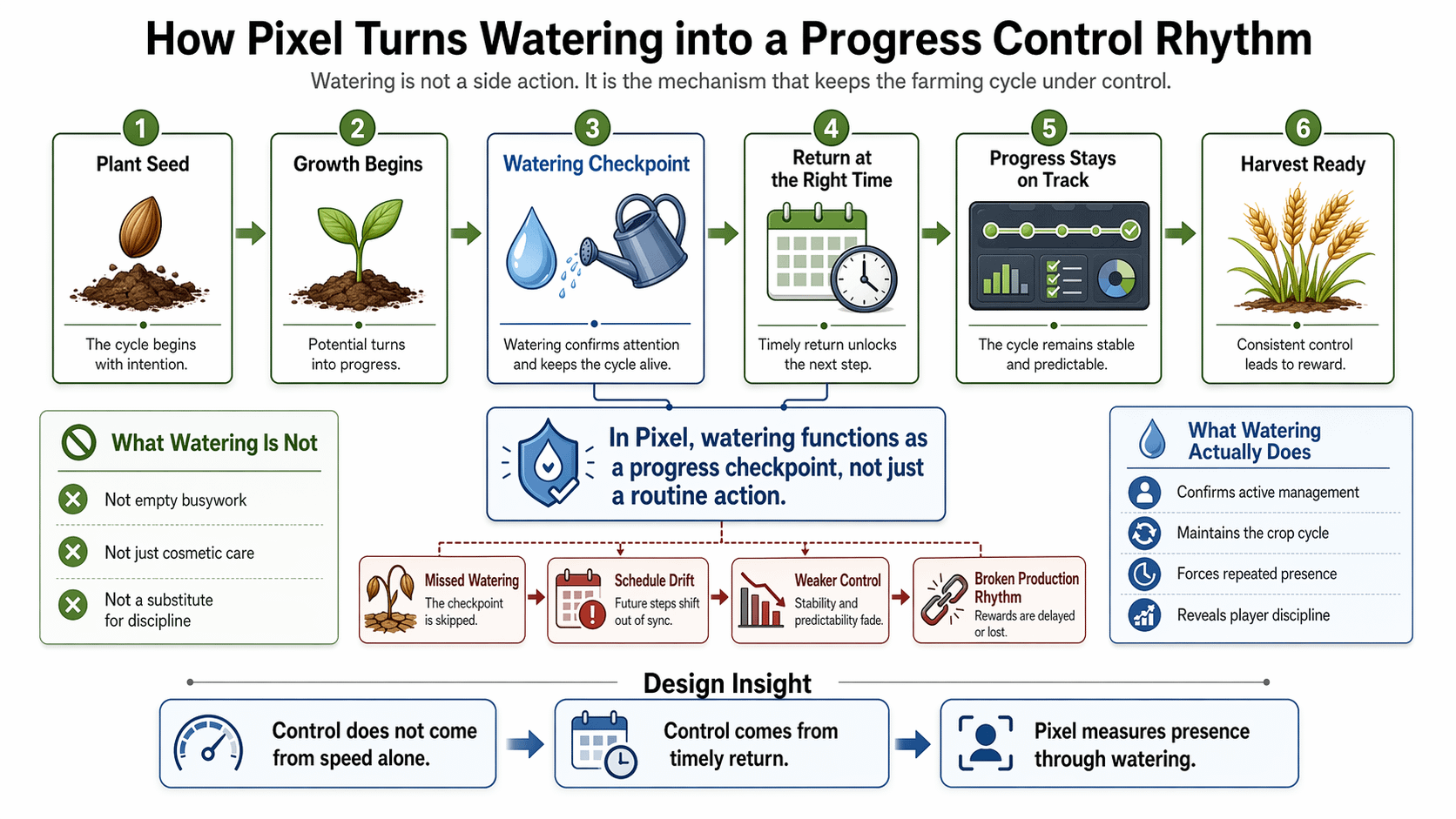
Many people look at this mechanic and conclude that the game is simply making users busier. Honestly, I do not agree. Being busy is when a system makes you touch many things without changing the nature of the outcome. Here, each act of watering is a confirmation that the process has not been abandoned. If that link is ignored, the crop does not just slow down, the plan behind it also falls out of rhythm.
That is exactly why Pixel creates a very real kind of pressure, the pressure to come back. It is not glamorous, it does not give an instant feeling of victory, but it forces players to reveal the quality of their own operation. Anyone can talk about expanding land or organizing output, but not everyone can maintain a care schedule consistently enough to turn that intention into results. Ironically, the least celebrated part is the part that most clearly exposes the gap between someone who merely wants growth and someone who truly knows how to operate.
If you look more closely, Pixel is doing something not many projects dare to do, which is pulling value away from the moment of harvest and placing it in the phase of maintenance. Value no longer lies entirely in the final item, but in the ability to preserve the cycle before that item comes into being. Maybe that is why the watering mechanic feels more like management than care. You are not simply raising a crop, you are keeping a process from collapsing.
I also find this project sharp in the way it refuses to give players the illusion that speed always means control. You may shorten a few stages, but if your return timing is off, that speed only makes the misalignment arrive sooner. This is a clear design stance. Pixel does not reward haste, it rewards the ability to stay attached to progress. No one would have expected such a brief action as watering to carry an entire logic of scheduling and responsibility toward the choices made before it.
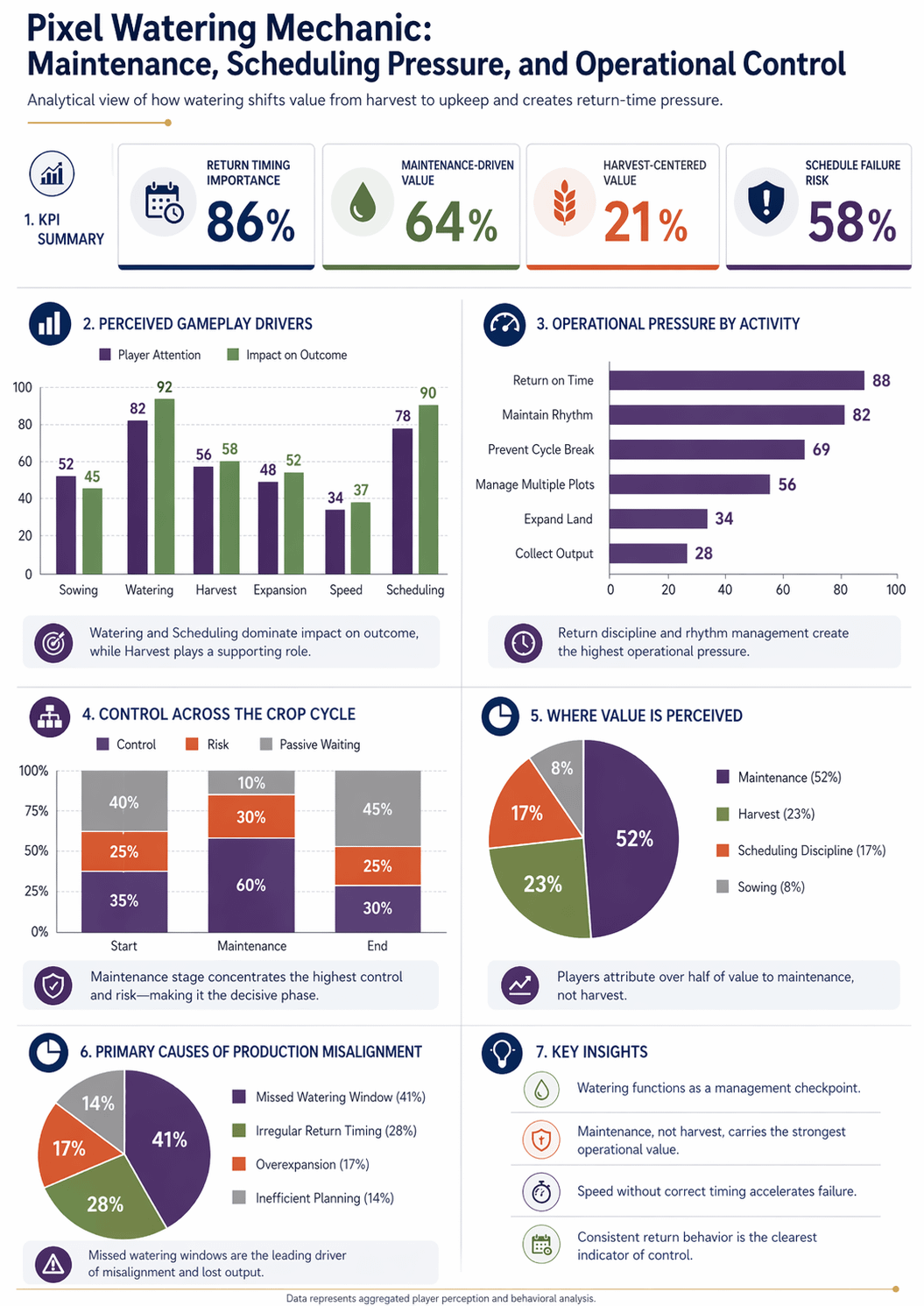
From a builder’s point of view, I value this far more than many loud layers of features. Pixel does not try to make everything look big, it makes one small detail heavy enough that players are forced to reexamine how they manage their own time. Or, to put it more directly, Pixel turns watering into a quiet test. You can log in many times, but if you do not return at the right moment, all that presence is still empty. You may have the ambition to expand, but if you cannot keep up the basic rhythm of care, that ambition is only a blueprint without support beneath it.
What made me pay attention is not that Pixel turned a familiar action into something more complicated, but that it forces players to face the dullest part of progress. In many places, people fall in love with the destination and forget the stretch where rhythm has to be maintained. Pixel goes in the opposite direction. It places weight on the next return, on the ability to keep a cycle from breaking halfway through, on the difficult question of who is really controlling this process. When a project places the whole idea of control inside a single act of watering, is the thing being measured here still just the crop.