
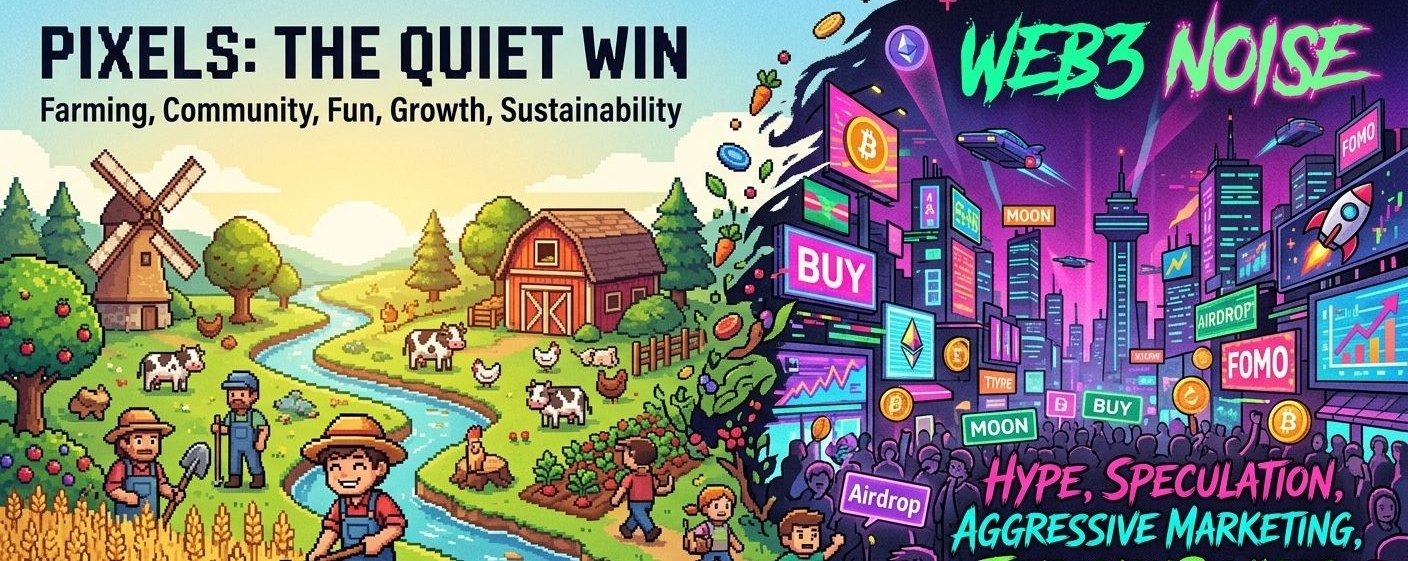
In the fast-moving world of crypto, where narratives often burn bright and fade quickly, Pixels has managed to do something rarer: it has created a sense of place. It is not only a token, not only a game, and not only a Web3 experiment. It is a living digital world built around farming, exploration, and creation, where players return not just to earn, but to belong. Powered by the Ronin Network, Pixels sits at the intersection of play and ownership, offering a vision of crypto that feels softer, more social, and more enduring than the usual cycle of speculation.
That alone makes it worth paying attention to. Many blockchain projects talk about utility, but few manage to make utility feel warm. Pixels does. Its open-world design and casual rhythm give it a quality that is easy to underestimate at first glance. The game does not shout for attention with heavy mechanics or intimidating complexity. Instead, it invites players into a space that feels familiar and welcoming, a world where farming a plot of land, wandering through landscapes, gathering resources, and building something personal can become part of a larger shared economy. In a market often driven by charts and volatility, that kind of emotional texture matters.
The strength of Pixels lies in how naturally it blends game design with crypto ownership. At its best, Web3 should not feel like a layer forced onto an existing experience. It should deepen the experience. Pixels seems to understand this instinctively. Rather than reducing players to passive speculators, it gives them roles inside a growing universe. Land, items, progress, and participation can all carry meaningful value, but that value is embedded in play, not separated from it. This is important because long-term adoption in crypto will likely come from products that feel useful and enjoyable before they feel financial.
Ronin Network plays a major role in that story. For a game like Pixels, the underlying chain is not just infrastructure. It is part of the promise. A smooth, low-friction environment is essential for casual players who may never care about the technical architecture but will absolutely care about speed, cost, and convenience. Ronin’s reputation in gaming has made it a natural home for projects that need strong performance without overwhelming users with blockchain complexity. In that sense, Pixels benefits from a foundation that helps keep the experience fluid enough to support growth.
What makes Pixels especially interesting is its emotional design. Farming in a game may sound simple, even quaint, but simplicity can be powerful when it creates routine and attachment. In many successful digital worlds, players return because the world gives them a rhythm. They check on their land, improve their resources, interact with others, and watch their small efforts accumulate over time. This is more than gameplay. It is a form of digital stewardship. People do not only want assets; they want a reason to care about them. Pixels offers that reason through a world that feels alive enough to nurture.
From a crypto perspective, this matters because markets are increasingly skeptical of empty promises. Users have seen enough projects that inflate expectations and deliver little beyond short-term excitement. A game like Pixels has a different kind of appeal. It suggests that value can emerge from repeated engagement, from social connection, and from the slow compounding of participation. That does not eliminate risk, of course. The gaming sector in crypto remains competitive, and attention is always fragile. But it does suggest a healthier model than the old pattern of launch, hype, and collapse.
There is also something quietly important about the social dimension of Pixels. A casual open-world game is not simply a place to grind. It becomes a shared environment where identity, creativity, and community begin to overlap. In the best cases, this kind of world creates a feeling that is difficult to manufacture elsewhere: the sense that your time leaves a mark. Whether through farming, building, trading, or exploring, the player is not just consuming content. The player is shaping the world. That shift, subtle as it may seem, is at the heart of why Web3 gaming still has such deep long-term potential.
The token itself exists within this broader idea of participation. In crypto, tokens often struggle to justify their own existence beyond market movement. The most resilient ones tend to be tied to systems where usage creates relevance. Pixels fits that mold more naturally than many of its peers because the game environment gives the token a reason to matter. If the world grows, the token’s role can grow with it. If the community deepens, the economy can become more meaningful. If players continue to find value in returning, then the token is no longer a detached instrument. It becomes part of the world’s pulse.
Still, it would be naive to romanticize the opportunity without acknowledging the challenges. Web3 games must constantly balance entertainment with economics. If a project leans too far into speculation, it risks turning the experience into a financial treadmill. If it leans too far into pure gameplay, it may struggle to sustain the economic incentives that set it apart from traditional games. Pixels has to navigate that tension carefully. Its long-term success will depend on whether it can keep the world rewarding without making it feel extraction-driven. That balance is difficult, and it is where many promising projects lose their way.
Yet this is also why Pixels deserves serious attention. It is trying to solve one of crypto’s most persistent problems: how to make ownership feel meaningful without making the experience feel cold. The most memorable digital products are rarely the loudest. They are the ones that create a habit, a mood, a place people want to revisit. Pixels has the ingredients for that kind of persistence. Its world is approachable, its theme is human, and its foundations are aligned with a broader shift in crypto toward usability and emotional appeal.
In many ways, Pixels reflects a maturing phase of the market. The early era of Web3 was dominated by novelty, speed, and narrative excess. The next era may belong to projects that understand patience, texture, and community. A farm, an open field, a crafted item, a familiar routine, a circle of players returning day after day — these may sound like modest features, but they are often the ones that matter most. They create memory. They create attachment. They create a reason to stay.
And that may be the most important lesson Pixels offers. In a space built on technology, the winning projects may ultimately be the ones that remember how people feel.