

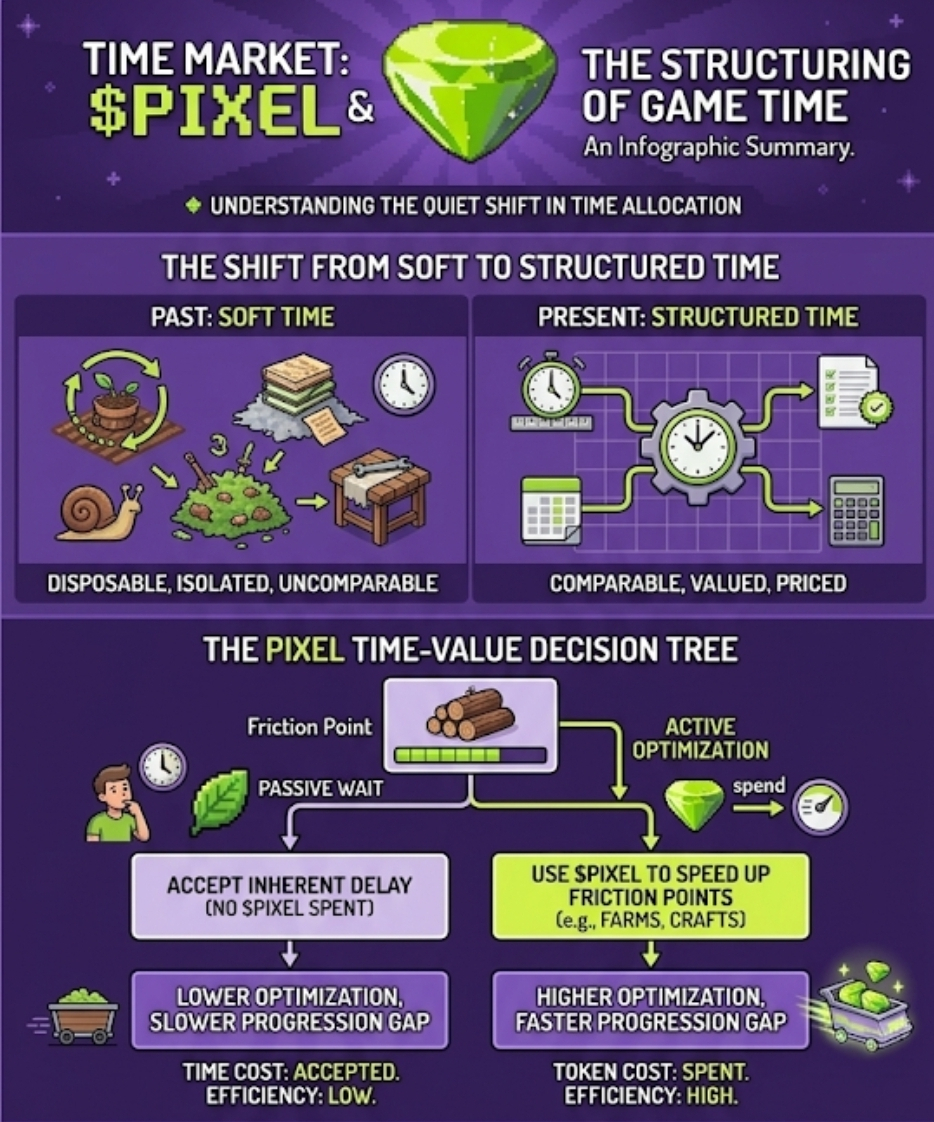
For a long time, I treated time in games as something soft. You log in, do a few tasks, log out. Nothing really sticks. It’s not like work, where hours have a price, or infrastructure, where delays cost money. In games, time feels disposable… until it doesn’t.
Pixels didn’t change that impression immediately. At first glance, it’s just another farming loop. Plant, wait, harvest. I didn’t think too much about it. But after a while, I noticed something slightly uncomfortable. Not obvious. Just a quiet pattern where different activities started to feel… comparable. Almost like they were being measured against each other, even when they shouldn’t be.
That’s where things started to shift for me.
Most games never solve this properly. Farming time is separate from crafting time. Questing sits somewhere else entirely. You can’t really compare them in a meaningful way. The system doesn’t try. It just rewards each loop differently and hopes players don’t notice the inconsistencies.
Pixels feels like it’s trying to solve that, but not directly. It doesn’t say “this is a time market.” It just builds enough structure that time starts behaving like one.
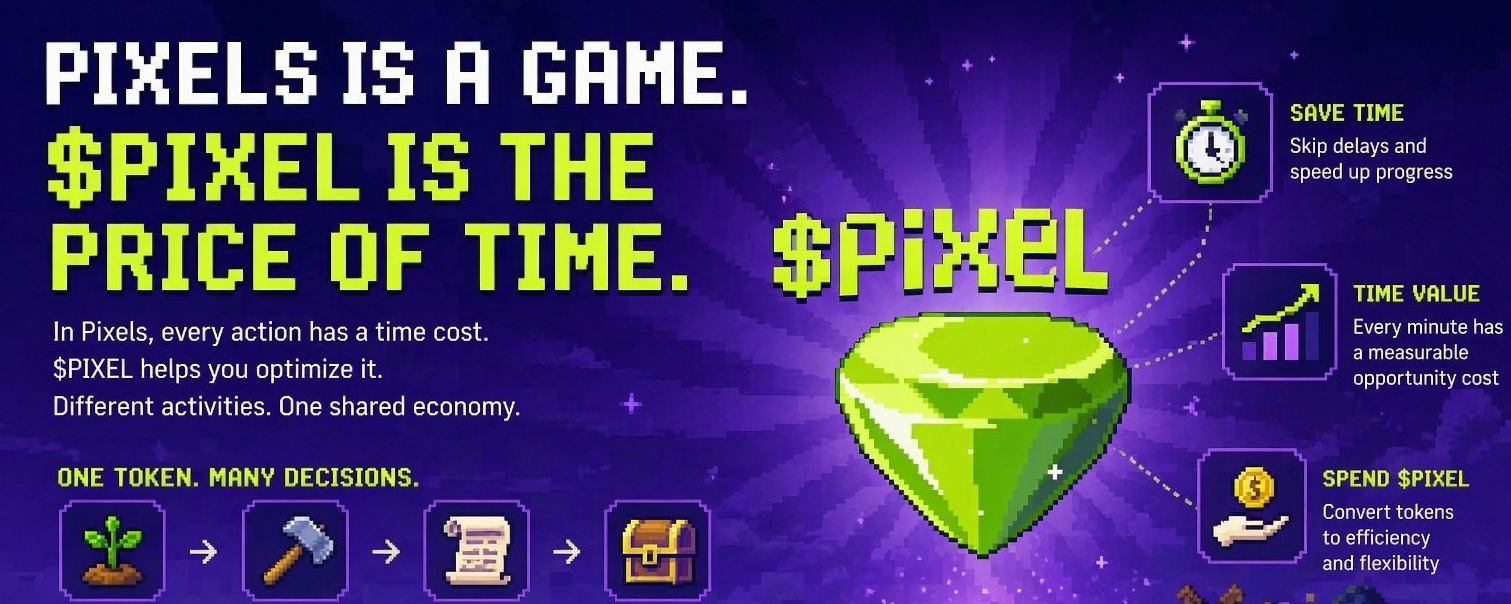
And once that happens, $PIXEL stops being just a reward. It becomes something closer to a pricing tool.
I didn’t realize this until I caught myself doing small calculations without thinking. Is it worth waiting here? Should I spend $PIXEL to speed this up? Not just in one activity, but across different parts of the game. Farming, crafting, progression gaps… they all start to feel like variations of the same decision.
That’s unusual.
Because now the question isn’t “what should I do next?” It quietly becomes “where is my time most valuable right now?”
That’s a different kind of system. Less about gameplay variety, more about time allocation.
And the token sits right in the middle of it.
What’s interesting is how subtle the friction is. It’s not aggressive. You’re not forced to spend. But there are enough delays, enough small slowdowns, that you begin to notice them stacking. Not annoying on their own. But together, they create this constant background pressure.
You can wait… or you can adjust the pace.
That adjustment is where Pixel comes in.
In a way, it reminds me less of gaming economies and more of something like cloud services. You pay to reduce latency, which just means you pay to save time. Faster processing, faster delivery, faster execution. The system doesn’t sell outcomes directly. It sells time efficiency.
Pixels seems to be doing a lighter version of that. Same idea, different environment.
The difference is, here it’s tied to player behavior. Not machines. Not infrastructure in the traditional sense. People.
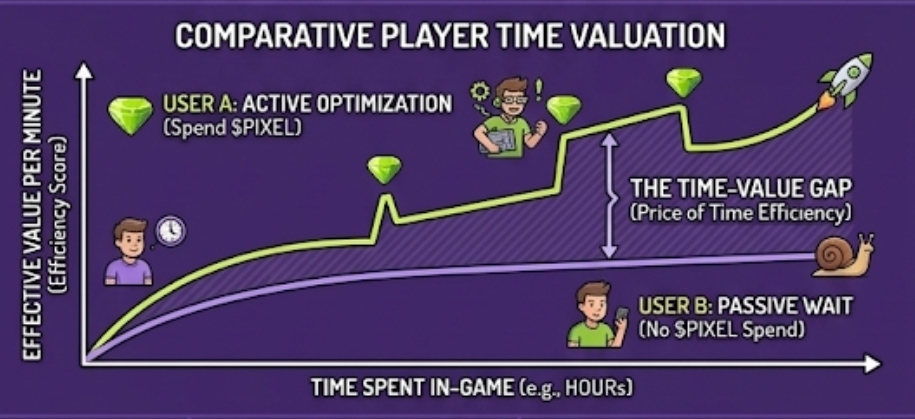
And that creates a strange effect. Two players can spend the same amount of time in the game, but end up in very different positions depending on how that time was “priced” through their decisions.
So time stops being neutral. It becomes structured.
That structure is where things get interesting… and also a bit fragile.
Because once players start optimizing, they don’t stop. They find the most efficient loops. The best return per minute. The least friction for the most output. It’s natural. Every system drifts there eventually.
If too many players converge on the same paths, the whole balance can shift. What looked like a world starts to feel more like a set of optimized routes. You see this in almost every economy, not just games.
And then there’s perception.
Even if the system is technically fair, it can start to feel engineered. That’s the risk. When players notice that time itself is being shaped, they begin to question it. Is this friction natural, or is it placed here on purpose? Is this a choice, or a nudge?
Those questions don’t break a system overnight. But they linger.
I’m not sure Pixels fully escapes that tension. Maybe it’s not trying to.
What it seems to be doing, whether intentionally or not, is turning time into something more consistent across the entire experience. Not equal, but comparable. That alone changes how the economy behaves.
And if that consistency holds, it opens a different path forward. Not just for one game, but potentially for multiple systems that could share similar logic. Where effort, not just assets, becomes portable in some form.
That’s still early. Maybe too early to say with confidence.
But I keep coming back to the same small realization. I don’t think Pixel is mainly about what you earn. It feels more like a way to adjust how your time is interpreted inside the system.
That’s a quiet shift. Easy to miss.
Until you start noticing that you’re no longer just playing. You’re constantly deciding what your time is worth.