
I was watching a shopkeeper sort small coins into separate jars on a dusty counter, pausing every few seconds to slide one or two aside into a drawer he kept half-closed. No one asked about that drawer. The customers just waited for their change and moved on, like the separation itself was part of the routine.
Later, while doing the CreatorPad campaign task inside Pixels, I opened the farming interface on public land and kept an eye on the energy bar as it drained faster than I expected. I harvested a few common crops, watched the $BERRY trickle in, and noticed how the rented land tooltip quietly mentioned the owner’s share. Nothing dramatic happened on screen—just small numbers updating—but that was the moment something felt off. The system didn’t just reward activity; it quietly decided where the value from that activity was allowed to settle.
I don’t think most players are actually participating in a neutral economy here.
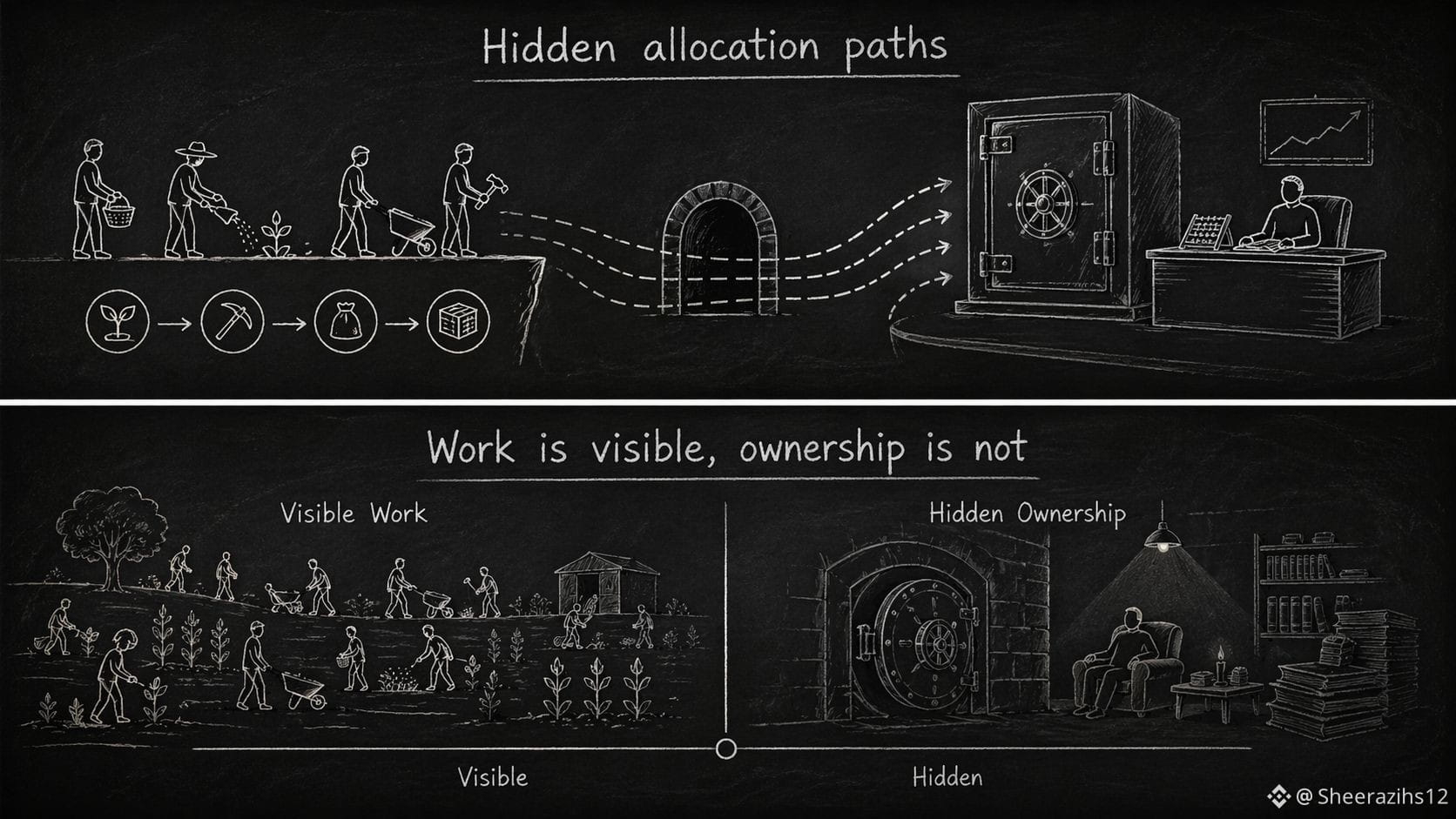
It felt more like I was stepping into a pre-arranged flow, where effort is visible but allocation is predetermined. The act of farming, moving, harvesting—all of it looked like production, but the distribution of outcomes had a structure that didn’t depend on how well I played in that moment. The more I repeated the loop, the clearer it became that my decisions were about efficiency within boundaries, not about changing those boundaries.
That small realization kept expanding in my head. In crypto, there’s this default belief that open systems naturally align rewards with contribution. If you show up, do the work, and optimize, you earn your share. But here, the system seemed to separate participation from ownership in a way that felt almost invisible unless you slowed down and watched the flows closely. The players who controlled land didn’t need to optimize every action; they just needed the system to keep routing activity through their position.
Pixels makes this easy to miss because everything looks interactive. You’re clicking, moving, harvesting, trading. It feels like agency. But the structure underneath doesn’t need your attention to keep working. In fact, it works better if you stay focused on the surface—on your tools, your timing, your next harvest cycle. The deeper layer, where allocation is decided, stays quiet.
I started thinking about how often we confuse visibility with fairness. Just because I can see my inputs and outputs doesn’t mean I’m seeing the full picture. The marketplace, the farming loops, the energy constraints—they create a sense of transparency. But transparency of action isn’t the same as transparency of distribution. One shows you what you’re doing; the other would show you who benefits from it over time.
What unsettled me wasn’t that landowners earn passively. That part is almost expected. It was how smoothly the system normalized it, how quickly it blended into the background of gameplay. After a few cycles, it stopped feeling like a design choice and started feeling like a natural law of the world. That’s when it becomes hard to question.
And if a system can make its allocation rules feel like nature instead of design, then what exactly are we trusting when we call it a fair market?$PIXEL #pixel
