
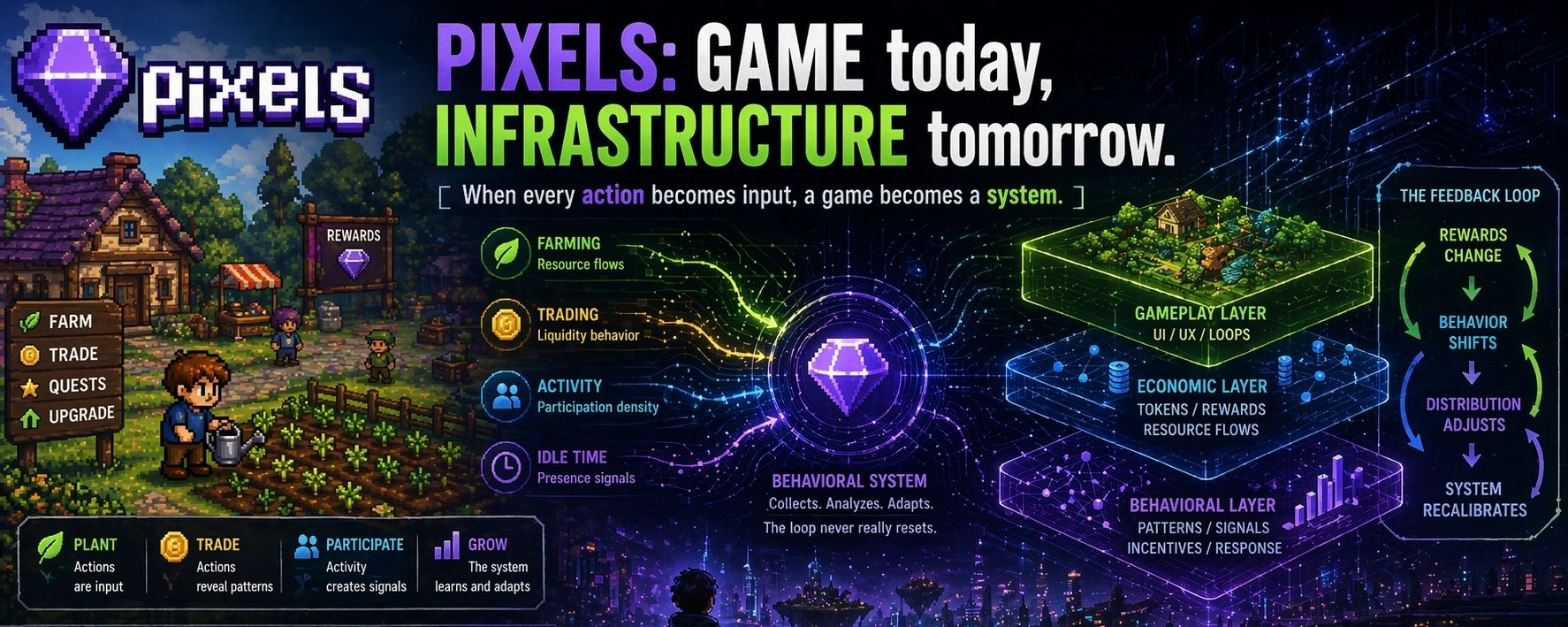

When i first step into Pixels, it seems pretty straightforward. It’s the classic Web3 farming loop log in, plant some crops, did a few chores, level up my land, grab rewards. Honestly, it’s so familiar you could learn it in five minutes, and then forget it just as fast.
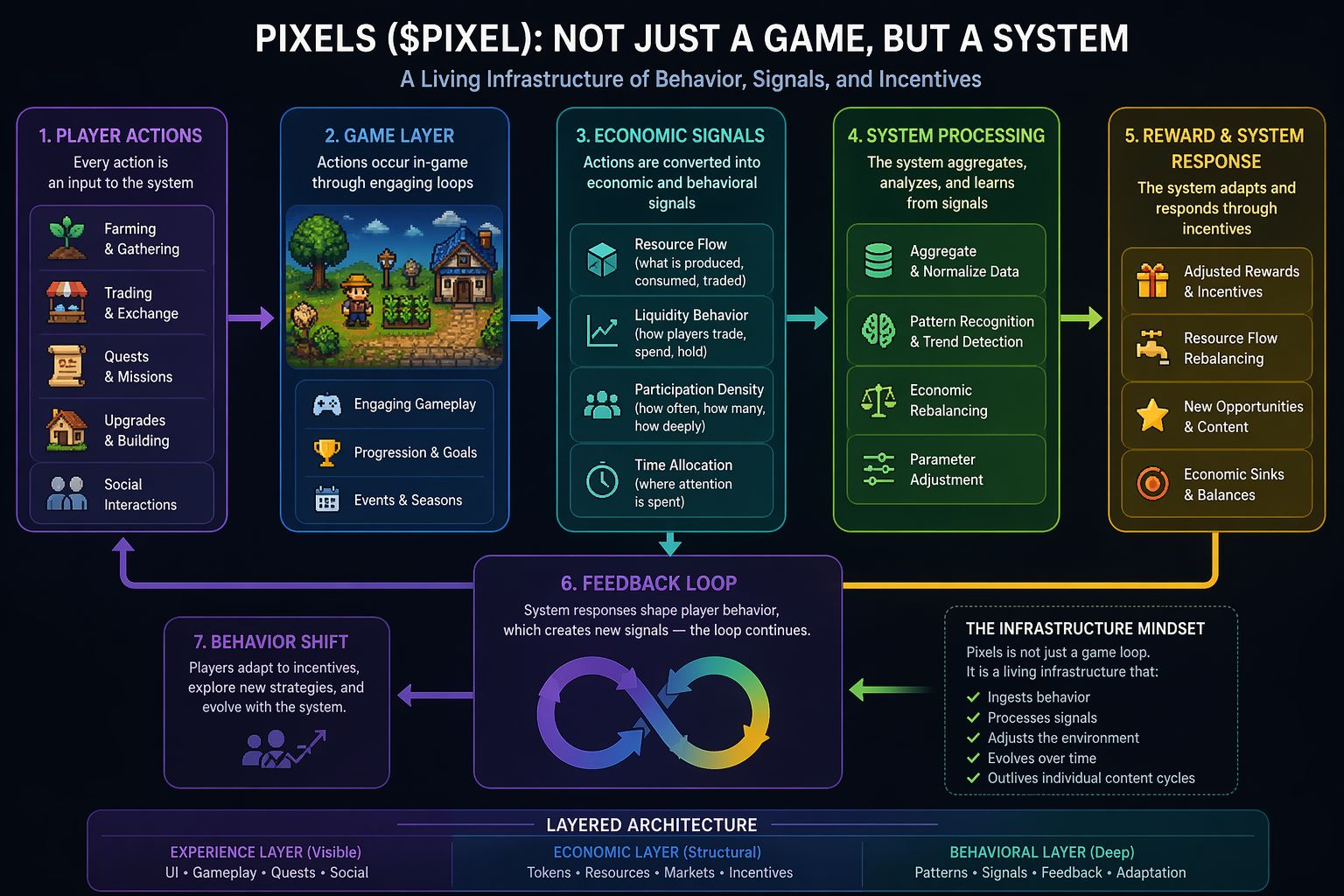
But stick around, and this surface-level simplicity starts to fade. There’s something else beneath it. Every action whether you’re farming, trading, or even standing idle goes into the system as more than just activity. The game doesn’t shout about this, but everything gets tracked. Your movements, your trades, your downtime all of it flows into a pattern the game quietly watches and adjusts around.
This is where things get weird. You start to wonder: is Pixels just a game, or is it a behavioral system dressed up as one? If it’s just a game, then it lives and dies by how much fun people have and how many stick around. But if it’s something deeper, every action stops being just play and starts becoming input data for the system itself.
Suddenly, the simple stuff planting crops, making trades, leveling up feels different. Are you playing, or are you creating economic signals? Are you grinding, or are you teaching the system how people behave?
This question is where Pixels gets interesting.
Here’s the twist: it’s not about the game mechanics themselves, but what those mechanics create over time. Traditional games treat actions as short events you do something, it pays off, then resets. Pixels doesn’t reset; everything stacks up. Farming feeds bigger resource flows. Trading starts to sketch out liquidity behavior. Just being active adds to participation signals.
Eventually, the game stops being a timeline of events and turns into this self-updating dataset. Now you’re thinking like infrastructure, not entertainment.
Infrastructure isn’t about individual actions it’s about what all those actions build together. Bridges don’t care who walks across. Power grids don’t care what device you plug in. What matters is that things flow and the system keeps moving.
Pixels feels similar it’s not just about the game on top, but the system underneath. The visible layer is gameplay the stuff you interact with. A second layer handles economics tokens, rewards, resource flows. But deeper still, there’s a behavioral layer, tracking how people respond over time.
And these layers are tight. Change the rewards? Behavior shifts right away. Behavior shifts? Resources redistribute. Distribution changes? The system recalibrates. It starts to feel less like a game economy and more like a feedback loop a living system.
All kinds of infrastructure run this way. Traffic systems manage flow, not drivers. Financial systems scale liquidity, not single trades. Cloud platforms care about demand, not individual users.
So, Pixels is moving toward treating players as a network, not individuals. That shift is big. When a game optimizes the system itself not just entertainment it stops being just a pastime. It turns into an environment that organizes everyone’s behavior, and environments last longer than games.
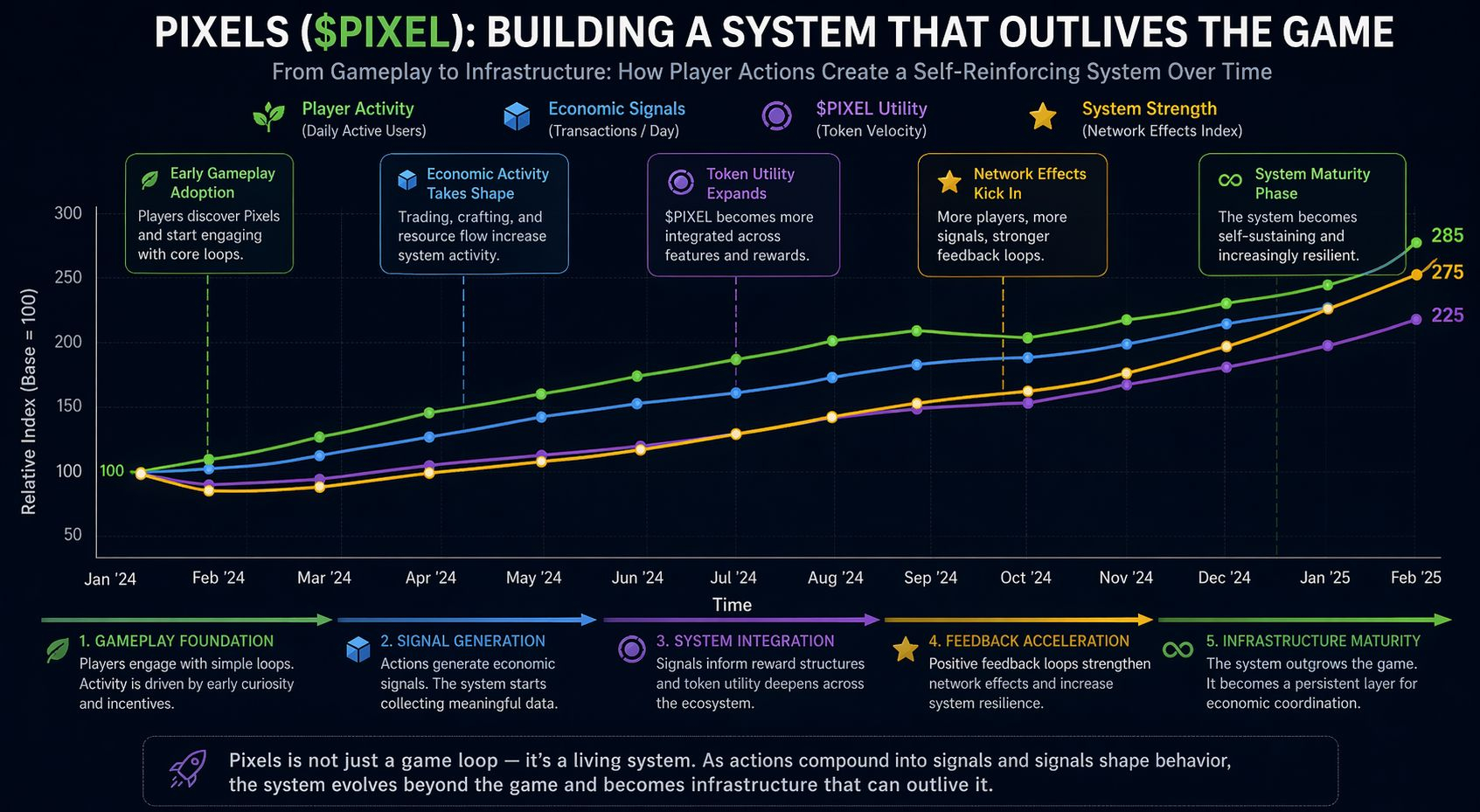
Games are temporary people leave, and the fun ends. But systems keep evolving, even as people come and go.
So maybe the real question isn’t whether Pixels is fun or whether its loop works. It’s this: What happens if a game stops designing for play and starts designing for persistent human behavior?
If Pixels pulls that off, it won’t just survive on fresh content or new features. Instead, it keeps going as long as people feed it activity, and the loop keeps learning and shaping itself.
At that point, it’s not even a game anymore it’s a protocol for interaction. Protocols don’t end; they scale, adapt, attract new uses.
That leads to something uncomfortable: maybe Pixels isn’t trying to win the “best game” trophy. Maybe it’s aiming to become something games connect to a layer that quietly influences how digital worlds behave.
Not a world you drop into, but the foundation beneath all virtual economies. And if any of that’s true, then Pixels isn’t just gameplay. It’s infrastructure collecting and learning from everyone, all the time, and building something longer-lasting than a game itself.
