
I've been logging into Pixels every day for four months. Not every day because I'm having a wonderful time every day. Every day because I log in every day, and the momentum of that streak has become its own reason to continue it.
I want to think about this carefully because I think the distinction between routine engagement and compulsive engagement in Pixels is real, important, and mostly ignored in community discussion.
What a Healthy Routine Looks Like
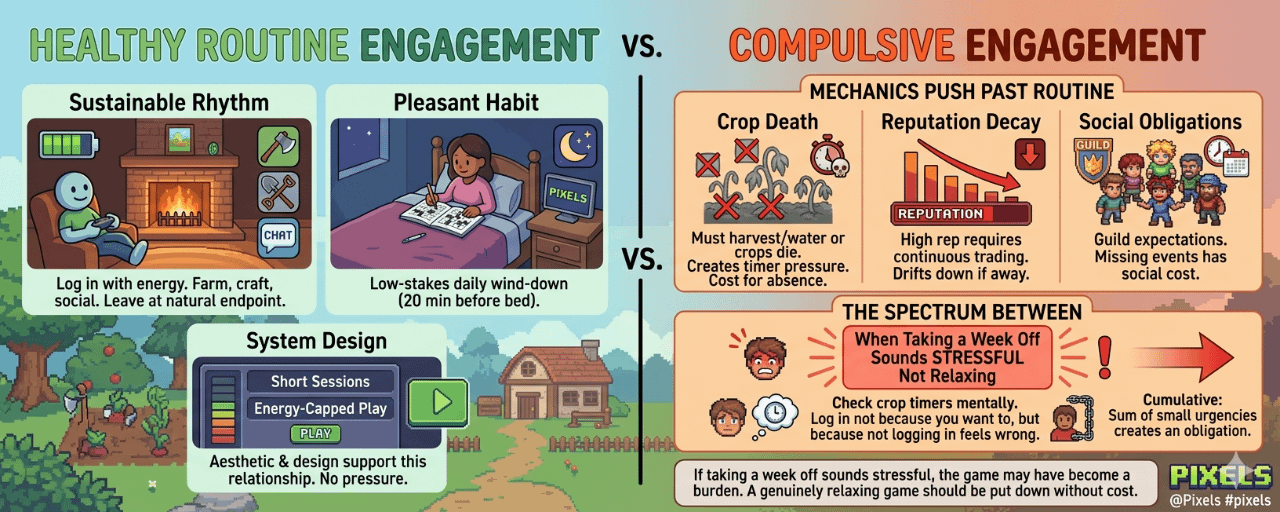
There are players in Pixels who have found a sustainable rhythm with the game that I would describe as genuinely healthy. They log in when they have energy for it, they do their farming and crafting and social interactions, they leave when the session's natural endpoint is reached, and they don't experience significant pull toward the game outside of those sessions.
I know these players exist because I've talked to them in guild chats. They describe Pixels as a daily wind-down activity, something they do for twenty minutes before bed the way other people do a crossword or watch a show. The game is a pleasant habit, consistent and low-stakes.
This is what the Pixels visual aesthetic and energy-capped session design is ostensibly trying to create. Short sessions, repeatable daily engagement, no pressure for marathon play. The system is designed to make this kind of healthy relationship possible.
The Game Mechanics That Push Past Routine
But Pixels has also built systems that create pull beyond what a healthy routine requires.
The crop death mechanic: crops that are not harvested or watered regularly die. This creates timer pressure. You're not just motivated to return because it's enjoyable. You're motivated because absence has a cost. The game punishes non-attendance in the most immediate way available: destroying the thing you were trying to grow.
The reputation score that decays: higher reputation requires continued marketplace activity to maintain. If you step away from active trading for an extended period, your score drifts toward the threshold where features become unavailable again. Resuming after a break costs re-accumulation effort.
The guild social obligations: committed guild members have implicit attendance expectations. Guilds that rely on member coordination for events or resource sharing create social pressure around regular login. Missing guild activities has social costs that have nothing to do with the game's mechanics directly.
None of these are unusual in MMO design. All of them are standard tools for retention. What makes them worth examining in Pixels specifically is the contrast with the game's stated positioning as a relaxing, casual-friendly experience. The cozy aesthetic sits in real tension with the mechanics that make absence costly.
The Distance Between Routine and Compulsion
I want to name the distinction as clearly as I can, because I think it's genuinely important for players to be able to locate themselves in this spectrum.
Routine engagement: you have a habit of playing Pixels. The habit is positive. You look forward to it. When you can't play for a few days because life intervenes, you don't experience significant distress. Coming back after a gap is easy, and the things you missed are manageable.
Compulsive engagement: the thought of not playing for several days produces something that functions like anxiety. You find yourself checking crop timers mentally while doing other things. You log in not because you want to but because not logging in feels wrong. The game has become something you manage rather than something you enjoy.
The mechanics I described above can move players from the first category toward the second without any single mechanism being dramatically out of line. It's cumulative: the crop death timer adds small urgency, the reputation maintenance adds small obligation, the guild social dynamics add small social pressure, and the sum of small urgencies creates a different engagement relationship than any one of them alone would produce.
What the Game Doesn't Say
Pixels doesn't acknowledge this spectrum anywhere in its official materials. The positioning is consistently about fun, cozy gameplay, and player ownership. There is no documentation that says: here is what it looks like when the game starts feeling like an obligation, and here is how to reset that relationship if you need to.
Most games don't acknowledge this, to be fair. It is not standard practice for games to provide players with tools to examine their own relationship with the engagement mechanics. The industry standard is to optimize for engagement, not to create self-reflection resources around whether engagement is healthy.
But Pixels markets itself specifically as a game for players who want a gentle, relaxing experience. That marketing creates a specific implicit promise: this game will not become a burden. That promise is in tension with mechanics that make absence costly.
I'm not saying Pixels is uniquely predatory. I'm saying that the gap between the promise and the mechanism is larger than I initially understood, and that players who are close to the obligation end of the engagement spectrum may not have language to name what's happened to them because the game's framing doesn't provide it.
The signal I eventually developed: if taking a week off from Pixels sounds more stressful than relaxing, that's information worth sitting with. A game that genuinely delivers on its relaxing promise should be the kind of thing you can put down without cost.
Whether Pixels is that game for you depends on which mechanics you're engaged with and how deep your roots are. I genuinely don't know which side of the line I'm on.