
Project doesn’t really announce itself the way most things in this space do. It just sort of appears, a quiet loop of farming, wandering, and making things, running on , as if it expects you to notice it on your own time rather than chase you down.
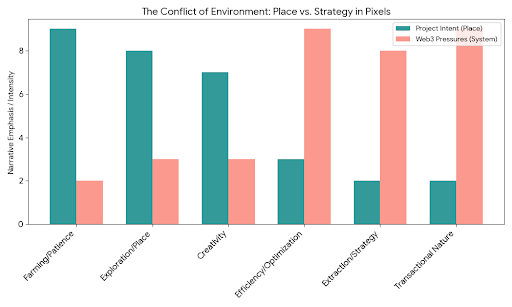
At first glance, it feels simple in a way that almost makes you suspicious. A soft, open world where you plant crops, explore a bit, interact with others, and slowly build something that looks like progress. Nothing about it screams urgency. And maybe that’s the point, or maybe it’s just how it happens to look before people really get involved.
Because once people do get involved, things always change.
It doesn’t matter how calm a system appears on the surface. The moment there’s value attached—tokens, time, attention—behavior starts bending toward efficiency. You can almost predict it now. Someone figures out the fastest route. Someone else shares it. Suddenly a slow, reflective loop starts to feel like a routine. What looked like a world begins to act like a system.
Pixels seems aware of that, at least indirectly. You can feel it in how it leans into farming and small, repeatable actions instead of big, dramatic moments. Farming has a rhythm to it. It suggests returning, not rushing. It gives the impression that time matters in a different way here, not just as something to compress or exploit.
But impressions don’t always survive contact with reality.
A farming loop, no matter how well designed, can easily turn into a checklist if the surrounding environment pushes it that way. And Web3 environments almost always do. Not because they’re badly designed, but because they attract a certain mindset. People come in looking for opportunity, and opportunity tends to flatten everything else if it’s strong enough.
That’s where the tension sits.
Pixels feels like it wants to be a place, but it exists inside an ecosystem that constantly turns places into strategies. You can see it in small ways. The way players move through space. The way conversations drift toward optimization. The way creativity sometimes takes a backseat to whatever produces the most consistent return. None of this is unique to this project. It’s just more noticeable here because the surface is so calm.
Still, there’s something about it that keeps pulling attention back, even after that realization sets in.
Maybe it’s the lack of noise. Or the way it doesn’t try to over-explain itself every few seconds. There’s a kind of patience in it that feels out of step with the rest of the space. Not necessarily better, just different. It doesn’t feel like it’s in a rush to prove something, which is rare in an environment where everything is constantly trying to justify its existence.
That patience might be its strength, or it might just be a phase.
The real test isn’t whether people show up. People always show up, especially early on. The real test is what happens after the initial curiosity fades. When the systems are no longer new, when the loops are fully understood, when the only reason to stay is because the experience itself still holds up.
That’s usually where things start to thin out.
Because sustaining attention without leaning too heavily on incentives is difficult. If the incentives are too strong, the world starts to feel transactional. If they’re too weak, people drift away. Finding that balance is harder than most projects admit, and it’s rarely solved by design alone. It’s shaped over time, by how people actually behave once they settle in.
And people don’t settle in the way designers expect.
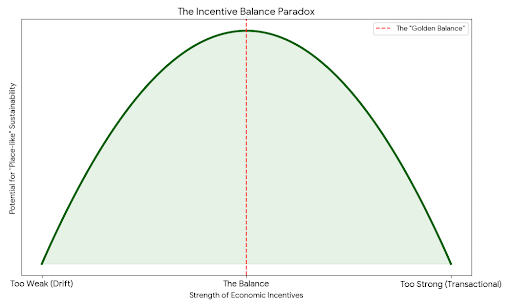
They skip steps. They cluster around efficiency. They ignore parts of the world that don’t immediately reward them. Over time, that reshapes the entire experience. What began as an open world slowly narrows into a set of optimized paths. It’s not intentional, but it happens almost every time.
Pixels hasn’t fully collapsed into that yet, but you can see how it could.
That doesn’t mean it will fail. It just means it’s walking the same narrow path that a lot of these projects walk, whether they acknowledge it or not. Trying to build something that feels alive while existing inside a system that constantly pushes toward extraction.
And maybe that’s the real reason it exists at all.
Not to solve everything, but to push back a little against the idea that digital spaces have to feel disposable. There’s a kind of quiet frustration behind projects like this, even if it’s never stated directly. A sense that people want somewhere to return to, not just something to pass through.
Whether Pixels can actually hold that feeling over time is still unclear.
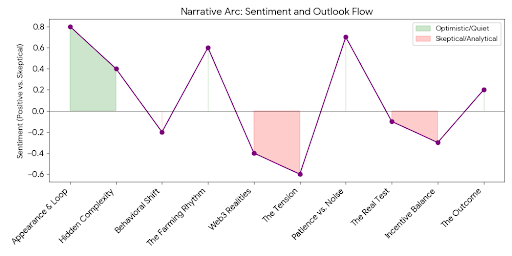
For now, it just sits there, somewhere between a game and a place, being shaped slowly by the people inside it. Not perfect, not finished, and definitely not immune to the usual patterns. But still trying, in its own restrained way, to be something that lasts a little longer than most things around it.