

It’s difficult to approach any new Web3 project without carrying some residue of past cycles—the overpromises, the token-driven incentives that briefly simulate activity, and the quiet fade once attention moves elsewhere. Projects like NFTs, play-to-earn ecosystems, and metaverse platforms all arrived with confident narratives about reshaping digital ownership or online interaction. Most didn’t collapse because the ideas were entirely wrong, but because the gap between concept and sustained, real-world usefulness was larger than expected. That context matters when looking at something like Pixels.
At first glance, Pixels presents itself as a casual, open-world farming game with social elements, built on blockchain infrastructure. But the immediate question is whether it addresses any real friction—or whether it’s layering crypto mechanics onto a problem space that already functions adequately without them. Farming games, social games, and sandbox-style exploration already exist in abundance. They’re accessible, stable, and widely adopted without requiring users to manage wallets or interact with tokens. So the burden here is not to prove that such a game can exist, but to justify why it needs to exist in this particular form.
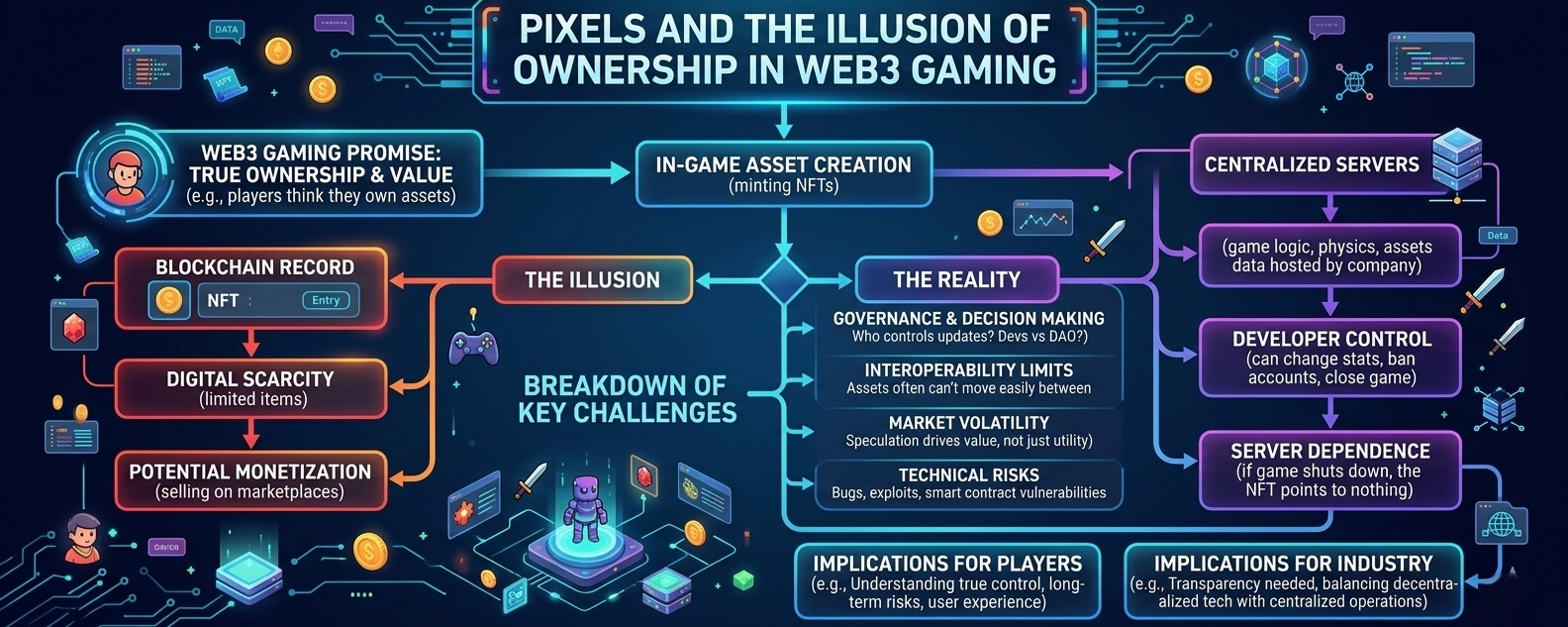
If there is a core problem being addressed, it likely revolves around ownership and player agency. Traditional games operate within closed ecosystems where assets are controlled by developers. In theory, blockchain integration allows players to own items, trade them freely, and carry value across platforms. That sounds reasonable in isolation. But the deeper issue is whether players actually experience this lack of ownership as a meaningful constraint. Most players seem content with centralized systems as long as the game itself is engaging. The friction that Web3 tries to solve—asset ownership, interoperability, decentralized economies—often feels abstract compared to the immediate concerns of gameplay quality, balance, and community.
Stripped of its terminology, the core idea behind Pixels is fairly simple: it’s a farming and exploration game where in-game items and currencies exist on a blockchain, allowing players to trade or monetize their activity outside the game’s internal systems. That’s not inherently flawed. But it does introduce a shift in player behavior. When value becomes externalized, gameplay risks becoming instrumental rather than experiential. Instead of playing for enjoyment, players may begin optimizing for extraction—time spent becomes tied to potential earnings. That dynamic has already been tested, and in many cases, it leads to fragile economies that depend heavily on continuous user inflow.
The question then becomes whether Pixels functions as real infrastructure or as a narrative wrapped around familiar mechanics. Real infrastructure tends to fade into the background—it solves a problem quietly and reliably. In contrast, many Web3 projects foreground their architecture because the architecture itself is the selling point. With Pixels, it’s not entirely clear that blockchain integration disappears into the experience. Managing wallets, understanding tokens, and navigating external marketplaces are still additional layers of complexity. If those layers don’t provide a tangible improvement to the core gameplay loop, they risk feeling like overhead rather than enhancement.
There’s also a tension between openness and control. A fully open economy invites speculation, botting, and imbalance. A tightly controlled system, on the other hand, starts to resemble traditional game design, which raises the question of why decentralization is necessary in the first place. Balancing these forces is not trivial. Games require careful tuning to remain enjoyable, but decentralized systems resist centralized intervention. Pixels sits somewhere in that unresolved space, where both ideals—player freedom and system stability—pull in different directions.
Execution risk is where many of these ideas tend to falter. Sustaining an in-game economy tied to real value is difficult. It requires constant demand, careful emission control, and a user base that isn’t purely transient. There’s also the question of audience. Traditional gamers are often skeptical of crypto integrations, while crypto-native users may prioritize financial upside over gameplay depth. Bridging that gap is not just a design challenge—it’s a cultural one.
Adoption, in this context, may not fail dramatically; it may simply plateau. A niche audience could sustain the system for a time, especially if incentives are structured well. But whether that translates into a durable, widely adopted platform is less certain. The history of similar projects suggests that early growth can be misleading, particularly when driven by rewards rather than intrinsic engagement.
None of this means Pixels is destined to fail. It may find a balance, refine its mechanics, and build a community that values both the game and its underlying systems. But it operates in a space where many have tried similar approaches, and where the core assumptions—about ownership, incentives, and user behavior—remain only partially validated.
So the question isn’t whether the idea is appealing on paper. It’s whether, over time, the system can sustain itself without leaning on the same patterns that have already proven unstable. That’s harder to answer, and it’s probably where the real test lies.
