
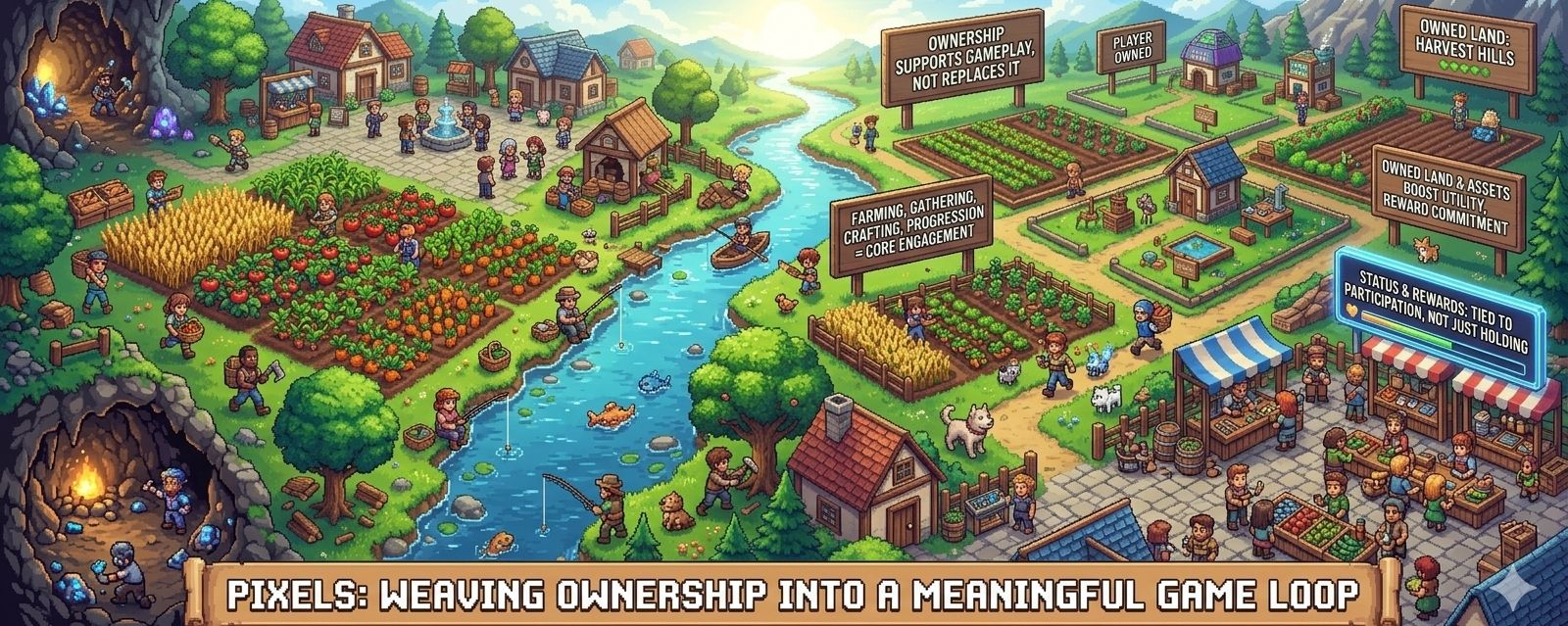
The old mistake in Web3 gaming was pretty simple. Too many projects thought ownership was enough. Give players land, items, tokens, and a marketplace, and the game would somehow take care of itself. But that rarely happened. What players got instead was a weak game loop wrapped around an economy. People showed up for the asset story, not because the world itself was worth returning to.
That is where Pixels feels different.
What Pixels seems to understand is that ownership only matters when the game already works without it. The farming, gathering, crafting, task completion, and daily progression come first. That loop gives players rhythm. It gives them a reason to log in that is tied to routine, planning, and small improvements over time. The ownership layer then sits on top of that and adds depth.
That is the part many Web3 games missed. In Pixels, land is not interesting just because it is ownable. It matters because it can support activity, attract players, and become part of a wider social and economic loop. Pets are not there only to look scarce. They add utility. Status systems do not seem to reward holding alone. They work better when tied to actual participation.
That creates a much healthier balance. Ownership becomes something that strengthens the game rather than swallowing it.
To me, that is the deeper problem Pixels is trying to solve. Web3 games have spent years confusing financial presence with real engagement. They built systems where players behaved more like extractors than residents. Pixels looks like an attempt to reverse that. It wants the token, the land, and the assets to matter, but only because the underlying game already gives them context.
That does not mean the model is guaranteed to work forever. Any tokenized game can drift back toward speculation if the economy starts pulling harder than the gameplay. But Pixels feels more self aware than most. It seems built around the idea that ownership should reward commitment to the world, not replace the need for one.
That is why it stands out. It is not asking players to care about assets first. It is trying to make the world itself worth caring about, then using ownership to deepen that connection. In Web3 gaming, that is still a rare thing.