
I’m watching how people move through Pixels lately, not with urgency but with a kind of quiet repetition. I’m waiting to see whether that rhythm deepens or fades. I’ve seen cycles like this before in other games—moments where activity feels alive on the surface, yet something underneath is still deciding what it wants to become. So I’m not rushing to conclusions. I’m looking at how it holds attention when no one is trying to prove anything.
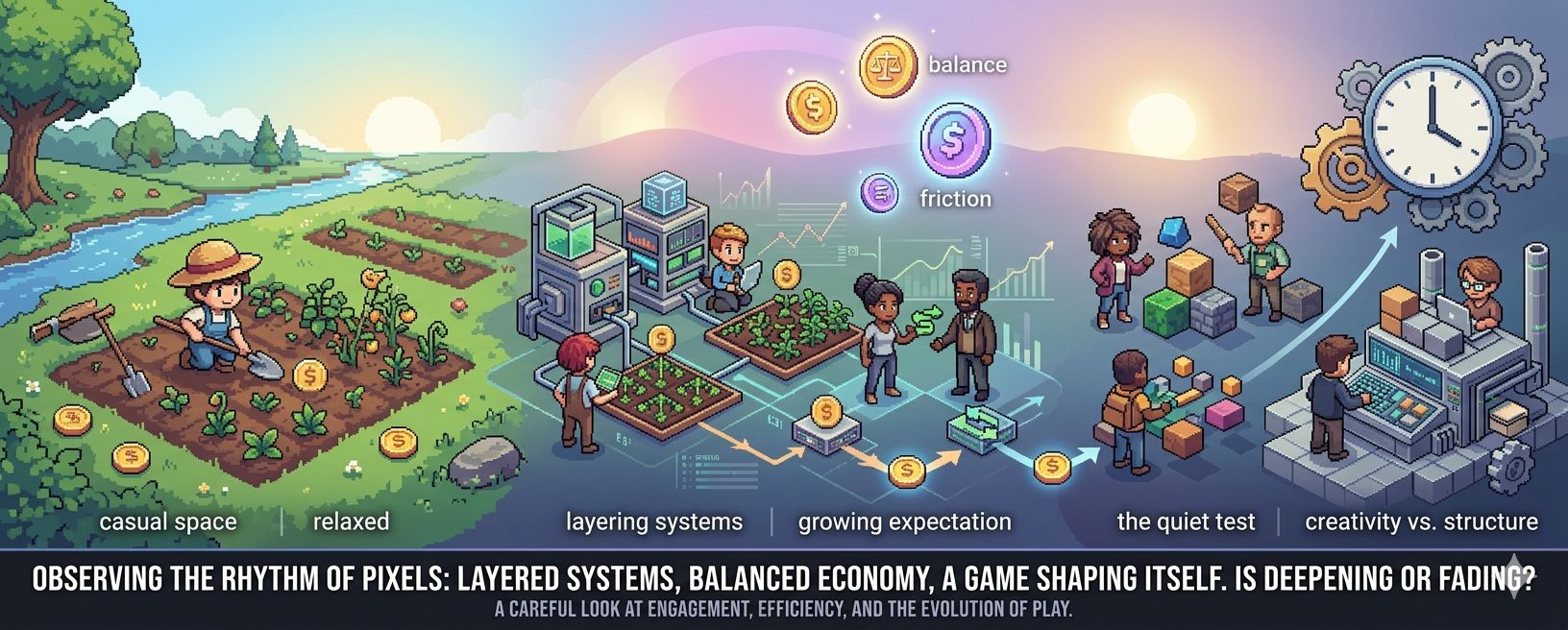
At first glance, Pixels still carries that familiar softness. Farming, crafting, small loops of effort that return small rewards—it’s all there, and it works in a way that doesn’t demand too much from the player. But when I focus a bit longer, I start to notice the shift that’s been happening quietly through recent updates. The systems are layering. Not aggressively, but steadily. More industries, more dependencies, more subtle pressure to optimize time and land. It doesn’t feel like a sudden transformation. It feels more like the game is slowly tightening its own structure.
What stands out is how players are reacting to this shift. Some are leaning in, treating it less like a casual space and more like a system to be understood. You can see it in how land is managed now, how resources are planned, how time is spent with intention rather than curiosity. Others seem to drift at the edges, engaging lightly, almost resisting the pull toward efficiency. That contrast is interesting because it shows the game hasn’t fully decided who it’s for anymore. It still presents itself as open and relaxed, but beneath that, there’s a growing expectation of participation at a deeper level.
The token, PIXEL, sits quietly inside all of this. It’s not loud, not constantly demanding attention, but it’s always there, shaping behavior in subtle ways. I’ve seen how even small changes in earning or spending mechanics can shift the mood of the entire environment. People don’t always talk about it directly, but you can feel it in how they play. When rewards align smoothly with effort, there’s a sense of flow. When they don’t, the atmosphere changes—less exploration, more calculation. Right now, it feels like Pixels is somewhere in between those two states, still trying to balance its internal economy with the experience it wants to offer.
What I find myself coming back to is the question of weight. Every new system adds potential depth, but it also adds friction. Not immediately, not obviously, but gradually. I’ve seen games reach a point where the accumulation of mechanics starts to shape behavior more than the original design ever intended. Pixels isn’t there yet, but I can see the direction it could take if that layering continues without careful restraint.
At the same time, there’s something quietly compelling about how it all fits together. The world doesn’t feel chaotic. It feels controlled, almost deliberately paced. Even the updates don’t arrive with a sense of urgency—they settle in, giving players time to adjust, to find their place again. That pacing matters more than it might seem. It gives the impression that the project isn’t chasing attention, but trying to build something that can sustain it.
Still, I keep noticing how engagement shifts over time. Not dramatically, but subtly. People come in with curiosity, then settle into routines, and eventually start questioning those routines. That’s where the real test begins. Not in the first interaction, but in the fifth, the tenth, the moment when familiarity replaces novelty. Can Pixels keep that moment from feeling empty? That’s something I’m still watching.
There’s also a quiet tension between creativity and structure. The game invites players to explore and create, but the underlying systems naturally guide them toward efficiency. That balance is delicate. Too much freedom, and things lose direction. Too much structure, and it starts to feel like work. Right now, Pixels seems to be walking that line carefully, though not perfectly. You can feel both sides pulling at the experience.
I don’t think this is a project that reveals itself quickly. It doesn’t rely on sharp moments or dramatic hooks. Instead, it builds its presence slowly, through repetition and subtle interaction. That can either become its strength or its limitation. If the systems continue to deepen in a way that feels meaningful, the engagement might grow more rooted. If not, the quietness that makes it approachable could also make it easy to leave.
So I’m still here, observing more than participating, paying attention to how it evolves rather than what it promises. I’m watching how players adapt, how the systems settle, how the balance shifts over time. I’m not convinced yet, but I’m not dismissing it either. It feels like something in progress—not unfinished, but not fully defined.
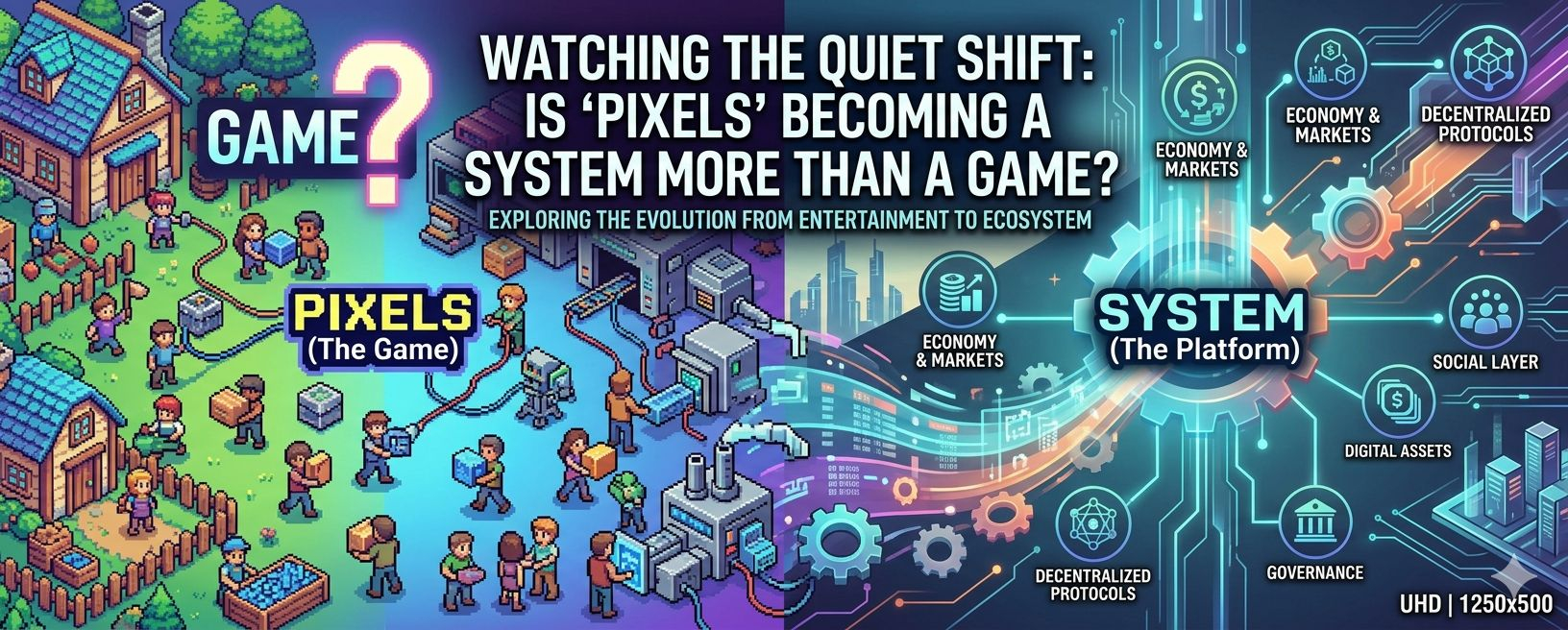
And maybe that’s the most honest way to look at Pixels right now. Not as a complete idea, but as a space still shaping itself, one small adjustment at a time.
